A German-heavy GT spine underpins ELMS’s 47-car milestone grid
A record 47-car ELMS grid for 2026 hides a familiar truth: German GT cars, teams and drivers continue to define the championship’s competitive core.

The European Le Mans Series will line up with a record 47-car grid in 2026, and beneath the headline number sits a familiar structural truth. German GT engineering, German teams and German drivers continue to form the backbone of the championship’s professional end of the field.
The series’ growth is often framed in terms of quantity. What matters more is composition. In 2026, the competitive centre of gravity in LMGT3 remains firmly anchored around Porsche, Mercedes-AMG and BMW, supported by outfits that have made ELMS a proving ground rather than a holding pen.
Porsche remains the reference point
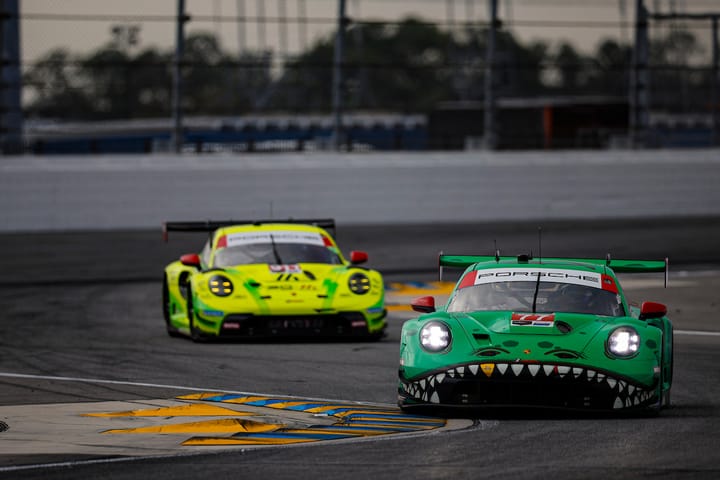
If there is a default GT car for ELMS, it is still the Porsche 911 GT3 R. Its presence is not just widespread but strategic.
Teams such as Proton Competition and Manthey-affiliated operations continue to use ELMS as an extension of Porsche’s wider endurance ecosystem. The 911 GT3 R’s balance, serviceability and tyre discipline suit a championship defined by long stints, traffic management and strategic elasticity rather than outright sprint pace.
That matters. ELMS is where manufacturer programmes test depth, not shine. Porsche understands this better than most, and its cars tend to peak when races turn awkward rather than spectacular.
Manthey’s influence still looms large
While Manthey’s most visible successes have come in WEC and IMSA, its philosophical footprint remains all over ELMS. Driver development pathways, engineering standards and racecraft habits honed in the series continue to feed into Porsche’s global GT effort.
Drivers with Manthey lineage often arrive in ELMS already calibrated to its rhythms: patient opening stints, conservative tyre management and ruthless efficiency in the final hour. That knowledge transfer is harder to quantify than wins, but it is persistent.
Mercedes-AMG brings scale and seriousness
The Mercedes-AMG GT3 is no longer an occasional guest in ELMS. Its 2026 presence reflects a broader recalibration of Affalterbach’s customer racing strategy.
Mercedes-AMG entries tend to arrive with experienced bronze-rated drivers and highly organised silver and gold support. That combination plays well under ELMS regulations, where execution matters more than qualifying fireworks. The GT3’s stability over long runs continues to make it a reliable platform for teams targeting championships rather than individual races.
There is also a wider implication. Mercedes-AMG’s sustained ELMS commitment reinforces the series’ role as a legitimate pillar of global GT racing rather than a feeder that top manufacturers eventually abandon.
BMW’s quieter but meaningful contribution
BMW’s BMW M4 GT3 does not dominate headlines in ELMS, but its presence is deliberate. The M4 GT3’s strength lies in consistency across varying track types, from high-speed circuits to more technical venues.
BMW-aligned crews often approach ELMS with a developmental mindset, refining driver pairings and operational processes rather than chasing immediate dominance. In a series where marginal gains over six hours decide outcomes, that approach has long-term value.
German drivers shape the competitive tone
Beyond the cars, German and German-affiliated drivers continue to set the competitive temperature in LMGT3. Their defining trait is not aggression but control.
ELMS rewards drivers who can lose a second now to gain ten later. That philosophy aligns neatly with the training culture common in German GT racing, where restraint and repeatability are prized over flash.
It is no coincidence that many of the championship’s cleanest closing stints come from drivers steeped in Nürburgring, ADAC GT Masters or Porsche one-make backgrounds.
Why this matters for ELMS
A 47-car grid is impressive. What gives it credibility is the quality at its core. German GT machinery and methodology provide that spine.
They stabilise the championship, raise its baseline professionalism and ensure that ELMS remains a place where serious endurance racing is done properly, not merely a stepping stone to somewhere else.
For 2026, the numbers may be new. The foundations are reassuringly familiar.