Bathurst 2026: structural fragility beneath the podium
The 2026 Bathurst 12 Hour revealed German GT3 strength in hardware but fragility in customer ecosystem control. The result flatters. The structure does not.
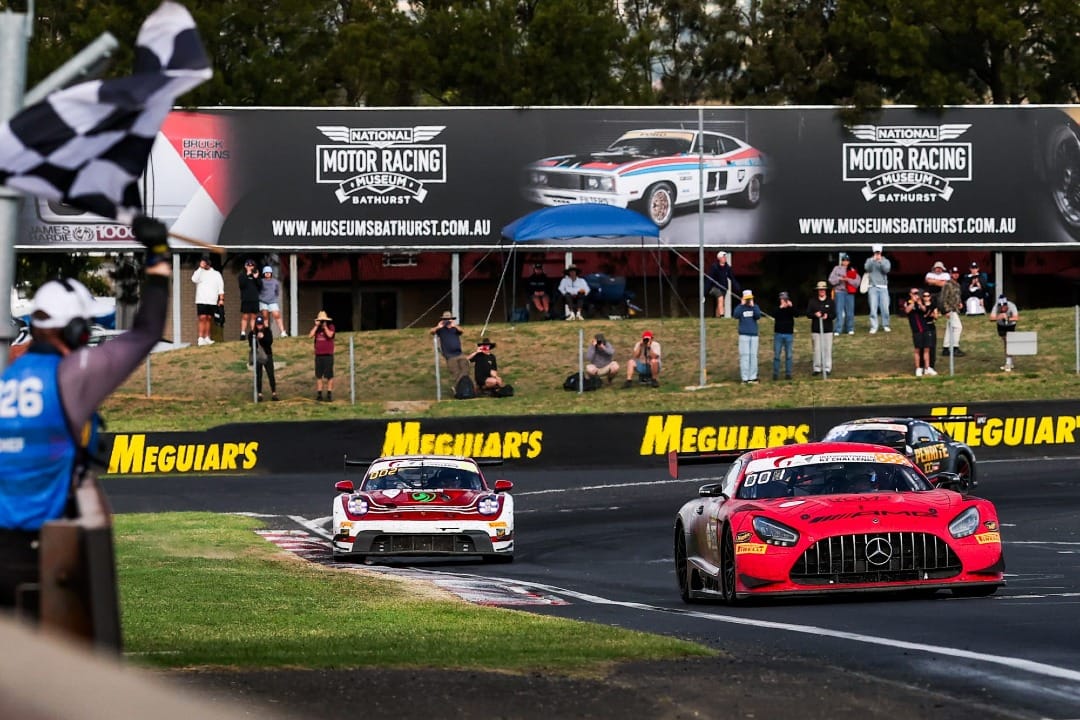
The podium at the 2026 Liqui-Moly Bathurst 12 Hour reads as a German consolidation.
Mercedes-AMG victory.
Porsche second.
BMW present in the strategic window.
On paper, that suggests platform stability across the GT3 field.
The race itself tells a different story.
Bathurst did not test engineering durability. It tested manufacturer control inside multi-car customer ecosystems. That is where the stress fractures appeared.
The signal beneath the result
The winning Mercedes-AMG GT3 Evo of Triple Eight Race Engineering survived a race defined by interruption:
- 12 hours and 1 minute total running time
- 10 Safety Cars
- 1 Red Flag
The interruptions compressed strategy. They increased restart density. They forced factory-aligned customer cars into repeated proximity.
Under those conditions, Mercedes-AMG eliminated two of its own competitive assets through inter-team contact.
This is not a driving anecdote. It is a structural question.
When multiple cars represent a single manufacturer inside a Balance of Performance formula, the manufacturer’s primary responsibility is fleet preservation. Points, data, and brand equity are shared assets.
At Mount Panorama, that discipline failed.
The fact that the #888 recovered and won does not invalidate that conclusion. It isolates it.
Mercedes-AMG left the race with a trophy. It did not leave with evidence of ecosystem control.
That distinction matters as the Intercontinental GT Challenge (IGTC) calendar moves toward higher-density traffic environments.
Pro-Am as a systems audit
The second-placed Porsche 911 GT3 R entry was Pro-Am.
In theory, that classification imposes a competitive constraint. A Bronze-rated driver should cap outright performance relative to full-Pro line-ups.
Instead, the Pro-Am car out-executed most of the professional field.
Its race profile was simple:
- Controlled lap time variance
- Minimal bodywork exposure
- Conservative tyre consumption
- Clean pit sequences
It did not generate headline pace. It generated positional stability.
That outcome reframes the narrative.
Bathurst was not decided by superior peak speed. It was decided by variance management.
If a Pro-Am structure can outperform factory-aligned Pro entries through restraint, then the limiting factor is not hardware. It is decision-making inside high-pressure stints.
RSR’s long view requires us to treat that as a signal, not a curiosity.
Environmental volatility and formula limits
Two incidents involving wildlife materially affected race trajectories.
Mount Panorama remains a semi-contained public road circuit. It is not a sealed facility in the modern European sense.
From a cost-controlled global GT3 perspective, this introduces a layer of randomness that cannot be modelled or mitigated through simulation.
Random attrition favours:
- Cars that avoid exposure
- Teams that prioritise survival over pace
- Manufacturers with broad entry numbers
In other words, it rewards structural depth.
That partially explains how Mercedes-AMG converted disruption into advantage.
But randomness cannot be a strategy. It can only be absorbed.
The Nürburgring 24 Hours introduces similar unpredictability through weather and traffic density. Manufacturers that lack strict intra-brand hierarchy will struggle in both environments.
Hardware validated, governance questioned
There is no engineering indictment here.
The BMW M4 GT3 remains mechanically durable.
The Mercedes-AMG GT3 Evo is structurally resilient.
The Porsche 911 GT3 R continues to demonstrate competitive efficiency.
All three platforms survived repeated neutralisations and restart cycles.
The failure was organisational.
German manufacturers operate vast customer networks. That scale is an asset only if it is centrally disciplined.
Bathurst suggested the following:
- Mercedes-AMG possesses race-winning capacity but limited intra-brand restraint.
- Porsche’s Pro-Am execution exposed inefficiencies inside some of its Pro structures.
- BMW remains operationally credible but not yet dominant under restart compression.
None of this decides the IGTC season.
It does, however, adjust the questions we should ask before the Nürburgring 24 Hours.
Bathurst 2026 did not confirm German control.
It confirmed that German hardware is solved.
The software, meaning governance, hierarchy, and decision discipline, remains unstable.
And in endurance racing, instability compounds.