Bathurst is not a race. It is an audit.
Bathurst is a twelve-hour audit of GT3 programmes under heat, compliance, and procedural load. It exposes organisational weakness faster than any other event.
Bathurst as a systems stress test
Hard fact: Mount Panorama enforces ride-height compliance checks at 22 psi while permitting in-race radiator and brake duct cleaning because heat and debris loads routinely exceed passive margin.
Bathurst is a twelve-hour audit of organisational competence under compound stress. It rewards tolerance control. It punishes wishful thinking.
The circuit drives suspension travel into regions GT3 platforms barely visit elsewhere. The climb to Skyline and the high-speed crests force aero stability and mechanical compliance to coexist. They rarely do. Compression at The Chase tests whether the aero platform remains legal and predictable when ride height departs the intended window.
Brake failures do not arrive as drama.
They arrive as missing deceleration at 280 km/h.
Heat is not incidental. It is written into the rulebook. Driver cooling mandates above 30.1°C exist because baseline systems are marginal. In-race cleaning allowances exist because debris accumulation is expected. If the cooling package is near limit in practice, it is already compromised in traffic.
Why the rulebook matters more than lap time
Pit lane is not a place to gain time.
It is a place to avoid penalties and unforced errors.
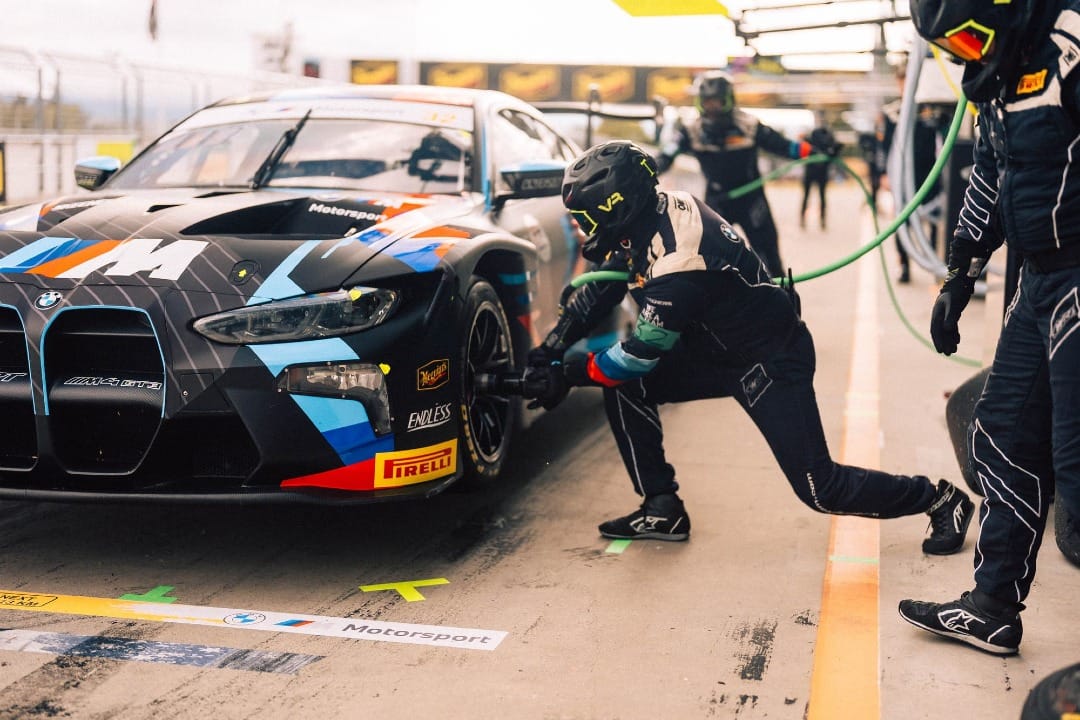
Bathurst’s pit stop prescriptions turn service into a constrained workflow. Colour-coded armbands. Fixed roles. Limited interchangeability. That design filters teams by process maturity, not by bravery.
Spa tests time discipline.
IMSA tests reaction speed.
Bathurst tests whether procedure survives fatigue.
A single Safety Car lapse is enough. One Full Course Yellow misread is enough. A refuelling mis-sequence is enough. None look spectacular. All are terminal.
Pit lane as a failure filter
Bathurst matters because it arrives early, before organisations learn how to conceal weakness. As the opening round of the Intercontinental GT Challenge, it forces new structures, new pairings, and fresh procedures into a high-load environment.
What fails here was never robust.
Manufacturers do not attend for romance. They attend because the event exposes programme quality faster than internal reporting ever will.
Manufacturer programmes under exposure
Some organisations treat Bathurst as a hybrid operation. Customer entry on paper, factory backbone in practice. Works drivers embedded inside a nominally independent structure. That is not branding. It is risk control. When late-race optionality swings the outcome, it is strategy and execution creating the performance delta, not the BoP sheet.
Others approach the event like an industrial process review. Repetition. Drill. Pit stop rehearsal as doctrine. Driver comments that prioritise procedure over pace usually come from an organisation that knows exactly where it bleeds.
Platform evolution is another tell. Updates aimed at cooling, reliability, and drivability are a customer-racing survival kit. Bathurst is where those changes either validate the design or expose the weakness.
History is consistent.
Mechanical and procedural failures repeat because the stressors repeat.
Power steering issues. Brake failures. Practice incidents that remove cars before the race begins. Operational errors under Safety Car conditions. These are not exotic. They are predictable outcomes of narrow margins and poor process control.
BoP can adjust weight and restrictors. It cannot equalise organisational competence. The rulebook can regulate a car. It cannot regulate how a team behaves when the plan fractures.
What Bathurst reveals before the season begins
Pre-race, ignore lap times. Watch behaviour.
Pit rehearsals should look boring. Quiet. Repeatable. No improvisation. Scrutineering should be uneventful. Fast. Clean. Any late compliance scramble is a proxy for deeper organisational drift. Leadership language should be procedural, not emotive. Teams speaking in process terms usually understand their failure modes. Teams selling vibes rarely do.
Bathurst strips narrative and exposes interfaces.
If your programme cannot survive contact with a rigid rulebook, high thermal load, aero sensitivity, and procedural constraint, it will fail in public. It will fail predictably.
And the factory will still call it bad luck.