Feature: Hans Herrmann and the virtue of endurance
Hans Herrmann’s career spanned Formula 1’s most dangerous years and endurance racing’s formative decades. His legacy is defined by range, restraint, and longevity.
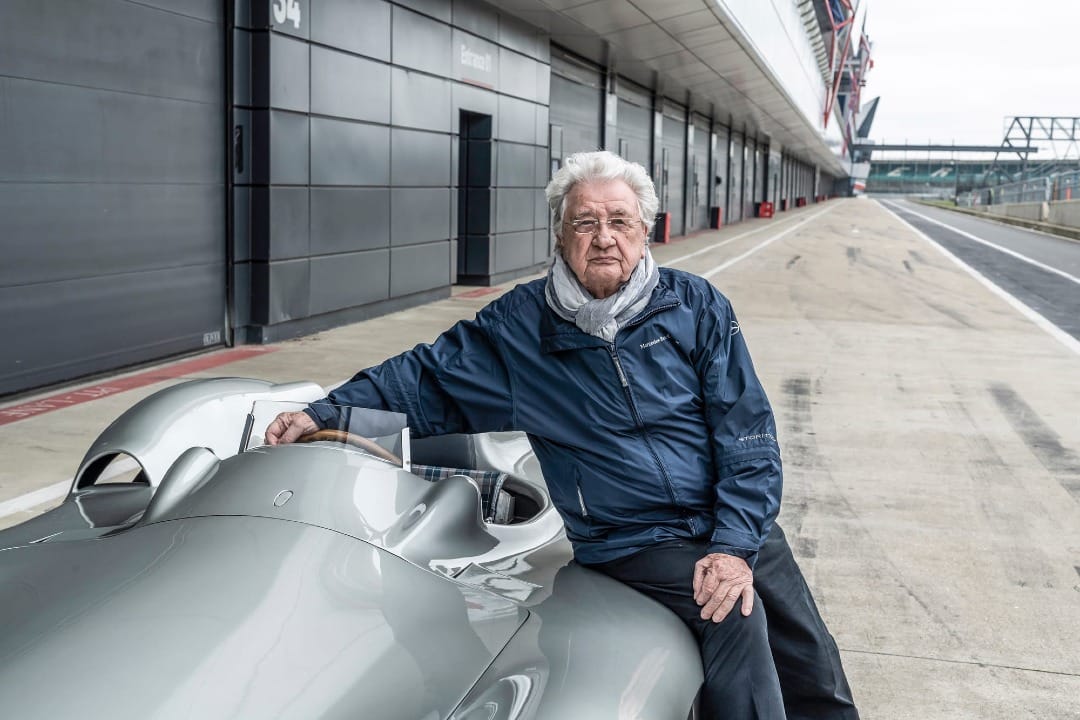
The death of Hans Herrmann at the age of 97 closes a chapter that modern motorsport no longer produces. His career did not belong to a single category, manufacturer, or narrative. It belonged to time.
Herrmann mattered not because he was the loudest or the most decorated, but because he endured. Across Formula 1, sports cars, rallies, and long-distance racing, he remained competitive, adaptable, and relevant across nearly two decades of profound technical and cultural change.
That kind of career no longer exists.
Forged inside Mercedes-Benz’s sharpest moment
Herrmann’s international reputation was established during Mercedes-Benz’s brief and unforgiving return to frontline racing in 1954 and 1955. As a works driver, he joined a team built around engineering certainty rather than experimentation.
Alongside Juan Manuel Fangio and Karl Kling, Herrmann drove the W 196 R Formula 1 car and the 300 SLR sports car at a time when Grand Prix racing still demanded mechanical sympathy, physical bravery, and tactical judgement in equal measure.
When the W 196 R made its debut at Reims in July 1954, Herrmann set the fastest lap. That moment has often been treated as a footnote, but it revealed something essential. Mercedes-Benz did not hand responsibility lightly. Herrmann was trusted with machinery that represented the company’s post-war return to international competition.
Survival was not incidental
Herrmann’s career unfolded during motorsport’s most dangerous period. Accidents were frequent, medical support was limited, and risk was accepted as part of the profession. His nickname, ‘Hans in Luck’, reflected not fortune alone but judgment.
That judgement was tested in May 1955, when a serious accident during Monaco Grand Prix practice left him badly injured, particularly to his hip. The timing proved decisive. Mercedes-Benz withdrew from motor racing later that year, ending one of the most intense factory programmes the sport had known.
Herrmann’s Formula 1 trajectory effectively closed there. What followed defined him more clearly.
Endurance as a natural home
Where Formula 1 rewarded immediacy, endurance racing rewarded restraint. Herrmann proved ideally suited.
He became one of the era’s most versatile long-distance drivers, competing successfully across manufacturers and formats. Targa Florio in 1960, the 24 Hours of Daytona, the 24 Hours of Le Mans in 1970, traced a career built on patience rather than peaks.
His Le Mans victory, achieved with Porsche, carried a finality that feels almost unthinkable today. Herrmann had promised his wife that he would retire if he won. He kept that promise and stopped racing immediately.
No farewell tour followed. No attempt to trade on the moment. He simply stepped away.
A legacy measured in decades
After his retirement, Herrmann remained connected to the sport in a quieter way, most visibly through his role as a Mercedes-Benz Heritage Brand Ambassador. He became a living reference point rather than a symbolic one.
When he drove historic cars in demonstrations and heritage events, he did so not as an actor recreating the past, but as someone who had lived inside it. The machinery was familiar because it had once been current, unfinished, and dangerous.
That distinction matters.
Herrmann represented a generation of drivers for whom versatility was assumed, survival was a skill, and longevity was earned. He raced when categories overlapped, when manufacturers moved freely between disciplines, and when careers were shaped by adaptability rather than optimisation.
Why Hans Herrmann still matters
For Rennsport Report readers, Herrmann’s career reinforces a simple truth. Motorsport only makes sense when viewed over time.
He raced in Formula 1 when it demanded courage more than precision. He mastered endurance racing when it rewarded discipline more than speed. He won across continents and categories, then walked away without hesitation.
Hans Herrmann did not dominate motorsport. He lasted within it.
That, in the end, may be the rarer achievement.