Formula 1 2026: what Mercedes understands, and Audi is still learning
A post-shakedown analysis of Formula 1’s 2026 regulations, contrasting Mercedes’ continuity with Audi’s reinvention, and explaining why systems understanding will matter more than early speed.
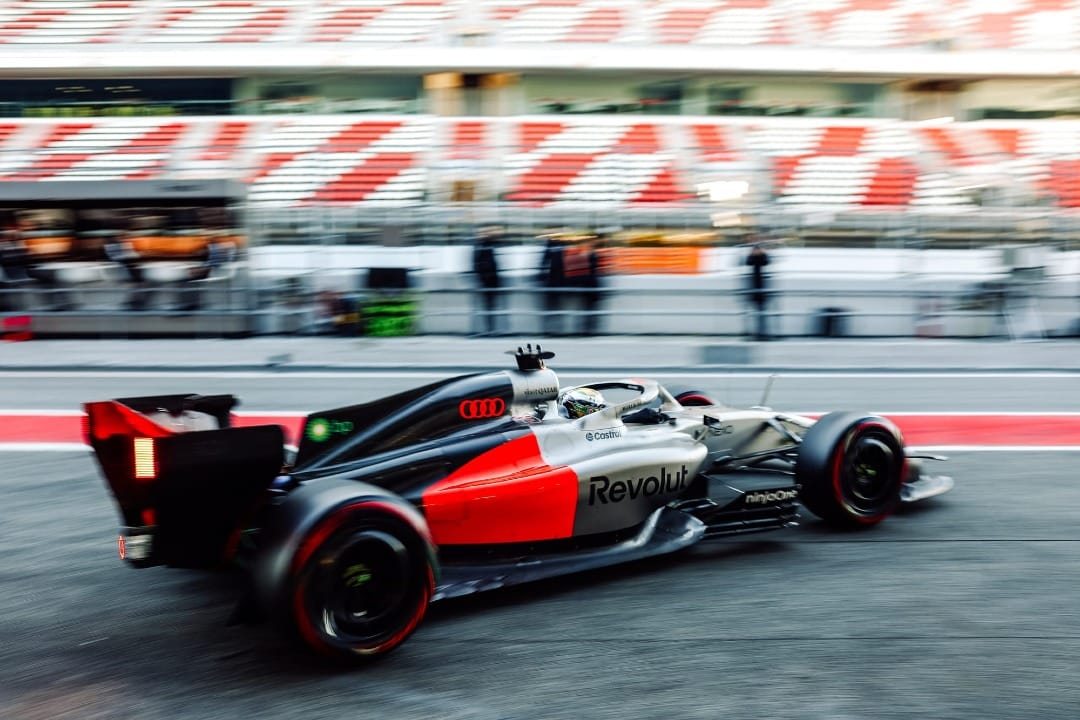
The shakedown phase of Formula 1’s 2026 regulation cycle has already done its real work.
Not on the stopwatch.
Inside the organisations.
For German manufacturers, shakedown running is not an opportunity to express intent. It is a compliance exercise designed to confirm that the programme’s internal model of the rulebook closely matches reality to permit controlled expansion later.
Viewed through that lens, the contrast between Mercedes and Audi is not subtle.
Mercedes is continuing a process.
Audi is still building one.
That distinction matters more in 2026 than raw technical ambition, because this regulation set punishes misunderstanding earlier and more permanently than any recent cycle.
The compliance problem, not the performance problem
The 2026 Formula 1 regulations do not present teams with a singular technical challenge. They present a compliance environment in which multiple constraints interact continuously:
- Electrical energy is mandatory, not optional.
- Deployment windows are prescribed, not elastic.
- Cooling architecture feeds directly into drag sensitivity.
- Financial governance limits corrective iteration.
- Homologation timing penalises late discovery.
This is not a landscape that rewards early optimisation.
It rewards organisations that internalise the box first, then operate at its edges without triggering a corrective response.
German works programmes are structurally comfortable here.
Mercedes: a mature compliance organism
Mercedes enters 2026 with an advantage that is easy to overlook because it is not visible on track.
It has lived inside hybrid compliance since 2014.
That matters because modern hybrid Formula 1 performance is not extracted mechanically. It is negotiated administratively, through control software, energy accounting, thermal margins, and procedural repeatability that survive scrutiny across multiple regulatory layers.
Mercedes does not treat the rulebook as an adversary.
It treats it as a system to be absorbed.
During shakedown runs, Mercedes performed as expected. The car ran conservatively. Installation choices favoured margin over expression. There was no visible attempt to provoke behaviour or explore edge cases.
That is not hesitation.
That is an organisation validating that its internal compliance model remains intact under a new ruleset.
Mercedes already knows how expensive late surprises are.
Energy management as an administrative discipline
In 2026, power unit performance is no longer a question of peak output.
It is a question of access discipline.
Electrical energy must be harvested, stored, and deployed inside narrow windows, repeatedly, without degrading stint average or destabilising thermal balance once aerodynamic drag begins to climb.
This is not an engineering trick.
It is an operational discipline.
Mercedes has spent more than a decade building the organisational reflexes required to manage this trade space. Control software maturity. Failure mode anticipation. Procedural recovery when assumptions break.
None of that reveals itself in a shakedown.
It reveals itself later, when systems begin interfering with one another under sustained load.
Audi: credibility without institutional reflex
Audi’s technical credibility is not in doubt.
Its endurance racing record, hybrid experience, and organisational depth are real. What Audi does not yet have is Formula 1 hybrid institutional memory, which is a different thing entirely.
This is not about intelligence or capability.
It is about reflex.
Audi is learning how Formula 1 enforces compliance, how quickly interpretation becomes exposure, and how narrow the tolerance is once cost controls and homologation freeze points converge.
Shakedown running reflected that reality.
Audi’s approach appeared exploratory. That is expected. Early mileage for a new works effort is about mapping behaviour, not confirming it.
The risk is not slowness.
The risk is freezing the wrong compromises too early.
The chassis–power unit interface trap
The most dangerous failure mode in 2026 is not a weak component.
It is a weak interface.
Energy deployment affects aerodynamic efficiency. Cooling affects drag. Weight distribution constrains packaging. Cost governance restricts redesign. These interactions do not fail with a bang on the dyno. They fail silently in the data, appearing only as tyre temperatures that won't stabilise or energy deployment that clips two laps early.
Mercedes has repeatedly solved this problem, even when the solutions were imperfect.
Audi is solving it for the first time under Formula 1 constraints.
That difference will not show up in qualifying simulations.
It will show up later, when development bandwidth is spent correcting fundamentals instead of accumulating margin.
Why endurance racing experience only partially carries over
Audi’s endurance racing pedigree is an asset.
It is not a shortcut.
Endurance racing rewards robustness across long stints and variable conditions. Formula 1’s 2026 framework demands robustness and repeatable peak extraction inside tightly governed windows.
Porsche learned this distinction the hard way in early hybrid eras. Mercedes internalised it over a decade. BMW is still inconsistent.
Audi is now on that path.
The shakedown phase does not measure how far along it is.
The long view
This is not a judgment on who will be fast in March.
It is an assessment of who is structurally positioned to converge cleanly over multiple homologation cycles without burning development capacity, correcting early assumptions.
Mercedes looks like an organisation already in refinement mode.
Audi appears to be an organisation still validating its baseline.
Under previous regulation resets, that gap could be closed with spending.
Under the current rules, it must be closed with discipline.
Conclusion
Shakedowns are not performance tests.
They are compliance confirmations.
For German works programmes, the signal is not who looks quick, but who behaves as though the rulebook is already understood.
Mercedes behaves that way.
Audi is learning to.
The outcome of 2026 will be shaped less by brilliance than by how few irreversible decisions are made before full understanding is achieved.
That is the real contest.
Editor’s note
This analysis follows Rennsport Report’s interim assessment of the 2026 shakedown phase and examines how German works culture and compliance behaviour shape early programme posture. A Bahrain testing interpretation will follow once sustained system interaction is visible, designed to confirm that the programme’s internal model of the rulebook closely matches reality.