Manthey sets its sights on IMSA with a two-car GTD and GTD Pro assault for 2026
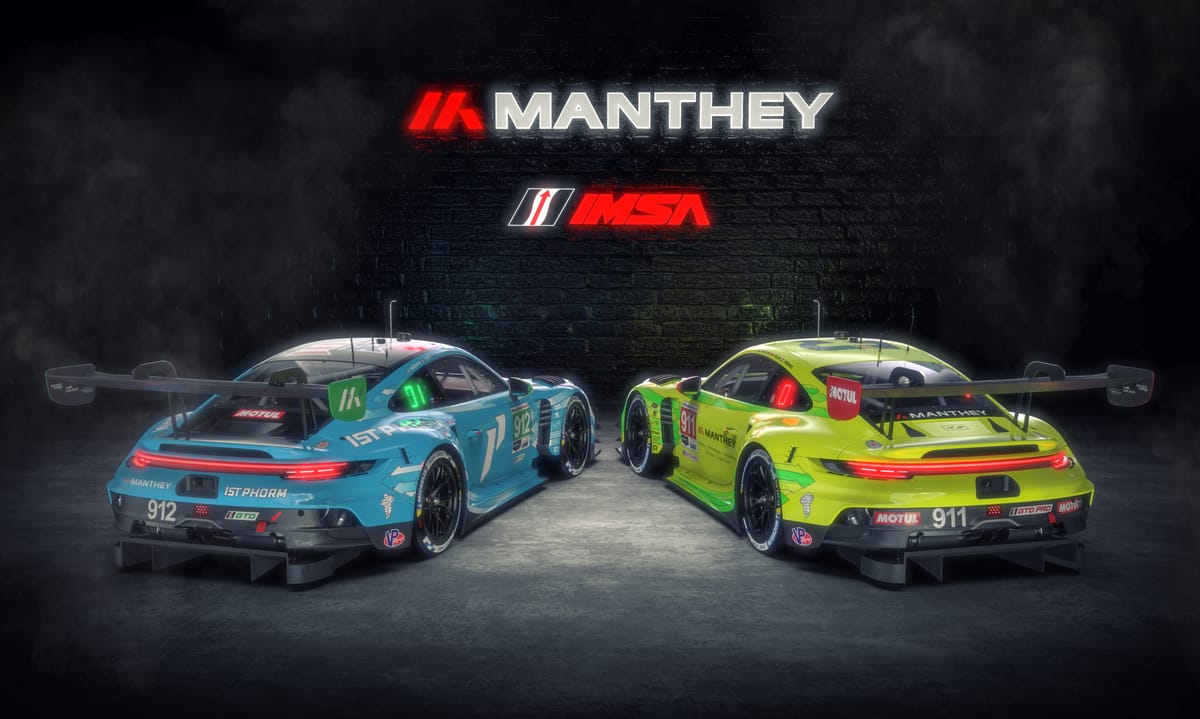
Manthey will enter the IMSA Michelin Endurance Cup for the first time in 2026, committing a pair of Porsche 911 GT3 R entries to a five-round endurance campaign that opens with the 24 Hours of Daytona in January. The programme marks a significant expansion of Manthey’s footprint outside Europe, following its recent title-winning form in the FIA World Endurance Championship.
The team will field the no. 911 Grello in GTD Pro, driven by Klaus Bachler, Thomas Preining and Ricardo Feller. The sister no. 912 Manthey 1st Phorm entry will compete in GTD with Ryan Hardwick, Riccardo Pera and Morris Schuring, joined by Richard Lietz for Daytona.
The announcement confirms what many expected after Manthey’s test at Daytona in November. The team has chosen continuity, experience and proven intra-team chemistry for a demanding schedule that includes Daytona, Sebring, Watkins Glen, Road America and Petit Le Mans.
Strong foundations for a major American venture
Manthey’s move into IMSA has been anticipated for some time, given both Porsche Motorsport’s strategic interest in the United States and Manthey’s growing global reputation. The Endurance Cup format suits the team’s strengths. Races range from 6 to 12 hours, with Daytona as the sole 24-hour race.
Speaking about the line-ups, Patrick Arkenau, Director Racing at Manthey Racing GmbH, emphasised the advantage of familiarity. He said the team enters the season with “a very strong driver line-up with close ties to Manthey” and highlighted the shared history with Hardwick, Pera and Schuring on the 912 side, and the WEC and DTM experience that links Bachler and Preining on the 911.
Arkenau noted that Feller would be helpful, adding further depth to the Grello crew. His experience with American circuits from earlier GT racing campaigns should be useful as Manthey learns the nuances of IMSA’s procedures, traffic patterns and race management.
Nicolas Raeder, Managing Director of Manthey Racing GmbH, framed the programme as the start of a new chapter, stating that the team enters IMSA “with experienced drivers, most of whom already know our team from the DTM, WEC and the Nürburgring”. For a team that thrives on continuity, the driver selection reflects both ambition and caution: the scale of the challenge in America has not been underestimated.
The Grello returns on American soil
Few GT liveries attract more attention than Manthey’s Grello. The no. 911 entry will compete in the GTD Pro class, which features all-professional driver line-ups and a level of competition that often produces the fastest GT racing in North America.
Klaus Bachler has long wanted to race in the Grello, and he acknowledged that point directly. He said sharing the car with Thomas Preining, a long-time colleague, and Ricardo Feller, with whom he will partner for the first time, makes the project especially meaningful. Preining spoke of a unified team goal: a strong debut season and a push for victory at Daytona.
Feller last raced in IMSA endurance events in 2019 and was eager to return. He referred to the Rolex 24 as an immediate priority, conscious that the opening race sets the tone for the season. His ability to jump between sprint and endurance formats without losing speed makes him a valuable addition.
With Bachler’s consistency, Preining’s raw pace, and Feller’s familiarity with the American series, the 911 group looks balanced. It is also a trio used to high-pressure environments. Given Manthey’s operational standards, they will expect to fight at the front once they adapt to IMSA’s safety-car structure, pit rules and tighter full-course yellow cycles.
The 912 Manthey 1st Phorm entry brings momentum from WEC
If the Grello brings the star power, the no. 912 brings the momentum. The combination of Ryan Hardwick, Riccardo Pera and Morris Schuring arrives fresh from winning the 2025 FIA WEC LMGT3 title. That shared success gives the group a foundation that could shorten the learning curve.
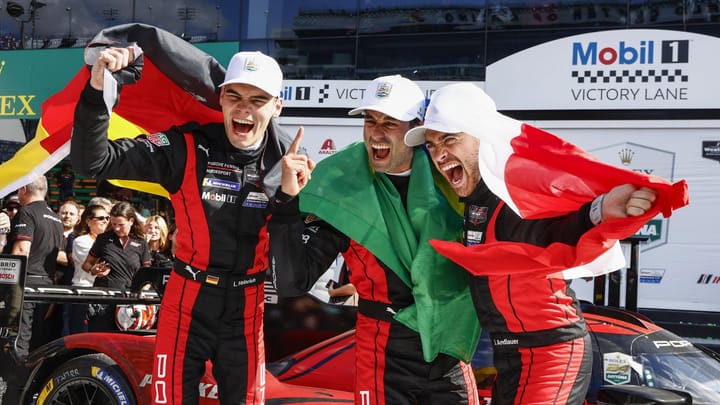
Hardwick returns to IMSA with unfinished business. He described the programme as a homecoming and pointed out the blend of youth and experience in the cockpit. The reference to his previous Daytona victory with Richard Lietz hints at confidence for January’s opener.
Pera echoed that sense of continuity, focusing on the partnership with 1st Phorm and the opportunity to tackle iconic American endurance events. The Italian has developed into one of the most reliable GT drivers in the WEC paddock, often producing long, stable stints that shape Manthey’s strategy. That trait will be crucial at IMSA, where the compression caused by safety-car restarts emphasises track position and pit timing.
Morris Schuring, fresh from being named 2025 DTM Rookie of the Year, continues a rapid rise. At just twenty, he has already raced at Le Mans, the Nürburgring, Spa and will now add Daytona to that list. He said he is “very proud” to reach this stage so early in his career and singled out the quality of his co-drivers as both an honour and a responsibility. That awareness will serve him well in the tighter GTD field, where traffic management can decide races more than outright pace.
Lietz joins the line-up for Daytona only. His role will be familiar: provide stability, keep the car in contention through the night and build a platform for the final hours.
A season shaped by five demanding circuits
The IMSA Michelin Endurance Cup covers five races:
• Roar before the Rolex 24, 16 to 18 January
• Rolex 24 at Daytona, 21 to 25 January
• Mobil 1 Twelve Hours of Sebring, 18 to 21 March
• Watkins Glen International, 25 to 28 June
• Road America, 30 July to 2 August
• Petit Le Mans, 1 to 3 October
Daytona sets the tone. Manthey has a race-winning pedigree in 24-hour events, but the Speedway rewards teams that master traffic patterns on the banking and maintain fuel and tyre discipline for long green-flag stretches.
Sebring is the opposite. The bumps, heat and evolving track surface punish every weakness. It is a stark contrast with the smooth European circuits on which Manthey often operates. This may be the team’s biggest learning test of the season.
Watkins Glen and Road America are fast, flowing circuits that suit the Porsche’s strengths. They reward bravery and commitment, qualities associated with both line-ups. Watkins Glen, in particular, often produces long green-flag runs, which brings strategy to the fore.
Petit Le Mans closes out the year and is notorious for its high traffic density. Night running at Road Atlanta compresses the field and often leads to a decisive final hour. By that stage, Manthey will hope its IMSA education is complete.
A measured but ambitious debut
Manthey rarely enters a championship without intent, yet the team also recognises what it must learn. IMSA is not WEC. Full-course yellows behave differently. The balance of performance is tailored to the American field. Race direction relies more heavily on procedures that compress the pack.
The driver line-ups show that Manthey prioritises stability over performance. Seven drivers with linked histories and similar working methods should accelerate the team’s adaptation.
The story of 2026 will depend on how quickly Manthey can translate its European strengths to American conditions. If the November test was encouraging, the real answers will come at Daytona. Both cars are capable of podiums. Both are capable of more if the execution matches the theory.
For a team with Manthey’s pedigree, this is not a tentative step. It is a deliberate stride into one of the world’s most competitive GT environments. The Grello in IMSA will attract attention. The results will decide the tone of the debut season.