Mercedes-AMG Motorsport 2025 review: momentum built the hard way
Mercedes-AMG Motorsport’s 2025 season was a mixed bag of scale and strain. Global GT success, a rushed WEC return with Iron Lynx, and hard lessons set the foundation for a stronger 2026.
Mercedes-AMG Motorsport’s 2025 season resists easy summary. On paper, the numbers are formidable. In practice, the year was shaped just as much by what went wrong as by what went right. That tension runs through the attached press release, and it is where the real story sits.
This was not a campaign defined by one championship or one race. It was a year of scale, stress, and strategic transition.
Customer racing at industrial scale
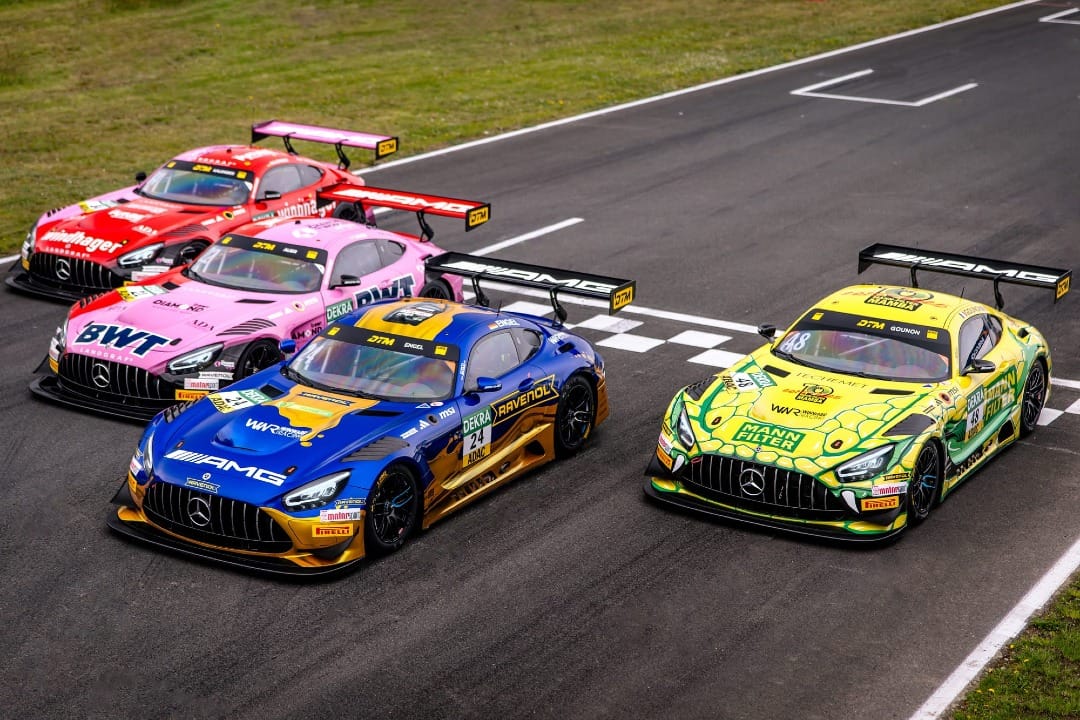
At the core of the programme remains Mercedes-AMG Customer Racing, which marked its 15th anniversary in 2025. Around 100 teams worldwide ran Mercedes-AMG GT3, GT2 and GT4 machinery, logging 1,368 race starts across 435 races. The returns were substantial: 61 victories, 209 podiums and 50 championship titles, plus three overall and 15 class wins in endurance racing.
That breadth matters. Mercedes-AMG’s motorsport strength is not built on a single factory effort but on a global network that turns racing into repeatable business. Few manufacturers can match that level of volume without losing competitiveness at the sharp end.
Christoph Sagemüller, Head of Mercedes-AMG Motorsport, is explicit about where the highlights sit. A 16th DTM manufacturers’ title keeps Mercedes-AMG as the most successful marque in the series’ history. In North America, all three GTD titles in the IMSA WeatherTech SportsCar Championship were defended. Globally, a seventh consecutive Intercontinental GT World Challenge manufacturers’ crown underlined continuity rather than novelty.
The message is clear: this programme wins often, and it wins everywhere.
The uncomfortable parts of the story
What gives the release credibility is its refusal to smooth over the failures. The FIA World Endurance Championship debut is described as a ‘difficult start’, not a learning exercise. The Nürburgring and Spa 24-hour races were ‘disappointing’. The DTM drivers’ title slipped away in a manner Sagemüller admits still troubles him, despite Lucas Auer scoring points in every race.
This matters because it reframes 2025 not as a victory lap but as a stress test. Mercedes-AMG operated at its usual scale while absorbing setbacks in some of the most visible arenas. That combination is harder to manage than either success or failure alone.
WEC entry under pressure
The most revealing section concerns the late decision to enter the FIA World Endurance Championship in LMGT3, alongside Iron Lynx. The programme was rushed, technically demanding, and unfamiliar. Torque sensors and other WEC-specific requirements arrived with little preparation time. The learning curve was steep.
Yet the outcome is telling. Mercedes-AMG finished the season with a second-place result in the final race. That does not rewrite the season, but it does validate the direction of travel. More importantly, it removes the stigma of failure from the brand’s return to Le Mans after 26 years.
For an organisation that values credibility above spectacle, that matters more than a headline result.
Product, partnerships, and positioning
Away from pure competition, 2025 was a year of consolidation and signalling intent. The Mercedes-AMG GT4 was re-homologated through to 2029, securing the long-term future of one of the programme’s most important customer cars. The 300th Mercedes-AMG GT3 delivery quietly underlined how embedded the car now is across global GT racing.
The unveiling of the Mercedes-AMG GT2 Edition W16 at Monza stood out for different reasons. With a direct Formula 1 link and Kimi Antonelli as patron, it was less about volume and more about brand narrative, a reminder that AMG still sees motorsport as cultural capital, not just competition.
New partnerships with adidas, Racing Force Group, OMP and Bell Helmets expanded the commercial perimeter, while initiatives like the Elite Racing Circle with GruppeM Racing point towards a more curated, premium customer experience.
Structural change ahead
The most consequential detail sits near the end. From January 2026, Affalterbach Racing GmbH will become fully operational as a development service provider, marking a transition away from HWA AG after years of collaboration. That is not cosmetic. It signals a shift towards tighter internal control over technical development at a time when GT racing regulations are stable but increasingly competitive.
Sagemüller also confirms that development of the successor to the current Mercedes-AMG GT3 will enter a critical phase in 2026. That frames 2025 less as an endpoint and more as groundwork.
What 2025 actually achieved
Strip away the statistics and statements, and 2025 reads as a season of resilience. Mercedes-AMG proved it can absorb regulatory shocks, late programme decisions, and high-profile disappointments without destabilising its wider racing ecosystem.
It did not dominate everything. It did not get everything right. But it finished the year stronger than it started, with clearer structures, renewed Le Mans credibility, and a stable base heading into a major development cycle.
When Sagemüller says there will be ‘more reason than ever to reckon with us’ in 2026, it does not sound like bravado. It sounds like an organisation that has just finished doing the hard work.
And in motorsport, that is usually when the results follow.