Mercedes-AMG tyre deficit costs five-hour Paul Ricard lead
Mercedes-AMG led Paul Ricard for five hours. Cold tyres and a safety car cost the win. BMW called P4 the maximum. Porsche's pace delivered nothing.
Mercedes-AMG's known tyre limitation decided the Paul Ricard opener. BMW acknowledged a pace ceiling. Porsche collected four operational penalties from four entries.
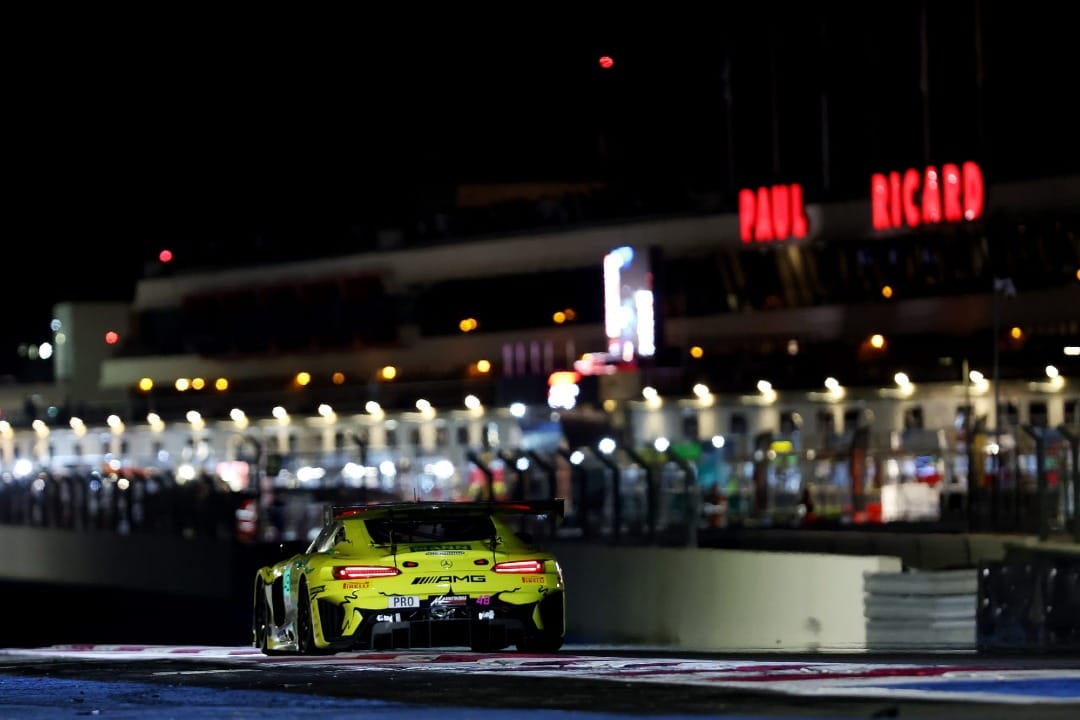
Mercedes-AMG Team MANN-FILTER led the GT World Challenge Europe Endurance Cup opener at Circuit Paul Ricard for approximately five hours, building a gap that exceeded 30 seconds. A late safety car, triggered when the number 93 Ziggo Sport Tempesta Racing Porsche stopped at Turn 11 with 47 minutes remaining, erased that advantage. Nicki Thiim in the number 7 Comtoyou Racing Aston Martin closed the gap and passed Lucas Auer after a small error on the Mistral Straight. The Mercedes-AMG finished 0.806 seconds behind after six hours.
The loss exposed a tyre characteristic that the team's own drivers confirmed as pre-existing. Luca Stolz said the team anticipated difficulty getting tyres into the optimal temperature window as conditions cooled, and knew this could become a problem. Fabian Schiller, driving the number 17 Mercedes-AMG Team GetSpeed car to seventh, identified the same warm-up deficit as a recurring issue at this circuit. Two drivers from two separate teams confirming the same limitation lends this claim weight, but the word Schiller used was 'here', referring specifically to Paul Ricard. Whether the characteristic extends beyond this circuit remains an open question that only data from a second venue can answer.
Mercedes-AMG placed three Pro-class cars in the top nine (second, seventh, and ninth) and brought all nine starters to the finish. Stefan Wendl, head of customer racing, described the weekend as a solid foundation. The 100 per cent completion rate across nine entries is the strongest aggregate manufacturer return, but it was not enough to win.
BMW acknowledged a pace ceiling. Kelvin van der Linde said the cars at the front were too fast. Augusto Farfus said ROWE Racing did not have the package to fight for the podium from Car 98's starting position of 22nd. Vincent Vosse, the Team WRT principal, characterised the P4 finish as the optimum. The number 32 BMW M4 GT3 EVO started 10th and finished fourth, gaining six positions without retirement or major penalty. That is a clean operational return from the primary entry, but the team and its drivers described the car's pace ceiling as fourth, not first. Valentino Rossi reported tyre grip problems in his second stint in the number 46 car, a technical complaint that parallels the Mercedes-AMG warm-up issue and raises the question of whether Paul Ricard's conditions exposed a circuit-specific limitation shared across multiple chassis rather than a single manufacturer's weakness.
Porsche generated the fastest single lap from any German manufacturer. Thomas Preining recorded a 1:55.249 on lap 20 in the number 80 Lionspeed GP car. The broadcast attributed the car's retirement after 95 laps to a steering rack or hydraulic failure, though the team has not confirmed this. Beyond the mechanical retirement, the official race message list documents four separate Porsche operational penalties across four entries: Car 89 received a drive-through for causing a collision at Turn 7 on Lap 1. Car 914 received a drive-through for causing a collision in the same incident. Car 2 (Boutsen VDS) received a 105-second converted stop-and-go penalty for a pit stop infringement. Car 80 accumulated two pit lane speeding penalties in free practice. No Porsche Pro-class entry delivered a clean race.
This reading does not claim that any manufacturer holds a chassis pace advantage. The top seven finishers completed 176 laps within 30 seconds of each other under Balance of Performance administration, and that convergence limits any single-event conclusion about relative car performance. What the race produced is one specific, driver-confirmed technical finding for Mercedes-AMG, one explicit pace-ceiling acknowledgement from BMW, and a cluster of operational penalties for Porsche that may or may not repeat.
For Mercedes-AMG, the tyre warm-up vulnerability at Paul Ricard is confirmed by two independent driver sources, but anchored to one circuit with extreme temperature variation. If the same pattern appears at a second venue with different surface and ambient conditions, it upgrades from a circuit-specific observation to a chassis characteristic worth tracking against the GT3 EVO successor programme. The next Endurance Cup round (Monza) is the correct test, not the Brands Hatch Sprint Cup on 2 to 3 May, because a one-hour sprint does not replicate the thermal management conditions that exposed the limitation.
For BMW, the concentration model delivered a clean points-scoring result from its primary entry, but both lead drivers and the team principal identified the car's competitive ceiling as fourth. Whether that ceiling is BoP-imposed or hardware-limited will become legible at Monza, where Farfus specifically said the team aims to do better.
For Porsche, four entries collected four separate penalties from distinct causes. Whether this is a programme-wide operational pattern or single-event noise depends on the next endurance round.
Clarification (15 April 2026)
This article linked Valentino Rossi's tyre grip complaint to the Mercedes-AMG warm-up vulnerability, suggesting both might reflect a shared circuit-specific limitation. Cross-referencing against the race message list shows Rossi's complaint occurred around the three-hour mark, approximately two hours before the Mercedes-AMG drivers reported difficulties under cooler conditions. The two issues are treated separately in the Deep Interpretation published on 15 April 2026.