Porsche's post-WEC programme just passed its hardest endurance exam
Sebring confirms the shape of Porsche's IMSA-only prototype future. The concentration thesis is no longer a diagnosis. It is operational.
Deep Interpretation: 2026 Sebring 12 Hours
Why this matters now
Five months after Porsche withdrew from the FIA World Endurance Championship (WEC) Hypercar category, and one Daytona victory later, the 2026 Sebring 12 Hours delivered the harder question. Daytona tested whether the restructured programme could win. Sebring tested whether the structure itself holds under the surface that punishes mechanical compromise most severely on the IMSA calendar.
The result, a Porsche Penske Motorsport 1-2 in GTP and a Porsche 1-2 in GTD Pro, suggests it does. RSR's Sebring preview asked whether this circuit would separate execution from hardware. It did. The answer is just not visible in the finishing order.
The concentration thesis is no longer a thesis
RSR has tracked Porsche's narrowing IMSA prototype commitment since late 2025. The working diagnosis held that Porsche was concentrating resources into fewer entries, tightening its factory driver pool, and extracting maximum value from a shrinking commitment window.
Sebring upgrades that diagnosis to a verdict. The withdrawal from WEC, announced on 7 October 2025 and effective after the 8 Hours of Bahrain season finale, removed any ambiguity about where Porsche's prototype programme lives. IMSA is not the surviving commitment by default. Porsche chose it explicitly, citing the strategic importance of the North American market and the availability of IMSA-specific funding sources that could not be used for the WEC. The dual-programme costs with Team Penske had risen beyond what senior management at Stuttgart were willing to sustain as Porsche AG profits fell approximately 90% between the third quarter of 2023 and mid-2025.
What Sebring reveals is the operational consequence of that choice. Three signals confirm the concentration is structural, not circumstantial.
The driver pool tells the story
Nick Tandy, a Platinum-rated factory driver who previously held a seat in the GTP programme, now races full-season for the #77 AO Racing Porsche 911 GT3 R in GTD Pro. The official IMSA entry list, a Porsche Newsroom press release dated 18 March 2026, and IMSA's own pre-event documentation all confirm Tandy's absence from the factory GTP roster. No public explanation for the move has been offered by Tandy, Porsche, or AO Racing.
His replacement in the factory structure is Laurin Heinrich, a younger driver tagged as a prototype rookie with high pace potential. The broader restructuring brought Kévin Estre and Laurens Vanthoor, who won the 2024 WEC drivers' championship alongside the now-retired André Lotterer, into the #6 car alongside Matt Campbell for endurance rounds, while Felipe Nasr and Julien Andlauer lead the #7 with Heinrich. This is the driver pool of a programme that has absorbed its displaced WEC talent into a two-car IMSA operation and pushed its established veteran GT resource downward to stabilise the customer tier.
Tandy's redeployment worked. AO Racing finished second in GTD Pro at Sebring. Manthey (#911) won the class. Porsche's customer GT programme delivered a 1-2 result with factory-grade talent driving customer-operated cars. The concentration is visible at both ends of the programme hierarchy.
The customer gap confirms the two-tier structure
JDC-Miller MotorSports, operating the #5 customer Porsche 963, elected not to apply the Evo Joker update process to its chassis for financial reasons. The car finished ninth in GTP, losing pace in low-temperature conditions. The factory entries ran updated machinery.
This is now a two-tier Porsche prototype field in IMSA: two fully resourced factory cars operating at peak specification with WEC-grade driver line-ups, and one customer entry running older-generation components with a silver and gold-rated crew. The gap between the two tiers is not a performance deficit. It is a programme design choice. Porsche has built an operation where the factory cars are expected to win, and the customer car is expected to participate. That is concentration by architecture, not by accident.
Absorbing the penalty
IMSA Technical Bulletin IWSC #26-28, dated 13 March 2026, mandated a 1055 kg minimum mass for the Porsche 963, a 20 kg increase since the Daytona season opener and the largest Balance of Performance (BoP) adjustment applied to any LMDh manufacturer for this round. All other LMDh models received a smaller 10 kg increase.
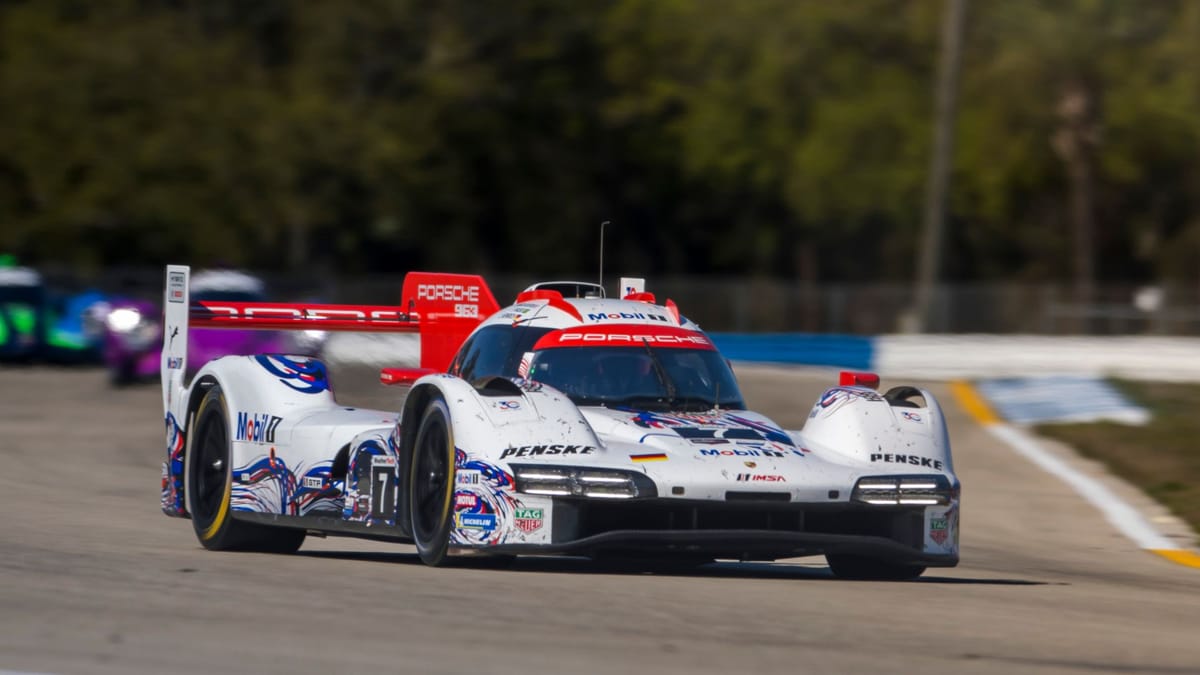
Porsche absorbed the penalty and produced a 1-2 finish, with the #7 car winning by 1.515 seconds over the #6 [Fact]. This is the second consecutive Sebring overall victory for the #7 car and Porsche's record-extending 20th outright win at Sebring International Raceway.
The engineering margin required to overcome a disproportionate weight penalty while locking out the top two positions points to a programme operating with structural depth that regulatory ballast alone cannot collapse. That depth is easier to maintain when all factory resources are directed toward two cars in a single series rather than split between two championships on two continents.
Le Mans is closed, not paused
The most consequential outcome of the WEC withdrawal is not what it did to the championship grid. It is what it did to Porsche's access to Le Mans.
WEC regulations require a manufacturer to field at least two Hypercar entries for a full season to qualify for 24 Hours of Le Mans eligibility. With no WEC commitment, Porsche Penske's earned Le Mans invitation as reigning IMSA GTP champions could not be activated. ACO President Pierre Fillon refused to make any exceptions.
A behind-the-scenes effort to preserve access to Le Mans unfolded throughout October and November 2025. Roger Penske explored a partnership with customer team Proton Competition to field two privateer 963s in WEC, which would have satisfied the two-car minimum. Porsche AG shut the plan down. Thomas Laudenbach, Porsche's Vice President of Motorsport, confirmed the decision, with senior management arguing that a Penske-Proton joint venture would create confusion around the brand's strategic position. Proton subsequently withdrew from WEC Hypercar entirely.
The Porsche 963 is now the first top-class Porsche prototype to never win Le Mans, with its best result a second-place finish at the 2025 race.
This matters for reading Sebring because it removes the final ambiguity from the concentration thesis. Porsche is not holding IMSA as a bridge back to Le Mans while maintaining selective WEC access. The Le Mans door is closed by regulation, not by choice. IMSA is not the fallback. It is the entire factory prototype programme, full stop.
BMW: operational transition under new management
BMW's Sebring produced a different structural signal. The factory GTP programme transferred entirely to WRT management for 2026, replacing the prior partnership with Rahal Letterman Lanigan Racing (RLL), which now runs a customer McLaren operation.
The #24 BMW M Hybrid V8 of Sheldon van der Linde, Robin Frijns, and Dries Vanthoor finished sixth after a late-race strategy gamble failed. The team opted for a fuel-only stop under a full-course yellow, sacrificing fresh tyres to gain track position, then lacked the pace to defend during the final 16-minute sprint. The #25 car of Philipp Eng, Marco Wittmann, and Kevin Magnussen finished 11th after early contact with a spinning car.
The convergence question, whether BMW's multi-platform presence is consolidating toward a single strategic priority, remains open. WRT's dual-programme structure (IMSA and WEC) is visible in the driver rotation: Vanthoor and van der Linde move between series. BMW received a power reduction at both stages for Sebring, alongside a 10 kg weight increase; the same adjustment applied to all non-Porsche LMDh entries. The BoP picture is neutral relative to Cadillac and Acura, but the 10 kg advantage over Porsche did not translate into a competitive result.
The #24 car's strategy call is worth isolating. A fuel-only stop under caution is a gamble that trades tyre performance for track position. It is the kind of decision a team makes when it believes track position is the only route to a podium, not raw pace. That reading fits a programme still calibrating its operational rhythm under new team management rather than one operating with the structural confidence to race on merit alone.
In GT classes, BMW remains dependent on customer teams. Paul Miller Racing (#1, GTD Pro) and Turner Motorsport (#96, GTD) both noted pace deficits relative to Porsche entries. This is not a programme converging. It is a programme in operational transition, with the prototype tier centralised under WRT and the GT tier left to customer capability.
The regulatory environment has shifted beneath everyone
Two regulatory developments from Sebring carry structural weight beyond a single round.
IMSA introduced Article 2.2.3.a in January 2026, a BoP conduct clause that prohibits manufacturers, competitors, drivers, constructors, and any associated persons from making 'any public comments regarding the BoP process, methodology, data, or outcomes' across all media platforms. The clause is new for the 2026 season. IMSA holds sole discretion to determine whether a communication constitutes a violation, 'regardless of intent'.
This is not a restriction on disputing BoP. It is a blanket prohibition on discussing it publicly. The topic of performance balancing has been removed entirely from public discourse. Before the withdrawal, Laudenbach made pointed public comments about BoP at the 2025 WEC round at the Circuit of the Americas, questioning results and stating plainly that his car should have won Le Mans. That kind of public signalling is now prohibited in IMSA. The pressure valve is closed. Strategic displeasure must be communicated through programme decisions, entry commitments, or private channels.
The provision mirrors a WEC policy under which Toyota Gazoo Racing received a suspended fine in 2024 for public comments on BoP transparency. No IMSA manufacturer has been penalised under the new clause yet.
Separately, Team Penske management noted that the complexity of the Bosch/Williams/Xtrac hybrid systems is increasingly obscured by proprietary sensor data, making independent performance analysis by rival teams difficult. This is a transparency problem that compounds the conduct clause: teams cannot publicly discuss BoP, and they increasingly cannot independently verify the performance data that informs it.
For a manufacturer that publicly cited BoP frustration as a secondary factor in its WEC departure, the IMSA gag order is a notable constraint on how Porsche can communicate if the same tensions arise in the one series it has left.
Mercedes-AMG and Audi: marginal footprints
Mercedes-AMG fielded three entries at Sebring (one GTD Pro, two GTD) with no prototype presence. The programme showed signs of stress: the #48 GTD Pro entry received a post-qualifying ride-height infraction, and the #57 GTD car of Winward Racing retired after a collision exiting Turn 17. Neither result produces a structural signal beyond confirming that the Mercedes-AMG IMSA footprint remains customer-dependent and GT-limited.
Audi had zero entries in any WeatherTech championship class. Its North American presence is restricted to customer TCR entries in the Pilot Challenge support series. This confirms, for a second consecutive season, Audi's exit from top-flight North American sports car competition, and marks the Volkswagen Audi Group's third Hypercar-class departure after Audi cancelled its own LMDh programme before racing and Lamborghini withdrew the SC63 after a single WEC season.
The position
Porsche's Sebring performance is the output of a programme that made a hard financial choice in October 2025 and is now executing the consequences of that choice at the highest level available to it. The factory operation has absorbed its WEC-displaced talent, concentrated its engineering resources on two cars in one series, redeployed its veteran GT drivers to stabilise the customer tier, and produced back-to-back Daytona and Sebring victories while carrying the largest BoP penalty in the GTP field.
This is not a programme in decline. It is a programme that chose its ground, lost Le Mans as the price of that choice, and is now proving it can dominate the ground it kept.
The open question is no longer whether Porsche will return to WEC and Le Mans. Both Penske and Laudenbach have publicly stated that a return is the intent, with Penske expressing hope that it happens before 2030. Porsche has retained key infrastructure at its Mannheim facility and kept core personnel. The question is whether the IMSA programme's current dominance makes the financial case for a WEC return easier to justify to Stuttgart, or whether it demonstrates that Porsche can sustain its racing identity without Le Mans.
What to watch next
The BoP trajectory for the Porsche 963 at the next IMSA round is the primary trigger. If the weight penalty escalates again and Porsche continues to absorb it without visible performance loss, the engineering margin argument hardens. If the penalty stands or is reversed, the Sebring result becomes less diagnostic.
Secondary triggers: any Porsche communication referencing the 2027 programme scope or WEC re-entry timelines; the ACO's Le Mans entry list for any signals of rule flexibility on the two-car minimum; and the operational performance of BMW under WRT at the next endurance round, as a comparator for programme transition maturity.
The conduct clause's suppressive effect on manufacturer signalling also bears monitoring. If the weight penalty increases and no Porsche response is visible, the gag order becomes a confirmed operational constraint. The silence will be real, but its meaning will be difficult to read.