Turner’s BMW revival rests on familiar methods
Turner’s Indianapolis win leaves it provisionally six points behind Winward. Familiar strengths in strategy and race management are helping sustain its renewed title challenge.

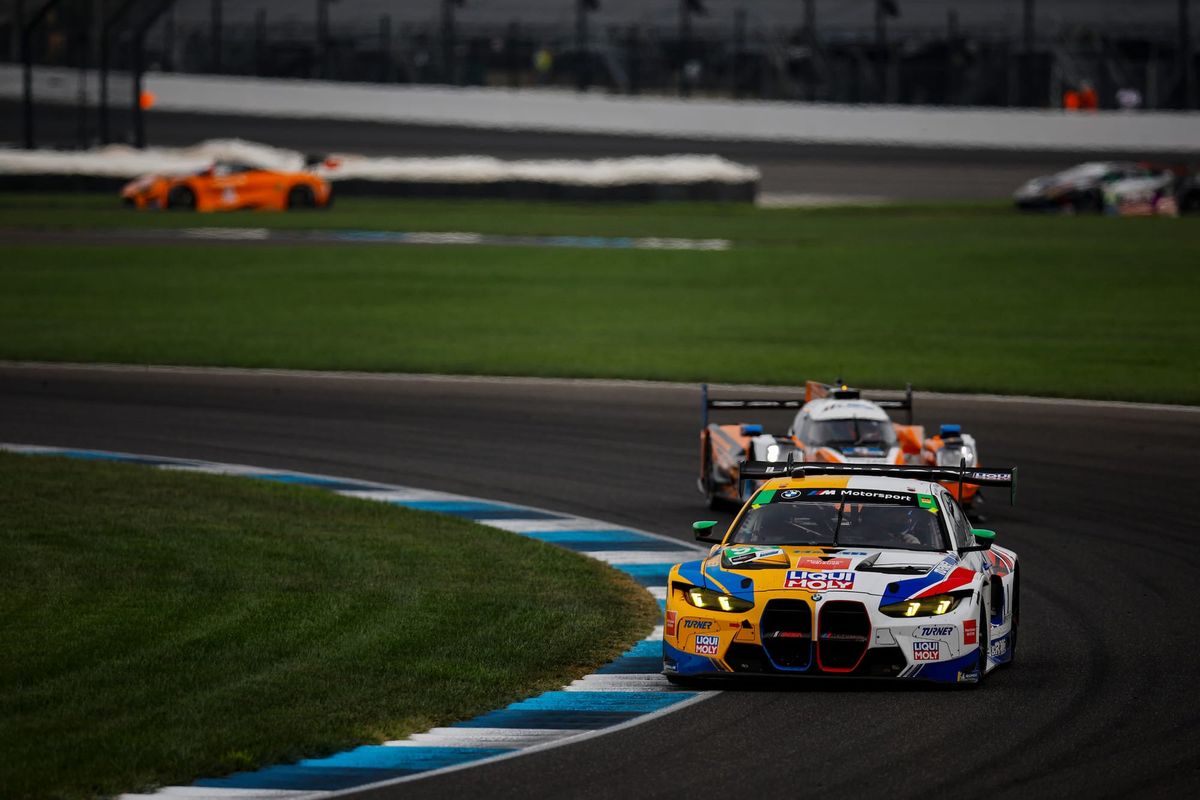
Turner Motorsport’s return to the IMSA WeatherTech SportsCar Championship GTD title fight suggests that familiar strengths in strategy and race management are again producing championship-level returns. The victory at Indianapolis Motor Speedway adds to a season in which a former championship runner-up has repeatedly turned opportunities into valuable points.
In IMSA’s provisional standings, Robby Foley and Patrick Gallagher sit six points behind Winward Racing’s Russell Ward and Philip Ellis before Petit Le Mans. Winward has four wins to Turner’s one, yet their points totals are almost identical. Race victories and points accumulation tell different parts of the championship story. The win count alone cannot establish which car has the stronger underlying pace.
Gallagher and Foley finished second in the 2024 championship. By July 2025, their first six results with the updated BMW M4 GT3 EVO ranged from fifth to ninth. In a contemporary IMSA interview, Gallagher said the team was learning the EVO and gaining ground, while retaining the same people.
He also described his trust in strategist Don Salama’s fuel targets. Turner’s confidence in its strategy work had survived the disappointing results. The team was learning an updated car with an established working relationship between drivers and pit wall.
Progress was already visible later that year. Turner’s season review records fourth in the GTD championship and three consecutive fourth-place finishes at Road America, VIRginia International Raceway and Indianapolis. That sequence makes the recovery look gradual. Treating the whole first EVO season as a competitive failure would hide the improvement already under way.
This season, those working relationships have helped produce podiums. At Long Beach, Salama chose fuel without new tyres at the sole stop. Gallagher described saving fuel to gain positions through the pit sequence, while Foley brought the car home second despite contact. Fuel management gave the pit wall a strategic option, and the drivers helped turn that decision into points.
At VIR, Turner inherited second after contact between the leaders. Both drivers acknowledged a pace deficit to the #57 and #27. Staying close enough to benefit when rivals lost ground mattered more than matching their speed. Turner could collect a substantial points return even when the BMW lacked the pace to win.
At Indianapolis, timing and penalties helped create the winning opportunity. Winward’s #57 Mercedes-AMG GT3 went to the back of its class after failing to grid on time, leaving Turner at the head of GTD. Foley’s final stop preceded the decisive caution. A penalty for Conquest Racing’s #34 then handed him the lead, which he retained against Ellis.
Winward recovered to finish just 0.501 seconds behind in the provisional classification and preserved its points lead. That recovery demonstrates a strength shared by both teams: the ability to extract a valuable result from a race that does not run their way entirely. Winward’s starting penalty and its response deserve separate judgements.
My reading is that Turner’s established strengths are again sustaining a title challenge. The technical explanation remains open. Team learning, Balance of Performance, circuit suitability and race circumstances could all contribute to the improved results. There is no verified basis for assigning that recovery to a particular BMW change, or for claiming that Turner’s organisation remained unchanged in every respect.
For BMW, Turner’s renewed title challenge strengthens the evidence for this customer programme’s ability to convert the EVO’s available performance into results. The manufacturer’s wider operating depth was already visible elsewhere. Indianapolis adds a specific IMSA example of recovery, with a championship consequence that extends beyond the race itself.
Petit Le Mans will test whether Turner can sustain that conversion. Competitive stints, tyre and energy management, pit decisions and avoidable losses will matter alongside the finishing position. Repeated execution would strengthen the continuity reading; evidence of a substantial operational change would require revising it. The championship outcome alone cannot explain how Turner recovered.