WEC preserved its finale, but shortened the road back
WEC’s move to Barcelona and Monza preserved eight rounds but removed six racing hours and one third of the points from its original finale.

Signal note: 2026 FIA WEC calendar change
WEC has preserved an eight-round season. It has not preserved the same championship.
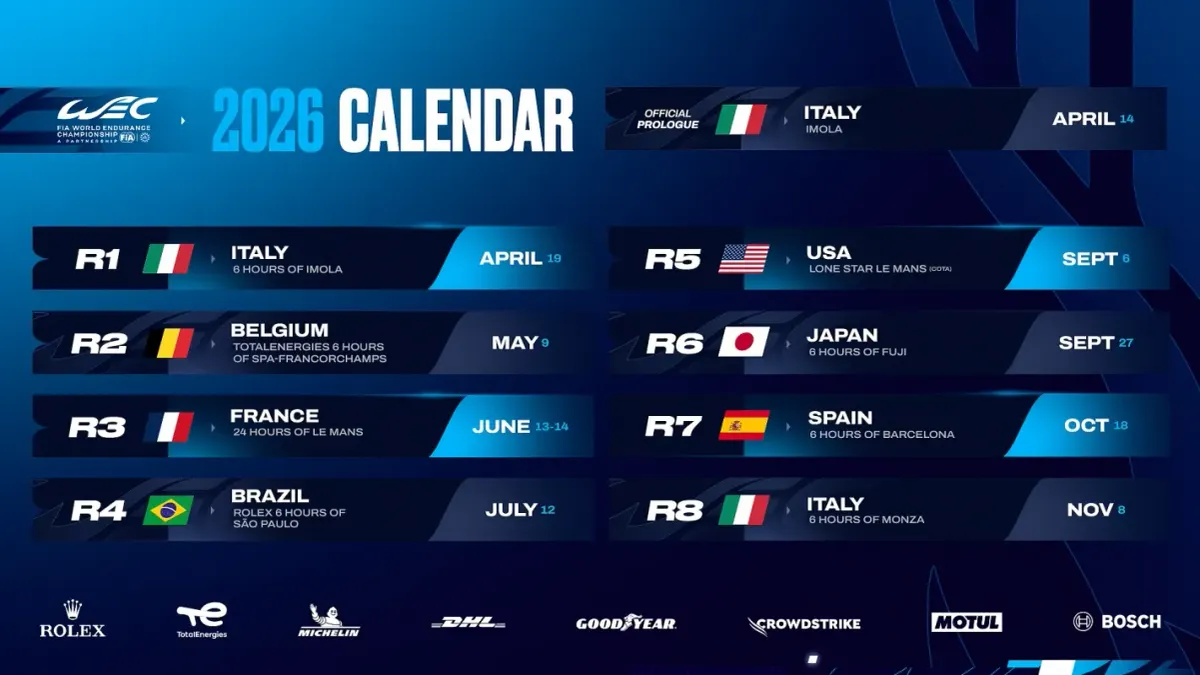
Regional developments affecting freight and travel have forced the Qatar 1812km and the 8 Hours of Bahrain off the 2026 calendar. Barcelona will stage a six-hour race from 16 to 18 October, followed by another at Monza from 6 to 8 November.
Tickets for both events are already on sale. The operational commitment is clear, even if the formal record is not.
The FIA and WEC still describe the amendment as subject to World Motor Sport Council approval. Specialist reports say an electronic vote has already ratified it, but no primary WMSC decision or revised FIA sporting calendar has been published. The live WEC calendar shows Barcelona and Monza, while the FIA’s consolidated calendar still lists Qatar and Bahrain.
That discrepancy requires a caveat. It does not erase the sporting consequence already defined by the published regulations.
A six-hour WEC race awards 25 points for victory and one for pole. Eight- and ten-hour races award 38 plus one, with the regulations expressly placing the Qatar 1812km within the longer-race scale.
The original final two rounds therefore offered 78 maximum points for a driver or LMGT3 team. Barcelona and Monza offer 52. Six scheduled racing hours and one third of the points available from those two championship slots have disappeared.
Across the four rounds remaining after São Paulo, the maximum falls from 130 points to 104. For the Hypercar manufacturers’ championship, where two designated cars score, it falls from 220 to 176.
That reduction applies equally to the field, but its effect is not neutral. Points already banked become harder to recover. A leader must still execute, while a trailing programme has fewer high-value opportunities to overturn an earlier deficit.
The revised calendar also changes the competitive examination.
Barcelona and Monza are not interchangeable European substitutes. Barcelona places sustained energy through the tyres and rewards balance across longer corners. Monza shifts the emphasis towards straight-line efficiency, braking stability, traction and kerb use.
Those characteristics could matter more than the points compression on a particular weekend. Event-specific Balance of Performance, tyre behaviour, temperature, reliability and safety-car timing may still reshape the title contest. No responsible forecast can yet declare the switch favourable to BMW, Porsche or Mercedes-AMG.
The structural consequence is nevertheless established. WEC planned to conclude its season with an 1812km race and an eight-hour finale. It will now conclude with four consecutive conventional six-hour rounds from Austin onwards.
The championship has become shorter, more uniform and less forgiving of points lost during its first half.
The operational judgement is more balanced.
Concentrating both closing rounds in one region exposed WEC to a single disruption affecting the whole finale. When the regional situation remained unresolved, freight and safe personnel travel could no longer be treated as dependable parts of the calendar.
Yet no international championship can remove geopolitical risk. WEC secured two credible circuits, preserved the round count and acted early enough for teams, manufacturers and the organiser to revise their arrangements. That is evidence of contingency competence as well as exposure.
The official explanation should not be extended beyond the evidence. WEC has cited regional security, freight and travel. It has not published a detailed freight plan, named an insurance restriction or attributed the decision to manufacturer travel bans.
Formula 1 now supplies useful supporting context. Its April races in Bahrain and Saudi Arabia did not proceed. The Bahrain Grand Prix is intended to be held at Sepang in October, subject to final approval, while Saudi Arabia has no replacement.
Qatar and Abu Dhabi remain confirmed for the Formula 1 finale, but Stefano Domenicali has set a mid-September decision point. If those races cannot proceed, Formula 1 says its season will finish in Europe.
That strengthens the conclusion that WEC acted against a continuing late-season regional risk. It does not establish that WEC was withdrawing from the Middle East or that Formula 1 will reach the same decision.
Qatar and Bahrain remain on WEC’s approved nine-round calendar for 2027. The ACO has committed to returning to both, while the FIA uses the more conditional formulation that it expects to return when circumstances allow.
The best reading therefore sits between resilience and vulnerability. WEC saved the season through decisive contingency work. It also demonstrated what happens when two closing rounds share the same regional exposure: the races can be replaced, but their duration, weighting and place within the championship cannot be reproduced automatically.
Sources
- FIA, “FIA and FIA WEC confirm venues for final two rounds of 2026”, 28 July 2026.
- FIA WEC, “FIA WEC and FIA confirm venues for final two rounds of 2026”, 28 July 2026.
- FIA WEC, “Tickets on sale for Barcelona and Monza”, 29 July 2026.
- FIA, 2026 FIA World Endurance Championship Sporting Regulations, version 1.2.
- FIA, consolidated 2026 sporting calendars.
- FIA WEC, 2027 championship calendar, 12 June 2026.
- Formula 1, Stefano Domenicali interview, 29 July 2026.
- Formula 1, Malaysia replacement announcement.
- FIA, Bahrain and Saudi Arabia notice.
AI tools were used to support preparation, editing or review. All facts were checked against named sources; final judgement, interpretation and publication responsibility remain with JP Hackett, Editor.