Signal Note: Audi F1 Power Unit Complexity Impacts Budget Cap
Audi led the push to close an F1 engine measurement loophole. What that campaign tells us about the structural risk baked into its Formula 1 project.
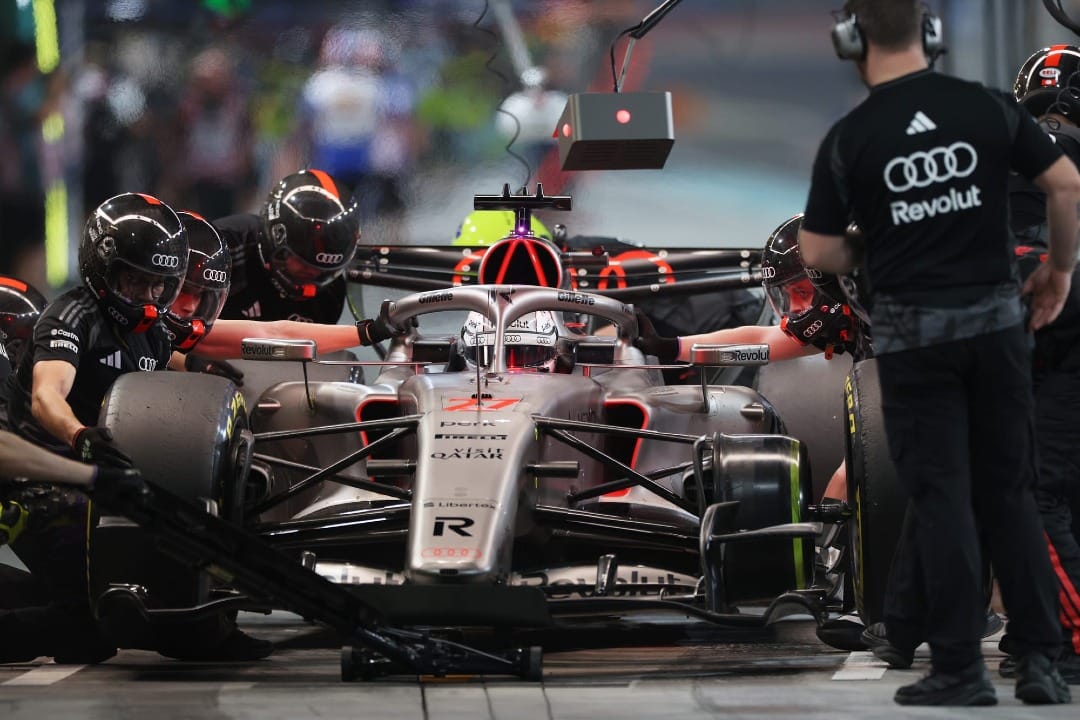
Audi did not enter Formula 1 to lobby its way to a level playing field.
That was never the plan. The plan was to arrive in a new technical era whose regulations had been written, in part, to accommodate a manufacturer like Audi. A compression ratio ceiling of 16:1, reduced from the previous 18:1. A cost cap on power unit development. A homologation framework designed to stop any single manufacturer running away with the championship in year one.
It made commercial sense. The risk was that it relied on rivals respecting the intent behind those rules.
They didn't.
Article C5.4.3 of the 2026 power unit regulations states that no cylinder may have a geometric compression ratio exceeding 16:1. It then specifies that measurements are taken at ambient temperature, with the engine stationary. What the regulation doesn't account for is conrod behaviour under thermal expansion at operating temperature. A manufacturer that selects materials with specific thermal properties can comply with the 16:1 limit in a cold, static check while running an effectively higher ratio out on track.
Mercedes is understood to have identified and exploited this gap. Simulation modelling shared within the paddock put the performance benefit at between 10 and 13 horsepower. That's worth 0.2 to 0.3 seconds per lap under 2026 conditions. Mercedes received written confirmation from the FIA that its power unit was fully legal under the existing protocol. That confirmation was accurate. Mercedes followed the measurement method precisely as it was defined.
Audi's response was to treat this as unacceptable.
James Key, Audi's technical director, set out the manufacturer's position at the team's car launch in January. 'No one wants to sit a season out if you've got a blatant advantage that you can do nothing with in a homologated power unit,' he said. Key argued from intent rather than letter. His position was simple: a hard limit is a hard limit, regardless of the conditions under which it is measured.
Audi assembled a coalition with Ferrari and Honda. The group pressed the FIA through the Power Unit Advisory Committee (PUAC) to introduce revised measurement criteria before the Australian Grand Prix. Red Bull-Ford, initially identified as a second manufacturer using similar conrod technology, switched position and joined the lobbying bloc.
The FIA ran a 10-day e-vote across all five manufacturers. All five voted for the compromise. The FIA World Motor Sport Council ratified the outcome on 28 February 2026.
The agreed solution runs in two stages. From 1 June 2026, the FIA will measure compression ratios under both hot and cold conditions. From 2027, measurements will be taken exclusively at the operating temperature of 130°C. The cold-state test disappears entirely.
This is a meaningful regulatory correction. It's also a concession that Mercedes accepted without apparent resistance, and that fact is worth sitting with.
Mercedes held a documented legal advantage, had it confirmed in writing, and then voted to remove it. That tells us one of two things. Either the thermal expansion benefit in the Mercedes power unit is smaller than rivals' estimates, making the concession relatively painless. Or Mercedes calculated that accepting a tighter standard now, before the season began and before any protest, was the cleaner path to protecting its long-term position. Both readings are plausible. Neither is flattering to the narrative that this was simply a rule clarification.
The FIA's decision to structure the change across two stages is telling in its own right. The dual measurement period from June through to the end of 2026 gives all manufacturers a defined window to understand exactly what they lose under the stricter standard. The Additional Development Upgrade Opportunities (ADUO) framework, the performance-balancing mechanism in the 2026 power unit rules, means that a manufacturer that falls behind the benchmark after round six in Miami can apply for additional homologation upgrades. A manufacturer that understands its compression ratio headroom loss before that window opens is in a materially better position to plan its upgrade path.
That's what the timeline is actually about. Not punishment. Planning.
The structural consequence for Audi is the one that matters most to RSR readers.
Audi entered Formula 1 as a direct beneficiary of the 2026 regulations. The reduced compression ratio limit existed partly to make the engine project viable. When a rival found a measurement gap that effectively restored the old ceiling, the entire premise of Audi's entry shifted. Its response, leading a governance campaign to close that gap before a single lap of the season had been run, confirms that the Ingolstadt programme will use political channels as a competitive tool when the engineering answer isn't available in time.
That instinct isn't inherently a weakness. Every manufacturer in Formula 1 lobbies. What distinguishes Audi's situation is the timing and the dependency. A more established programme might absorb a performance deficit in year one and close it through development. Audi, entering under a cost cap with a homologated engine and no prior competitive benchmark, couldn't afford to wait.
The compression ratio campaign wasn't politics for its own sake. It was risk management by a manufacturer that understood its business case required a specific regulatory floor, and moved quickly when that floor showed signs of giving way.
Sources: Motorsport.com, 28 February 2026. Motor Sport Magazine, February 2026. The Race, December 2025. PlanetF1.com, February 2026.