RSR Intelligence · Issue 008
Issue 008 examines Mercedes-AMG’s engineering-chain question, BMW’s multi-programme coherence, Porsche under regulatory pressure, and WEC’s new invisible-BoP regime.

Issue 008 · Thursday 23 April 2026
Editor’s note
Juha Miettinen, 66, died following a seven-car collision in the start phase of the first race of the ADAC 24h Nürburgring Qualifiers on Saturday 18 April. The race was red-flagged and abandoned. It is the first race fatality at the circuit since June 2013. Our condolences are with his family and those with whom he raced.
N24 Qualifiers
The Nürburgring Qualifiers weekend cannot be read as a normal final rehearsal for the 24-hour race. Saturday’s accident changed the register of the event. Race 1 did not resume. Race 2 ran on Sunday under standard Nürburgring Langstrecken-Serie procedure, with a minute’s silence and mourning ribbons on the grid.
Within that context, three RSR threads moved, but none were resolved.
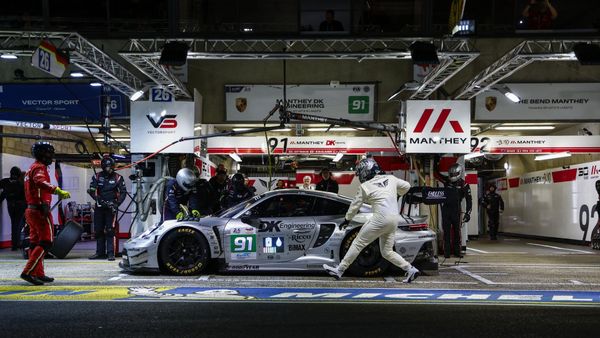
For the Porsche concentration thread, the important signal was not the podium itself. It was what Manthey said about it. Director of Racing Patrick Arkenau framed the result as one built partly on rivals’ mistakes. Thomas Preining said the team could not always match the pace of its competitors. That sharpens a pattern already visible elsewhere. Manthey remains operationally elite. It does not yet look unequivocally quickest.
For the BMW thread, the signal is platform depth. ROWE Racing, Schubert Motorsport and Gamota Racing all placed BMW M4 GT3 Evo entries in the top thirteen in conditions that did not obviously flatter the package. The Schubert BMW M3 Touring 24H also won SP-X. That is not headline material. It is healthier than headline material. It suggests customer depth across multiple operations.
For the Affalterbach succession thread, the Nordschleife evidence stays mixed. The Mercedes-AMG Team RAVENOL #80 finished fourth. The Mercedes-AMG Team Verstappen Racing #3 showed early speed, led on lap four, then dropped away after splitter damage. The hardware can clearly run at the front here. The question remains the same one Paul Ricard raised: whether the engineering chain behind the mature Mercedes-AMG GT3 Evo is consistently sharp enough to turn front-running potential into race-winning output.
That is as much as the weekend will bear. The next meaningful reading comes on 16 to 17 May at the 24 Hours of the Nürburgring itself.
Signal Note
Affalterbach’s opening weekend answers the wrong question
The Paul Ricard opener did not really answer whether Affalterbach Racing GmbH can still win races. It answered something narrower and more useful.
The Mercedes-AMG Team MANN-FILTER car took pole, controlled most of the race, and lost in the closing phase. The revealing point came from the drivers. Luca Stolz identified the issue in technical terms: as temperatures dropped, Mercedes-AMG struggled to bring the tyres into the optimal operating window. Fabian Schiller, in a separate Mercedes-AMG Team GetSpeed entry, named the same issue in the same post-race material. Two factory-supported operations. Same mechanism. That is not an anecdote. It is corroboration.
The comparative point matters. Aston Martin found a closing-race answer. Nicki Thiim described a deliberate setup direction tried during Prologue week. Mattia Drudi said the same direction paid off in qualifying and in the race. Aston Martin found a solution. Mercedes-AMG, across its three Pro Performance Team entries, did not.
That sharpens the thread. The Mercedes-AMG GT3 Evo is now a mature homologated chassis, and Stefan Wendl has already ruled out a 2026 replacement. The new Affalterbach subsidiary is not being asked to win through a new car. It is being asked to win through engineering support, setup direction, data interpretation, and customer-racing chain quality on a platform whose broad ceiling is already known. Paul Ricard says the opening question is not whether Mercedes-AMG still has race-winning machinery. It does. The opening question is whether the new engineering chain can still find race-winning answers inside a narrowing response window.
The first answer is: not yet.
That is not yet a full-season verdict. Wendl’s own public framing leaned instead on fleet reliability, all nine cars finishing, and a Bronze Cup recovery drive. That is a legitimate operational reading. It is also a different reading from the one his drivers were offering. They named the mechanism. The corporate line moved past it. That contrast is part of the evidence.
Brands Hatch will tell us very little because the sprint format rewards different things. Monza matters more. Spa matters most. If the same weakness reappears there, the thread changes from opening-season caution to a real succession diagnosis.
Signal Note
The 2026 rules you cannot read
The FIA and ACO have not merely altered the 2026 Hypercar Balance of Performance regime. They have altered what the public is allowed to know about it.
From Imola onward, BoP tables will not be published. Teams will know the figures. The public will not. Bruno Famin and Marek Nawarecki justified the move on two grounds: the underlying homologation parameters remain confidential, and the visible adjustments would be misleading without those private baselines. That is coherent as an administrative argument. It is also a clear move towards opacity.
The significance is larger than one technical bulletin.
Under the old regime, a reader could compare a race result against the regulatory starting point. If a manufacturer claimed progress, decline, or sudden convergence, the BoP table provided at least part of the check on that claim. Under the new regime, that check disappears from public view. The race classification remains visible. The regulatory context that shaped it does not.
That matters because Imola looked competitive. Toyota, Ferrari, Alpine, BMW and Cadillac all sat within a relatively compressed result picture. In previous seasons, that would have invited a second question: how much of that compression came from genuine manufacturer convergence, and how much came from pre-race regulatory adjustment? In 2026, the public cannot answer it.
The championship has therefore narrowed the analytical record on purpose.
That narrowing becomes clearer when set beside the abandoned Success Handicap idea. The series declined a transparent, visible balancing tool while simultaneously removing visibility from the one it retained. Those two choices are separate. Together, they describe a philosophy. The championship wants competitive management without public interpretive access to the variables doing the managing.
IMSA has chosen the opposite line. John Doonan said public BoP tables help tell the technical story of the class and made clear IMSA would not follow WEC automatically. So this is not an inevitable feature of modern top-class endurance racing. It is a specific WEC choice.
That is the editorial consequence.
RSR can still analyse race execution, reliability, stint quality, pit loss, and strategic control. What it cannot do, in the same way as before, is test manufacturer pace narratives against the public regulatory baseline. From this point on, the invisible-BoP regime becomes a standing constraint on coverage, not a passing complaint. Every serious WEC Hypercar reading in 2026 will have to declare what it cannot know.
Signal Note
BMW runs four programmes in one weekend
The simplest reading of BMW’s 17 to 19 April weekend is also the least useful one. Fifth and eleventh at Long Beach. Fifth and seventh overall at Imola. LMGT3 class win at Imola. Top-thirteen Nürburgring GT3 depth across multiple customer teams. That is a results list. The question is whether it adds up to anything more.
I think it does. It points toward operational coherence under structural load.
BMW M Motorsport ran relevant factory or factory-aligned programmes across IMSA, WEC Hypercar, WEC LMGT3, and the Nürburgring GT3 environment in the same weekend. That is not unique in a romantic sense. It is unusual in an analytical one. Multi-programme presence increases exposure to drift. Something, somewhere, usually slips. The striking feature of this weekend is that only one obvious BMW entry really did. The #25 at Long Beach had the bad race. One bad race in four active programmes is noise. Two starts to look like a pattern.
The Imola context makes the reading stronger. Robin Frijns had publicly said the day before the race that BMW did not yet fully understand the M Hybrid V8 and had not really been fighting at the front. Two days later, both Hypercars finished on the lead lap, with Frijns setting the field’s fourth-fastest race lap and BMW taking fifth and seventh in a tightly bunched result. That does not prove the programme is solved. It does suggest the 2026 Evo direction may be giving BMW a usable platform sooner than the pre-race mood implied.
The Nürburgring side matters too. ROWE, Schubert, and Gamota all had credible customer representation in difficult conditions. That is the kind of depth a manufacturer rarely gets credit for because it does not fit neatly into a podium graphic. It should. It says something about platform usability and programme support beyond the top-line works narrative.
This is where the thread sharpens.
BMW may be building the most coherent four-programme operating picture of the manufacturer's RSR tracks at the moment. Not the quickest everywhere. Not the cleanest in every single car. But the broadest live spread of credible output across championships, car types, and team structures.
That is not yet a verdict. It is a watch-brief. Spa, Le Mans, and the Nürburgring 24 Hours will tell us whether this coherence survives calendar compression. If it does, BMW’s 2026 season stops being a scattered set of decent results and starts to look like a case study in multi-programme delivery. If it does not, the mode of failure will tell us far more than any one podium ever could.
Signal Note
Porsche concentration checked, not broken
Long Beach did not end the Porsche concentration thesis. It tested its ceiling.
In 2025, Porsche Penske Motorsport turned Long Beach into an expression of programme control with a one-two finish. In 2026, IMSA pushed back hard. The factory Porsche 963s carried a 45-kilogram increase to the 1,100-kilogram GTP maximum, widely described as the largest single weight increase applied to an LMDh-era front-running prototype. The regulator had acted visibly and at scale.
The result is what matters. Porsche did not win. The #93 Acura Meyer Shank Racing car did, with Cadillac second. But Porsche still put three 963s in the top six. Both factory cars finished ahead of the lighter JDC-Miller customer 963 that carried only a 5-kilogram adjustment. That last point matters most. If the customer car sat 40 kilograms lighter and still finished behind both factory entries, the residual advantage in the Porsche programme is not reducible to a simple weight number. Some of it still sits in engineering chain quality, operational execution, and programme concentration.
So the thread changes, but only slightly.
This is no longer unconstrained concentration. It is concentration under visible regulatory counter-pressure. Porsche remains near the front, remains structurally difficult to dislodge, and remains capable of carrying a ceiling-level intervention without collapsing into the midfield. That is a weaker expression of dominance than 2025. It is still an expression of system strength.
The useful word here is not stopped. It is throttled.
That distinction matters because the concentration thesis was never that Porsche would win every race untouched. It was that Porsche had built the strongest cross-series, cross-team, cross-operational concentration of top-level endurance capability among the German manufacturers. Long Beach does not break that. It shows the regulator can slow it. That is different.
The stronger check on the thesis now comes elsewhere. At the Nürburgring, Manthey again looked elite operationally while still publicly conceding a pace deficit. That begins to split the concentration thread into two sub-questions: whether Porsche remains the best concentrated programme overall, and whether one of its most important concentrated assets, the Manthey Nordschleife arm, is now leaning more on execution than raw speed. That is a better question than did Porsche win Long Beach, and a more durable one.
For now, the thesis stands. Narrower than before. Still standing.
Reading the next fortnight
The spring evidence chain continues over the next ten days.
IMSA returns at Laguna Seca on 3 May. This is the next scheduled reading for the Porsche concentration thread. The important signal is regulatory. Whether IMSA sustains, reduces, or increases the 45-kilogram ceiling applied at Long Beach will tell us whether the regulator regards that intervention as sufficient. Three Porsche 963s finishing third, fourth and sixth under maximum constraint may or may not satisfy that test. Laguna Seca will tell us.
GT World Challenge Europe moves to Brands Hatch on 2 to 3 May for the Sprint Cup opener. Sprint format produces a different data set from Paul Ricard. Qualifying pace and first-lap execution matter more. Race management matters less. The Affalterbach thread’s cold-condition tyre-window finding does not transfer cleanly across formats, so Brands Hatch is not the place for a verdict. It is the place for an early read on whether the MANN-FILTER and GetSpeed Performance Teams are competitive across format types, and whether the Comtoyou Aston Martin pace repeats under different conditions. RSR will be trackside.
FIA World Endurance Championship resumes at Spa-Francorchamps on 9 May for the TotalEnergies 6 Hours of Spa. This is the BMW thread’s next like-for-like Hypercar measurement, and the second race under the invisible-BoP regime. The open question is straightforward. Did Robin Frijns and BMW show a new baseline at Imola, or one strong weekend under conditions that flattered the programme? Spa will start to answer it.
Issue 009 publishes on 7 May, between Brands Hatch and the Nürburgring.