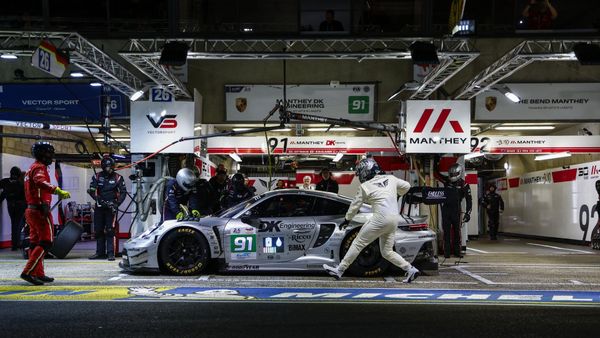
What Paul Ricard exposed about the German GT3 programmes
Paul Ricard data refined. Mercedes-AMG tyre finding holds at one circuit. BMW programme correction issued. Porsche customers collided with each other.

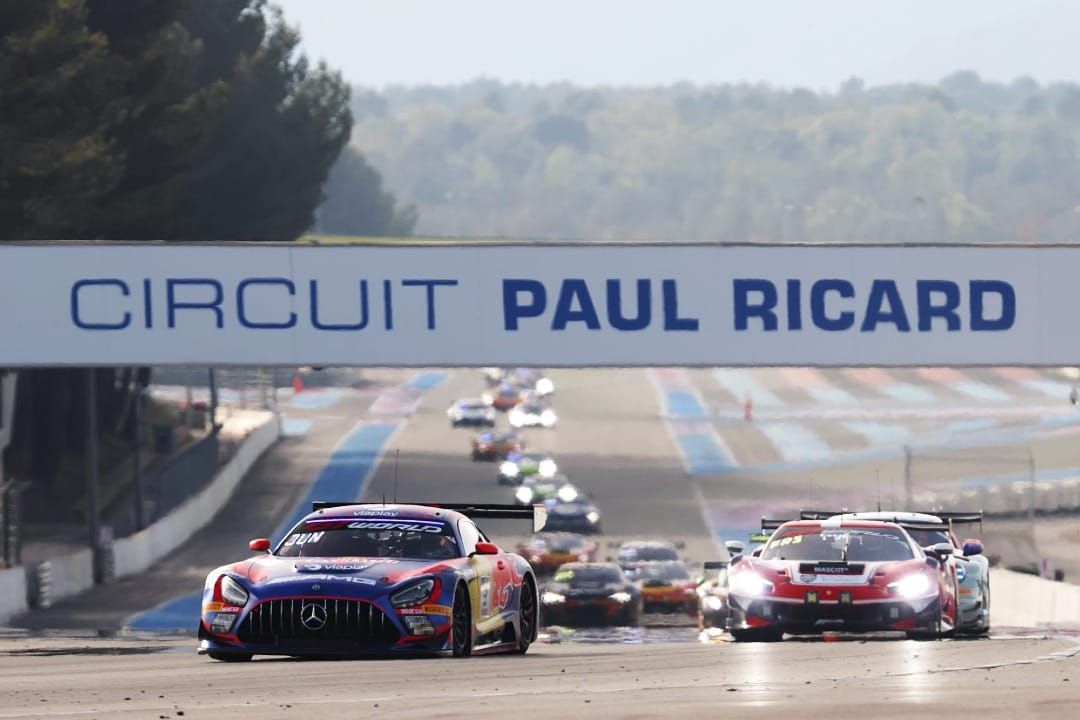
The Signal Note identified a Mercedes-AMG tyre vulnerability. Deeper scrutiny reveals a more complex picture: BMW's programme is broader than RSR described, Porsche's customer network collided with itself, and the tyre question may be narrower than it first appeared.
The Signal Note published on 12 April argued that Mercedes-AMG's known tyre warm-up limitation decided the Paul Ricard opener. Five days of additional source work, cross-referencing, and adversarial review have refined that reading in three places. One finding stands. One requires correction. One separates into two distinct issues that the Signal Note incorrectly grouped together.
The Mercedes-AMG tyre vulnerability holds, but its scope is narrower than the Signal Note implied
The Signal Note reported that Luca Stolz and Fabian Schiller independently confirmed a tyre warm-up limitation under cooler conditions. That finding stands. Stolz said the team anticipated difficulty as temperatures dropped. Schiller identified the same issue as recurring at this circuit. Two drivers, two teams, the same technical complaint.
What the Signal Note also did was link Valentino Rossi's tyre grip complaint in the number 46 BMW to the Mercedes-AMG finding, suggesting both might reflect a circuit-wide characteristic. Cross-referencing against the race message list and Rossi's own testimony shows this connection does not hold. Rossi's grip problem occurred during his second stint, around the three-hour mark, approximately 21:00 local time. The Mercedes-AMG drivers experienced tyre difficulties "towards the end of the race," hours 5 and 6, approaching midnight. Track temperature dropped from 33.6 degrees at the start to 18.0 degrees by the finish. The two complaints were separated by approximately two to three hours under materially different thermal conditions. They should be treated as separate issues until a second data point connects them.
Pirelli's pre-race documentation described the P Zero DHG slick compound as providing "a wider working range, faster warm-up and greater consistency of car balance over long distances" with no temperature-specific qualifications. The gap between this specification and the on-track behaviour reported by two Mercedes-AMG drivers is itself a finding. Either the compound's thermal window is narrower than the manufacturer's description suggests, or the Mercedes-AMG GT3 EVO's chassis characteristics create thermal demands that fall outside the tyre's operating range in specific low-temperature conditions. Both readings are plausible from the available evidence. Neither is provable without telemetry.
The next test is the next Endurance Cup round, not the Brands Hatch Sprint Cup on 2 to 3 May. A one-hour sprint does not replicate the six-hour thermal cycle that exposed the vulnerability. If the same pattern appears at a second endurance venue with different surface and ambient conditions, the diagnosis upgrades from circuit-specific to chassis-level.
Correction and consequence: BMW operates a two-team factory model
RSR's Paul Ricard preview (4 April 2026) described BMW's European GT programme as running entirely through Team WRT with no second factory-supported team. BMW M Motorsport announced the actual structure on 24 February 2026: Andreas Roos, Head of BMW M Motorsport, named both WRT and ROWE Racing as factory-supported operations fielding twelve works drivers across four Endurance Cup entries. This information was available when the preview was written. RSR corrects the record. A full correction notice appears at the foot of this piece.
What matters more than the correction is what the two-team structure revealed at Paul Ricard. WRT's Car 32 started 10th and finished fourth. ROWE's Car 98 started 22nd and finished sixth. Both teams independently confirmed the same competitive ceiling. Kelvin van der Linde said the cars at the front were too fast. Augusto Farfus said ROWE did not have the package to fight for the podium. Vincent Vosse characterised P4 as the optimum. Two separate engineering environments, two separate qualifying sessions, two separate race strategies, and the same conclusion: fourth was the maximum.
That convergence is the structural signal. If only one team had reported a pace deficit, the explanation could be team-specific: setup, strategy, driver management. When two factory-supported teams with different engineering staffs and starting positions reach the same ceiling, the limitation is more likely chassis-level or BoP-imposed. The data cannot distinguish between these two causes, because RSR does not hold itemised BoP ballast figures for the BMW M4 GT3 EVO at Paul Ricard. But it can rule out team-level explanations, which is itself analytically useful.
ROWE Racing's role extends beyond the Pro entry. The Car 998 Gold Cup programme, built around a formal mentoring project pairing experienced works driver Jens Klingmann with newcomers Ugo de Wilde and Tim Tramnitz, finished P10 overall and P3 in the Gold Cup. Hans-Peter Naundorf described the primary goal as "the targeted further development of our drivers." This is not a car entered purely for results. It is a works driver development pipeline embedded inside a competitive season. That pipeline feeds future WRT and ROWE Pro entries and represents a programme investment that the preview's single-team framing entirely missed.
Farfus named Monza as the next target. If either WRT or ROWE challenges for the podium there under different BoP parameters, the pace-ceiling reading weakens.
Porsche's customer network collided with itself
At Turn 7 on the opening lap, Cars 89 (Lionspeed GP), 2 (Boutsen VDS), and 914 (Razoon) collided. Race control initially logged the incident as involving only Cars 89 and 2 and penalised Car 89 with a drive-through for causing a collision at race time 1:03:42. Car 914 was not added to the investigation until race time 2:06:14, more than an hour later, and received its own drive-through at 2:06:53. The delayed investigation suggests the stewards required additional video review to establish Car 914's role, which means the two penalties reflect different levels of culpability.
Car 2 was subsequently penalised for a separate pit stop infringement: a 105-second converted stop-and-go penalty (Stewards Decision 128). This is an operational process failure distinct from the Lap 1 contact. Car 80, the fourth Porsche entry to encounter difficulties, retired after 95 laps. The broadcast attributed the failure to a steering issue. Lionspeed GP has not confirmed the cause.
Three Porsche customer entries hitting each other on the first lap is not the same diagnostic signal as three entries accumulating unrelated penalties across a six-hour race. The Lap 1 collision raises a specific question about pre-race coordination between Porsche customer teams on opening-lap positioning. The pit stop infringement raises a separate question about Boutsen VDS's operational preparation. These may share a common root (insufficient manufacturer-level oversight of the European customer network) or be entirely independent. One race cannot distinguish between these explanations.
The contrast with Porsche's IMSA programme remains visible. At Sebring, the factory-concentrated Manthey operation won GTD Pro on its debut. RSR's Sebring Deep Interpretation described the concentration thesis as "operational." That verdict language was premature. Two IMSA races do not meet the evidence threshold for a verdict under RSR's confidence controls. The thesis is re-labelled here as a high-confidence diagnosis. Watkins Glen in June remains the next IMSA falsifier.
For Europe, the specific falsifier is the next round of the Endurance Cup. If Porsche's Pro-class customer entries (Boutsen VDS and any Lionspeed replacement or continuation entry) complete the race without contact-related or pit stop infringement penalties, the operational-quality diagnosis weakens to a single-event observation. If Porsche customer entries are again involved in inter-programme contact on the opening lap, the coordination question upgrades from a question to a pattern.
Audi: insufficient data for a structural reading
Eastalent Racing's Car 84 finished P15, one lap down. Tresor Attempto Racing's Car 99 retired after 116 laps. Car 88 received a 75-second track limits penalty. No post-race statement from any Audi customer team has addressed the outcome of the race. The data does not support a structural claim about Audi's European GT3 programme at this stage. RSR will revisit if Audi entries produce a readable signal at a subsequent round.
This piece commits to four positions.
First, the Mercedes-AMG tyre warm-up limitation at Paul Ricard is a confirmed, circuit-anchored finding. Rossi's tyre complaint is a separate issue that occurred under different conditions and should not be grouped with it.
Second, BMW's European GT programme operates through two factory-supported teams. The pace ceiling confirmed independently by both teams points to a chassis-level or BoP-level constraint. The next test is Monza.
Third, Porsche's European customer network produced a Lap 1 inter-programme collision and a separate pit stop infringement by a fourth entry. The coordination question and the operational-quality question are distinct. The next endurance round tests both, but they require different evidence to resolve.
Fourth, Audi's European presence at Paul Ricard produced insufficient data for any structural reading.
Correction notice
RSR's Paul Ricard preview (4 April 2026) stated that BMW's GTWC Europe programme was run entirely through Team WRT with no second factory-supported team. BMW M Motorsport's pre-season announcement (24 February 2026) named both Team WRT and ROWE Racing as factory-supported operations fielding twelve works drivers. The preview contradicted this primary source. RSR corrects the record.
Researched and analysed with Claude