BMW won Spa, not the argument
BMW M Team WRT proved execution at Spa. It did not prove that BMW now owns Hypercar before Le Mans.

There are results that answer a question.
Spa did not.
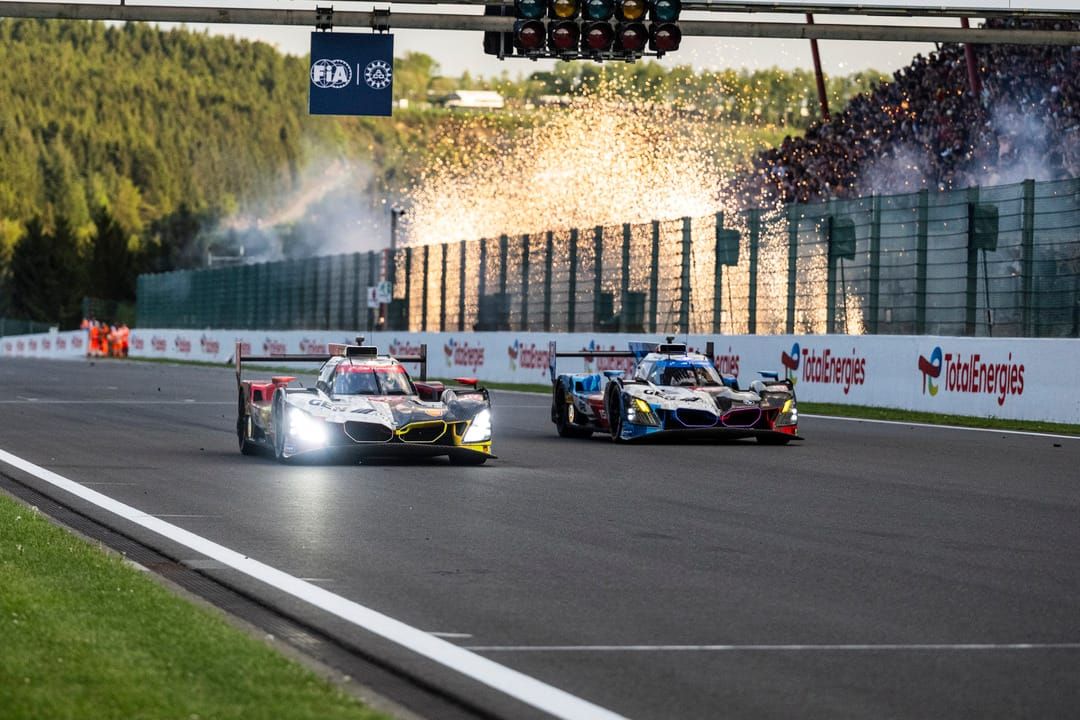
It gave BMW M Team WRT a one-two in the 2026 TotalEnergies 6 Hours of Spa-Francorchamps, and the first overall FIA World Endurance Championship (WEC) victory for BMW M Motorsport since it entered the championship in 2024. Robin Frijns, René Rast and Sheldon van der Linde won in the #20 BMW M Hybrid V8. Kevin Magnussen, Raffaele Marciello and Dries Vanthoor followed in the #15 car.
That matters. It should not be softened.
The selected post-race Hypercars passed technical checks, so no legality cloud sits over the result. The official classification put the top five within 6.015s after six hours: BMW, BMW, Ferrari AF Corse, Aston Martin THOR Team and Toyota Racing.
That matters too.
BMW did not leave Spa with a simple performance verdict. It left with something narrower, but perhaps more useful: proof that Team WRT can turn a messy Hypercar race into a win.
That is not the same thing as owning the order.
Behind BMW’s one-two sat a Ferrari close enough to keep the verdict open, an Aston Martin close enough to make the Valkyrie credible, a Toyota result that looked better once explained but still left work to do, a Peugeot pole that never became a full race answer, and an Alpine weekend that proved speed and frailty in the same afternoon.
This was not a race that crowned a new benchmark.
It was a race that showed who could survive the mess, read the timing and commit when the pit wall had no clean answer.
BMW did that best.
What BMW actually proved
BMW’s Spa victory should not be talked down. That would be lazy scepticism.
The #20 did not inherit a win from a collapsing field. WRT put it into the race through strategy, the car worked when it had clear air, and the #15 turned BMW’s good race into a result with depth. One car winning can still leave room for chance. Two cars at the front asks a harder question of the field.
BMW’s own account gives us the useful version, once the celebration is stripped away. The two BMW Hypercars started only 10th and 11th after a poor qualifying session. The #20 sat in traffic early. WRT used a shorter first stop to move Rast forward. Once the car ran in clear air, BMW says it could set quick laps and pull away.
That is not nothing.
It suggests the 2026 BMW M Hybrid V8 has made the step BMW needed most: not a one-lap leap, but a race-phase step strong enough for WRT’s strategy to matter. Andreas Roos linked the result to a car made more consistent for 2026. Rast said the team still lacked qualifying pace, then credited the strategy for bringing him to the front.
The weakness and the strength sit next to each other. That is what makes the result useful.
BMW did not control Spa from the first lap. It found a way to stop the first lap defining the day.
The #15 mattered just as much. Magnussen moved the car forward early, and later held second under pressure from Antonio Fuoco in the #50 Ferrari 499P. We should avoid the tidy “rear gunner” line unless WRT says that was the plan. But the effect was plain enough. The second BMW sat between the Ferrari and the winning #20 when it mattered.
This is what operational maturity looks like. Not dominance. A full race made from partial advantages.
The luck problem
The obvious counterargument is that BMW caught the race at the right time.
That counterargument is fair.
Van der Linde said the #20 strategy carried risk. Marciello admitted the #15 was “a bit lucky” with a Virtual Safety Car. When a team wins from 10th and 11th after a race shaped by neutralisations, tyre age, offset fuel cycles and mixed-class incidents, the cleanest reading is not raw pace.
But luck is too blunt a word on its own. It hides the work.
A neutralisation can only help a car that the team has placed in the right window. A strategy gamble can only pay when the car has enough race pace to make the position worth keeping. A late restart can only become a one-two if the drivers hold the line when Ferrari, Aston Martin and Toyota are close enough to punish one mistake.
Spa did not hand BMW a result. It gave BMW a race state that WRT converted better than most.
That distinction matters before the 24 Hours of Le Mans. Le Mans rarely rewards the fastest clean lap in isolation. It rewards cars and teams that keep finding their way through an ugly race.
Spa was ugly enough to make the point.
Ferrari kept BMW honest
Ferrari prevents any clean BMW hierarchy claim.
The #50 Ferrari finished third, 2.622s behind the winning BMW. That is too close to dismiss. It does not prove Ferrari had the stronger car, but it does prove BMW did not beat Ferrari into irrelevance.
Fuoco’s car stayed close enough to make the final classification uncomfortable for anyone trying to turn Spa into a blunt performance table.
The #51 Ferrari also retired, leaving another unanswered question. We know the classification. We do not yet have the cleanest public measure of how much that car still had to give in the final hour. The risk is obvious: overclaiming Ferrari’s lost result from a car that was no longer there.
So keep it simple.
Ferrari did enough to keep BMW honest. It did not do enough to stop BMW winning.
That is precisely why Spa refuses to settle the order.
Toyota made BMW’s win look more earned
Toyota was the missing piece. It no longer is.
Before Spa, Toyota had momentum. It had won the 2026 opener at Imola with the #8 Toyota TR010 Hybrid, with the #7 third. It also treated Spa as a final chance to prepare cars and operations before Le Mans.
The result was fifth and 10th.
That sounds underwhelming until the mechanics are separated. The #7 started 12th, stayed outside the top ten early, then moved forward through incidents, overtaking and the late race reset. Kamui Kobayashi ended fifth, only 6.015s from the winning BMW.
The #8 is the sharper point. Toyota says Sébastien Buemi, Brendon Hartley and Ryō Hirakawa used an alternative strategy early, with a short first stop helping Hartley move into second. The car held that place for long periods before a pit stop issue meant it was not fully refuelled. An extra stop dropped it out of the top ten before the final Safety Car.
That changes the reading.
Toyota did not simply lack answers. It had one car on a credible podium route, then lost the result due to an execution problem. The #7 salvaged points, but Mike Conway still said the car “just didn’t have the pace”.
That makes BMW’s result more convincing, not less. Toyota found a route into the race and failed to convert it. BMW found a route and finished one-two.
That is the difference Spa exposed.
Not a crisis for Toyota.
Not reassurance either.
Alpine showed the same lesson more brutally
If Toyota gave us discomfort, Alpine Endurance Team gave us the split personality of Spa in its purest form.
The Alpine A424 was quick. Charles Milesi qualified the #35 third, only 0.078s from pole, and the #36 joined it on the second row. In race trim, Alpine says António Félix da Costa used clear track to build a lead of nearly 20 seconds before handing the #35 back to Milesi.
That is real evidence. It should not be waved away because the result went bad.
The race then folded back on Alpine. A Safety Car bunched the field. Milesi lost places after being delayed by a backmarker at the restart. The #36 had to manage energy, then later lost out when a Virtual Safety Car arrived at the wrong time. The final sprint shrank to 24 minutes. Da Costa restarted fifth and then made the cold-tyre mistake at Raidillon that ended Alpine’s front-order argument. He accepted responsibility.
Alpine finished 11th and 12th.
That result tells one story. The weekend tells another.
Alpine had enough pace to matter. It did not have enough race control to turn that pace into a result. That is not the same as failure, but it is the difference between being part of the race and shaping it.
BMW shaped it.
Alpine could not hold it.
Le Mans will punish that difference for 24 hours.
Peugeot made the case, then lost the sample
Peugeot TotalEnergies remains the most obvious incomplete case, but the evidence is stronger than a one-lap pole story.
The #94 Peugeot 9X8 took the car’s first FIA WEC pole, and Peugeot says it remained in contention for a strong result before the GT3 incident ended its race. Loïc Duval described a positive opening phase, with the car about four seconds from the leader, while Théo Pourchaire said the #94 was still inside the top five with two hours remaining. Malthe Jakobsen then met the spinning GT car at Turn 5 while on cold tyres on his out-lap and had no way to avoid the impact.
The #93 finished seventh, but Stoffel Vandoorne set the fastest race lap late on. Peugeot also left Spa with its first championship points of the season.
That combination matters before Le Mans.
Peugeot showed pole speed, race phases and late-condition pace. It still left Spa with only seventh place and one retired car.
That is the Peugeot problem in one race: the signal is real, but the result remains incomplete.
BMW’s signal is less ambiguous because BMW converted. Peugeot still needs to.
Aston Martin became a serious variable
The most useful counterweight to BMW may not be Ferrari, Toyota or Peugeot.
It may be Aston Martin.
The #007 Aston Martin Valkyrie of Harry Tincknell and Tom Gamble finished fourth, five seconds behind the winner. Aston Martin called it Valkyrie’s best WEC result. Both Valkyries also reached Hyperpole, starting sixth and seventh.
The release is valuable because it does not pretend that the race was clean. Aston Martin says a timely Safety Car helped the #007 align its fuel strategy with the field. Gamble said late Safety Cars changed the race. The #009 car, shared by Marco Sørensen and Alex Riberas, ran strongly before its own late retirement.
Tincknell’s line is the one that stays with me: the Valkyrie was not always very fast, but had phases when it was.
That sounds like Spa. It sounds like the whole Hypercar field.
Aston Martin also made the Le Mans link more concrete. Tincknell pointed to strength in sectors one and three, the parts of Spa he saw as closest to Circuit de la Sarthe. That is team framing, not neutral proof, but it is still useful. Aston Martin now looks less like an experimental presence and more like a variable.
Not a favourite.
A variable.
And that makes BMW’s result harder, not easier, to explain away. A fourth-place Aston, five seconds from the winner, shows the field was close. BMW still put two cars ahead of it.
The open files still matter
Spa left two strands underdeveloped.
The first is Cadillac Hertz Team JOTA. The #12 Cadillac V-Series.R finished ninth. The #38 retired. Specialist reporting points towards penalty, tyre degradation and early contact as part of the story, but without a Cadillac or JOTA post-race explanation, the honest conclusion is restraint: Spa tells us Cadillac was present in the race’s early argument, not why it disappeared from the final one.
The second is Genesis Magma Racing. The #17 Genesis GMR-001 Hypercar finished eighth and scored the programme’s first WEC points in only its second start. Genesis says it managed power and energy issues, then used an aggressive late strategy call to give Pipo Derani track position. Derani held the place against cars on newer tyres.
That does not prove front-order pace. It proves something more modest and perhaps more useful for a young programme: the car and team can stay alive long enough to take what the race offers.
Both cases feed the same reading. Spa was not short of pace claims. It was short of clean proof.
BMW supplied the cleanest result.
What Le Mans should take from Spa
Spa’s role before Le Mans mattered before the cars even left the pit lane.
Toyota, Aston Martin and Alpine all framed Spa as Le Mans preparation, not just another six-hour stop on the calendar. Toyota described Spa as a final chance to prepare cars and operations before Le Mans, Aston Martin called it a final high-speed data point, and Alpine called it a representative test of the A424 and Michelin tyre work.
That is why the race matters beyond the result.
The wrong lesson would be to place BMW at the top of a clean new order. Spa does not support that. The result leaned too heavily on strategy timing, neutralisations and interrupted evidence from rivals.
The other wrong lesson would be to call the win a fluke. Spa does not support that either. BMW had to get both cars home at the front. WRT had to commit to the strategy early, then manage the consequences. The #15 had to hold Ferrari. The #20 had to finish the job.
BMW won the race Spa became.
That is the honest reading.
It is also enough.
The fog remains
Le Mans does not need Spa to name a favourite. It needs Spa to tell us which claims deserve respect.
BMW’s claim now deserves more respect than it did before Spa. WRT has shown it can win a live Hypercar race, not just discuss progress. The M Hybrid V8 has shown enough race-phase strength for its strategy to matter. That changes the tone of BMW’s season.
But Le Mans remains open because Spa left too many loose ends.
Ferrari was close. Aston Martin was closer than expected. Peugeot was fast before the race stopped answering. Toyota explained its disappointment, but not away. Alpine proved it had pace and showed why pace was not enough. Cadillac still needs a clearer account. Genesis has already stopped looking like a placeholder.
Spa did not clear the fog.
It showed who could drive through it.
Disclosure: Research and draft support from AI tools; editorial judgement and final publication decisions remain with the Rennsport Report.