Why German manufacturers still need the Nürburgring
The Nürburgring 24 Hours lets BMW, Porsche, Mercedes-AMG and Volkswagen prove different kinds of credibility on the same road.

Volkswagen does not need to win the 2026 ADAC RAVENOL 24h Nürburgring for its weekend to work.
That is the point.
The brand arrives at the Nürburgring Nordschleife with three Golf GTI Clubsport 24h entries, the first electric ID. Polo GTI, a Golf R 24H show car aimed at a possible 2027 race programme, and a 50th GTI anniversary story wrapped around the whole thing. Some of this is racing. Some of it is product theatre. Some of it is Volkswagen trying to make combustion heritage and electric performance share the same piece of ground.
The ground matters.
There are cleaner places to launch a car. There are easier places to build a brand weekend. There are cheaper ways to remind people that GTI still means something. At the Nürburgring, those claims carry more weight because the place still asks something of the car, the team and the badge.
That is why the race still matters to German manufacturers.
It does not ask them all to prove the same thing.
The race is not one argument
The 2026 Nürburgring 24 Hours has a 161-car entry list, the largest since 2014. That scale is not trivia. It is the structure of the event.
At the front sits the fight for overall victory. SP9, the class for Grand Touring 3 (GT3) cars, carries the main manufacturer contest, with nine GT3 brands and more than 40 cars in the top class. The organiser also counts 49 cars across SP9, SP-Pro, SP-X and AT1 for top qualifying.
That distinction matters.
The Nürburgring’s front group is not a single clean category. It is a set of linked arguments: GT3 cars, special projects, modified machinery and alternative-fuel entries all trying to force their way into the same qualifying conversation.
Then the field keeps going.
There are 22 further classes, from SP10 GT4 cars to Porsche Cup machinery, TCR entries, production-based classes and one-make categories. That depth is not background colour. It is the reason the Nürburgring can do something most major endurance races cannot.
It can hold several manufacturer stories at once.
BMW, Porsche and Mercedes-AMG can use SP9 to fight for GT3 authority. Volkswagen can use SP3T and SP4T to connect GTI heritage, race preparation, renewable-fuel messaging and a future Golf R signal. HWA Engineering Speed can use SP-X to turn Mercedes-Benz history into a live special project car. Tyre brands can use the same weekend to build data, not just banners.
Messy? Yes.
But useful.
SP9 is still the factory war
The hard end of the race remains SP9.
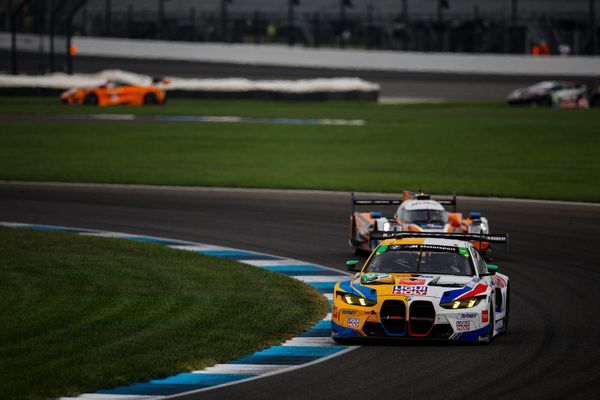
BMW M Motorsport brings three BMW M4 GT3 EVO entries. ROWE Racing returns with two cars, including the defending structure from BMW’s 2025 overall win. Schubert Motorsport adds the third BMW, running the #77 M4 GT3 EVO on Yokohama tyres rather than following ROWE’s Michelin path.
That split matters.
It gives BMW two readings of the same race: continuity through ROWE, and a different tyre and data path through Schubert. The manufacturer is not simply throwing three cars at the Nordschleife and hoping one survives. It is testing depth. Team depth, driver depth, tyre depth, operating depth.
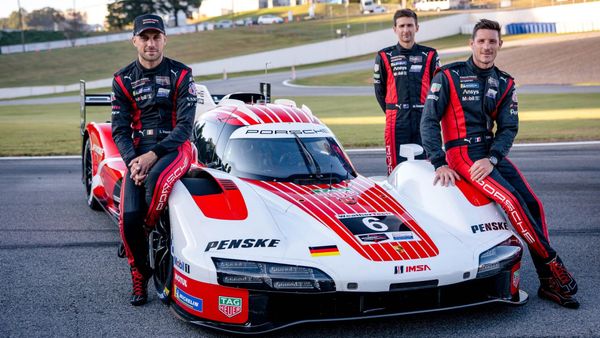
Porsche’s SP9 story has a different shape. Manthey Racing GmbH enters the #911 Porsche 911 GT3 R with Kévin Estre, Ayhancan Güven and Thomas Preining. It is a familiar line-up in a familiar car, in the team’s anniversary year, under the pressure that always follows Manthey at its home race.
Few GT3 teams carry the Nürburgring in the same way. Manthey’s presence is not just another Porsche entry. It is Porsche’s clearest link between factory-grade GT racing, Nordschleife identity and the knowledge that builds only when a team lives beside the place it is trying to beat.
Mercedes-AMG brings the attention spike.
Mercedes-AMG Team Verstappen Racing enters the #3 Mercedes-AMG GT3 with Max Verstappen, Lucas Auer, Jules Gounon and Daniel Juncadella. The name will drag the cameras with it. That part is unavoidable.
The mistake would be to treat Verstappen as the whole AMG story.
The entry list also includes Mercedes-AMG Team RAVENOL with Maro Engel, Luca Stolz, Fabian Schiller and Maxime Martin. That gives AMG more than one serious SP9 strand. Verstappen brings Formula 1-level attention, but AMG’s Nürburgring case rests on a wider GT3 structure.
SP9 does not prove which manufacturer builds the best road car. That claim would be too clean and wrong.
GT3 cars are specialised racing tools. Balance of Performance, or BoP, shapes the contest through weight, power, fuel and other controls. Modern Nürburgring authority is not raw speed in isolation.
It is the art of making a GT3 car live at the edge of its window for 24 hours.
That means traffic judgement. Tyre use. Pit work. Driver judgement. Set up range. Night discipline. Weather calls. Damage control. The circuit still punishes weak systems, even when BoP keeps the cars close.
This is why the race still has force.
A car can be quick at the Nürburgring and still not be ready for the Nürburgring.
BMW’s split makes the point
The most useful BMW detail is not the number of M4 GT3 EVOs. It is the split between them.
ROWE gives BMW its established route: defending-winner structure, Michelin continuity, experienced works drivers and a clear overall-victory target.
Schubert gives BMW the sharper question.
The #77 BMW M4 GT3 EVO runs on Yokohama tyres, and Schubert already gave that thread a result before the 24-hour race by winning an ADAC Nürburgring Langstrecken-Serie (NLS) preparation round. The result itself matters less than the language around it. The team talked about finding the Yokohama tyre’s operating window across all conditions and gathering data for the 24-hour race.
That is the Nürburgring in miniature.
It is not just a lap time. It is a search for a working range.
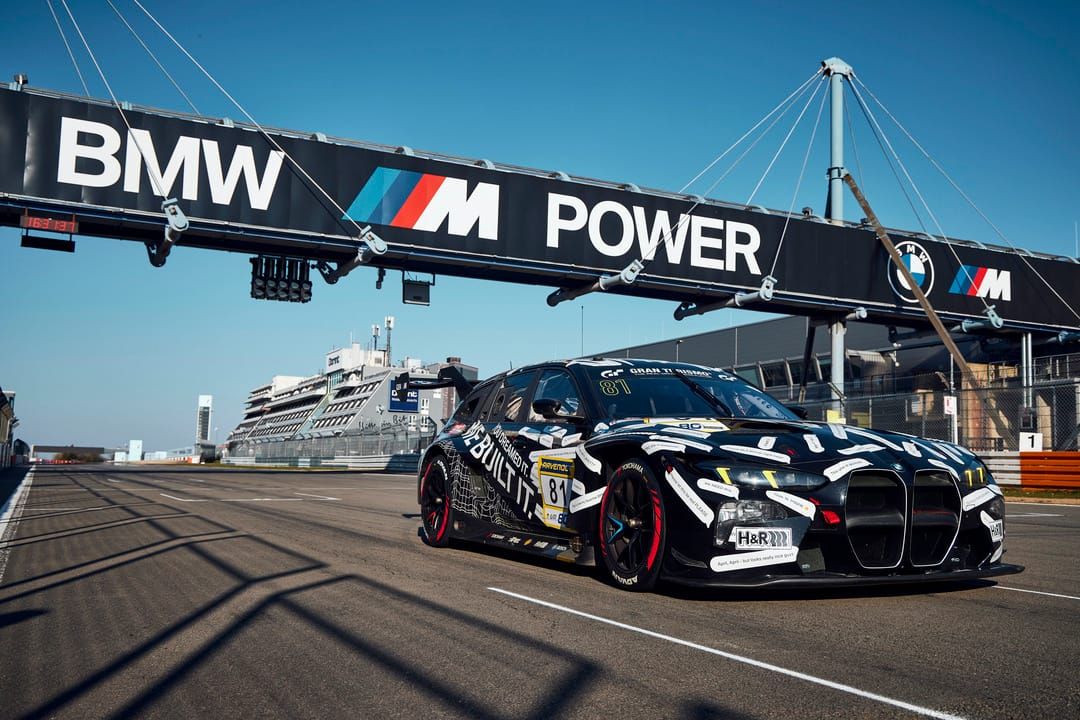
BMW’s M3 Touring 24H pushes the same point from another angle. The car runs in SP-X as a pure BMW M Motorsport works entry, with Schubert acting as the race team. It uses the same technical base as the BMW M4 GT3 EVO, but carries the body shell and shape of the BMW M3 Touring road car.
That matters because the car began as fan service and then became engineering work.
BMW’s own material traces the project from an April Fool’s social media post to a real race car. The response was large enough to push an existing idea into a concrete plan. BMW then built the car in eight months.
It would be easy to laugh at that. It would also miss the point.
The M3 Touring 24H is not a normal GT3 car in estate bodywork, and it is not just a joke made real. It is a works project that asks how far a road car silhouette can be pushed towards GT3 function.
The Touring shape created real problems: more drag, less rear-wing authority and a forward shift in aerodynamic balance. BMW’s answer was to move the rear wing 200mm rearwards and 32mm upwards, improve airflow across the roof, reduce rear lift and restore the balance towards M4 GT3 EVO levels.
That is why the car belongs in this article.
The road car silhouette is not decoration. It is the problem BMW chose to solve.
This is where the Nürburgring does something Le Mans cannot. A Touring-shaped race car can sit on the same weekend as a full GT3 factory fight without either story cancelling the other. One chases the overall result. The other asks whether a road-car idea can carry real racing substance rather than live as a paddock display.
There is fan service in the M3 Touring 24H. Of course there is.
But fan service is not automatically empty. At the Nürburgring, the car still has to run through traffic, over kerbs, into dusk, through temperature change, and back again. If it fails, the circuit will not soften the message.
BMW has built its Nürburgring programme around that split.
Porsche still has deep Nürburgring weight
Porsche does not need to explain why it is at the Nürburgring. That is part of the advantage.
The brand’s 2026 presence stretches from Manthey’s #911 GT3 R in SP9 to customer Porsche entries across the field and specialist cars outside the headline class. The Dunlop Motorsport #17 Porsche 911 GT3 R and Falken Motorsports #44 Porsche 911 GT3 R add another layer: Porsche GT3 strength is not only a works-backed question. It runs through tyre-backed teams, customer structures and preparation programmes that use the Nordschleife as more than a race venue.
Manthey gives the brand a sharp point. The wider Porsche field gives it mass. The Cup classes and modified entries give it depth.
The #992 Manthey Team eFuel Griesemann Porsche 911 GT3 Cup MR in SP-Pro adds a different argument again. It is not part of the SP9 fight, but it keeps Porsche inside the race’s special-project and alternative-fuel frame.
That is where Porsche still seems inseparable from the event itself.
At the Nürburgring, Porsche’s GT identity needs little translation. You can see the structure in the entry list: factory-linked sharp end, customer depth, Cup machinery, tyre-backed entries, and Manthey at the centre of the story.
Porsche does not need to say the Nürburgring matters.
Its presence says enough.
Volkswagen is the useful contradiction
Volkswagen is the section that needs the most care.
It would be easy to overstate this as a motorsport return. It is not that, at least not yet.
The three Golf GTI Clubsport 24h entries are real race cars. The #10 car is listed in SP3T, while the #50 and #76 cars sit in SP4T. All three carry an “AT” designation in the entry list. Volkswagen’s own material separately says the cars run on E20 fuel made from 60% renewable raw materials.
That gives the programme substance.
But Volkswagen is also unveiling the electric ID. Polo GTI in the Ring-Boulevard. It is also using the weekend to celebrate 50 years of GTI. It is also showing the Golf R 24H as a first look at a possible 2027 Nürburgring 24 Hours entry.
That gives the programme theatre.
Both readings are true.
Volkswagen is not mounting an old-style factory assault on overall victory. It is not trying to beat ROWE, Manthey, Schubert or Mercedes-AMG Team Verstappen Racing in SP9. It is doing something more contained and perhaps more realistic for the brand as it now stands.
It is using the Nürburgring to stitch together five things: GTI heritage, lower-class endurance racing, renewable-fuel messaging, electric GTI branding and a future Golf R performance signal.
That is not pure racing.
It is also not empty.
The car still has to run. Max Kruse Racing still has to prepare it. Drivers still have to manage traffic and risk. The gearbox still has to stay cool. The fuel claim still has to live inside a 24-hour racing context rather than a static display.
A product launch at the Ring-Boulevard says one thing.
A Golf GTI Clubsport 24h going through the night says another.
Volkswagen’s weekend suggests it still values motorsport credibility. The safer reading is that it is testing a lower-commitment way to get it. Not through a full factory GT3 programme. Not through the kind of prototype programme that now defines the top of global endurance racing. Through one of the few races where road-car culture, customer racing, brand history and technical strain still overlap in public.
The 2027 Golf R 24H will decide how serious this becomes.
If that car appears as a sustained race programme, the 2026 weekend will look like a first step. If it does not, it will look like a sharp anniversary campaign with a clever choice of stage.
For now, the ambiguity is the story.
Max Kruse Racing sits across several layers
Max Kruse Racing makes the Volkswagen story more interesting because the team is not only a Volkswagen delivery arm.
It also has two Audi R8 LMS GT3 evo II entries listed in AT1. That places the same organisation across several sides of the Nürburgring argument. The Audi entries sit in the AT1 layer. The Volkswagen entries sit in the GTI, production-adjacent and brand-renewal layer.
One team. Several uses of the race.
That is the sort of overlap the Nürburgring makes possible.
Audi itself does not need to become a pillar of this article. As a contrast, it still helps. Inside the same Max Kruse Racing structure, you can see the difference between GT3-based fuel-class presence and Volkswagen’s lower-class GTI performance story.
That difference is the point.
The Nürburgring lets related brands, teams and suppliers make different arguments without pretending they are the same.
HWA shows what SP-X is for
HWA Engineering Speed adds another strand in SP-X with three HWA EVO.R entries.
This is not a formal Mercedes-AMG GT3 programme. It belongs to a separate Mercedes-Benz heritage thread and should be treated that way.
The HWA EVO.R is a prototype developed for the Nordschleife. Its styling draws from the Mercedes-Benz 190E 2.5-16 Evo II, while HWA links the project back to its own roots, including the old AMG-Ing. Büro und Motorenbau era and the Mercedes 300 SEL 6.5 “Rote Sau”.
That matters because it shows another Nürburgring use case.
Not outright GT3 authority. Not a normal road-car proof exercise. Not a product launch in racing clothes.
A special-project car, built around heritage, engineering and the freedom of SP-X.
This is where the race’s untidy class structure earns its keep. It makes room for a car like the HWA EVO.R without forcing it to pretend to be a GT3 contender. It gives HWA a live stage rather than a static one.
That is the Nürburgring’s old trick.
It turns memory into mileage.
Tyres belong inside the system
There is a tyre thread here, but it should not take over.
The Nürburgring no longer runs a simple free-for-all tyre war in the top class. BoP and tyre controls exist because the organiser cannot let performance disappear into a private variable. Yet tyre choice still shapes the competitive system.
ROWE’s BMWs sit on Michelin. Schubert’s M4 GT3 EVO and M3 Touring 24H run on Yokohama. Dunlop and Falken each arrive with Porsche GT3 entries. Goodyear sits deep in the class structure, including TCR and BMW’s one-make categories.
This does not make the 2026 race a tyre story.
It makes the wider point sharper.
At the Nürburgring, the car is never alone. It brings its tyre, team, drivers, data, setup choices and programme logic. The race tests the whole chain.
That is why a simple results preview feels wrong.
The question is not only who has the fastest GT3 car. The question is whose system survives the most variables with the least waste.
Le Mans and the Nürburgring now prove different things
The Nürburgring does not replace Le Mans. It should not try.
Le Mans remains the top stage for prototype ambition. It asks manufacturers to spend heavily, commit publicly and defend a technical idea against the most-watched endurance field in the world. Winning there still carries a weight the Nürburgring cannot copy.
The Nürburgring asks a different question.
It shows more of the manufacturer ladder in one place. GT3 cars, special builds, production-based classes, one-make cars, alternative-fuel entries, tyre programmes, customer teams and road-car signals share the same weekend.
Le Mans tests the top of a manufacturer’s racing ambition.
The Nürburgring shows how much of that ambition still connects to road cars, customers, special projects and enthusiast culture.
That distinction feels more important now than it did ten years ago.
The Nürburgring still asks a harder question
The 2026 Nürburgring 24 Hours gives German manufacturers no single test.
It gives BMW a chance to defend outright authority while exploring a different tyre path and turning the M3 Touring into more than fan-service bodywork.
It gives Porsche a chance to use Manthey, customer depth and tyre-backed GT3 entries to restate a GT identity that remains clear here.
It gives Mercedes-AMG a chance to turn Verstappen’s gravity into more than attention by placing it inside a deep GT3 and customer-racing structure.
It gives Volkswagen a way to ask whether GTI can still mean something in public, at night, under load, as the brand tries to carry old combustion feeling into an electric naming future.
None of those questions will be answered by one result sheet.
That is what makes the race useful.
Not all German manufacturers need the same Nürburgring victory. That is why they still need the Nürburgring.