Mercedes-AMG set the Nürburgring benchmark
Mercedes-AMG’s Nürburgring win showed sharp-end depth, while BMW’s own reading points to damage limitation rather than parity.


Signal Note: 2026 Nürburgring 24 Hours
The first useful fact about the 2026 ADAC RAVENOL 24h Nürburgring is not that Mercedes-AMG ended a ten-year wait. It is that it built two winning cars and still won after one of them broke.
That makes this a sharp-end depth result, not a clean proof of grid-wide customer strength. Mercedes-AMG Team RAVENOL converted the race with the No 80 Mercedes-AMG GT3 after Mercedes-AMG Team Verstappen Racing lost what had looked like a likely one-two to a driveshaft failure. BMW M Motorsport took something more useful than the finishing order first suggests, but its own reading points to damage limitation rather than parity. Porsche left the top-line fight without a front-running answer. That does not mean Porsche lacked Nürburgring depth. BLACK FALCON Team ZIMMERMANN won Cup 2 with the No 900 Porsche 911 GT3 Cup, while W&S Motorsport repeated its Cup 3 win with the No 962 car, in a Porsche Endurance Trophy Nürburgring field that reached 28 entries across Cup 2 and Cup 3. But that strength sat below the overall GT3 contest.
The No 80 Mercedes-AMG GT3 of Maro Engel, Maxime Martin, Fabian Schiller and Luca Stolz started 25th and won after 156 laps. SRO Motorsports Group, reporting the race as round two of the Intercontinental GT Challenge (IGTC), said the car inherited the lead with just over three hours left when the other Winward-run Mercedes-AMG hit driveshaft trouble.
That matters. It stops the result from becoming a simple story of one flawless car. The stronger reading is that Mercedes-AMG had two routes to the same outcome. The No 3 Mercedes-AMG GT3 of Lucas Auer, Jules Gounon, Daniel Juncadella and Max Verstappen had been central to the race before the failure. When that route closed, the No 80 was still in place to finish the job.
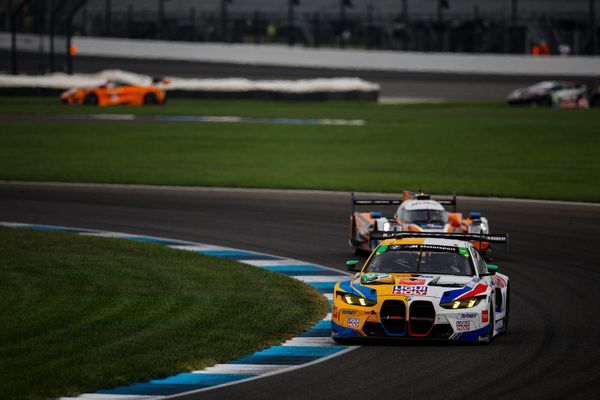
BMW’s evidence sits in a different category. The No 99 ROWE Racing BMW M4 GT3 EVO of Dan Harper, Max Hesse, Sheldon van der Linde and Dries Vanthoor finished fourth after an early spin. The BMW M3 Touring 24H then turned a fan-facing project into a serious result, finishing fifth overall and winning SPX with Schubert Motorsport.
That is not a weak weekend. Far from it. BMW also put the No 77 BMW M4 GT3 EVO ninth, while the defending No 1 ROWE Racing car retired with a fuel-system defect. But Andreas Roos, Head of BMW M Motorsport, gave the most important line in BMW’s own release: BMW “didn’t have the speed this year to fight at the very front”. That admission gives the result its shape.
The constraint is important. This does not prove Mercedes-AMG had the deepest customer picture across the whole race. Toyo Tires with Ring Racing finished 17th, the No 3 car was classified 37th after rejoining for the final lap, SR Motorsport by Schnitzelalm finished 101st after repairs, and the PROsport Racing Team BILSTEIN and KCMG GT3 cars retired. The win says more about the factory-supported Winward axis than the full Mercedes-AMG customer base.
Nor does BMW’s fourth place settle its pace level. The No 99 lost ground on lap one and still ended close to the podium. A clean opening phase may have changed the pressure on the front group. But BMW did not frame the race as a stolen win. It framed Mercedes-AMG as the benchmark and its own result as strong under the conditions it had.
That is why this matters beyond a single Nürburgring result. The 24-hour race is a stress test of preparation, tyre calls, failure containment and front-line redundancy. Mercedes-AMG did not just win. It absorbed the loss of one winning option and still had another one ready. In a season where the Nürburgring now sits inside the IGTC structure, that carries more weight than a local trophy.
The next test is whether the same pattern survives away from the Nordschleife. The reading strengthens if Mercedes-AMG places more than one car in the winning fight at Spa and keeps its IGTC lead without relying on rival trouble. It weakens if lap-by-lap and sector analysis show BMW or Porsche had equal clean-air pace once the early incidents and tyre calls are stripped out. It overturns if the Nürburgring result proves to be a Winward-specific execution peak rather than a repeatable Mercedes-AMG performance structure.