Qatar postponement resets the 2026 WEC calibration window
Qatar’s postponement forces Imola to open the WEC season, resetting setup baselines for Porsche, BMW, and Mercedes-AMG.
The postponement of the Qatar 1812km does not merely rearrange the FIA World Endurance Championship calendar. It removes the original aerodynamic-efficiency reference point for the 2026 season and replaces it with a circuit that tests a different set of engineering priorities entirely.
Every Hypercar manufacturer that calibrated its pre-season programme around Lusail International Circuit now faces a forced reorientation toward Imola, and the competitive picture at the 6 Hours of Imola on 17–19 April will reflect that disruption.
Evidence
The FIA took the decision to postpone the Qatar round, originally scheduled for 26–28 March, citing the evolving geopolitical situation in the Middle East. The organisation consulted with the Qatar Motor and Motorcycle Federation and the circuit operator before confirming the postponement. A revised date in the second half of the season will follow.
The technical consequence is direct. Lusail is a high-speed, flowing layout that rewards aerodynamic efficiency and tyre degradation management across long stints. The Autodromo Enzo e Dino Ferrari at Imola sits at the other end of the spectrum: tight, technical, and dependent on mechanical grip through low-speed corners. The setup window for one circuit does not transfer cleanly to the other.
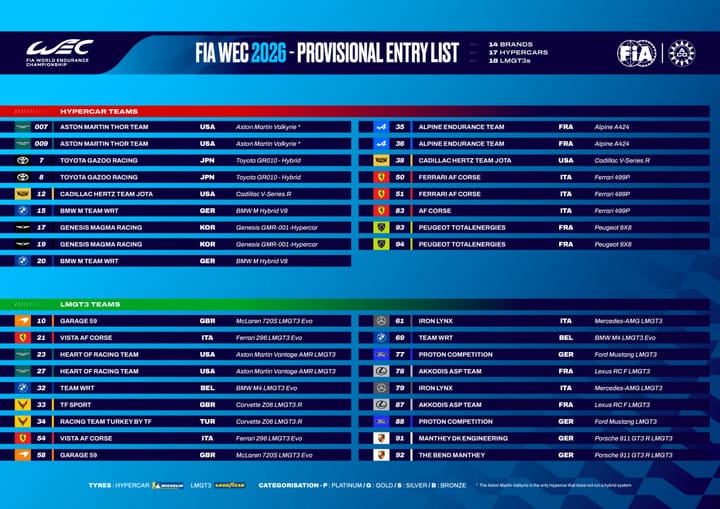
Porsche, BMW M Motorsport, and Mercedes-AMG each ran pre-season testing programmes with Qatar as the assumed opening round. Teams that anchored their baseline data to Lusail’s high-speed characteristics now carry a less relevant reference set into the first competitive weekend. The degree to which each manufacturer adapted its Bahrain test programme toward medium-speed conditions will likely determine who arrives at Imola better prepared.
Imola’s layout also compresses the competitive order in a specific way. Small handling imbalances become more visible at a circuit that punishes corner-entry instability and rewards traction out of slow sequences. For programmes still integrating new-specification machinery or updated Balance of Performance (BoP) settings, Imola offers less room to hide a deficit than Lusail would have.
Constraint
This reading does not claim that any single manufacturer gains a net advantage from the calendar change. Pre-season BoP tables remain unpublished, and no competitive timing data from race conditions exists yet for any 2026-specification Hypercar. The argument is structural, not predictive: the postponement changes the type of information the opening round will produce, not the outcome itself. It is also possible that manufacturers already tested across a range of circuit profiles broad enough to absorb this shift without material disruption.
Consequence
The first-order consequence is clear enough. Imola will now set the opening competitive reference for the season, and the data it produces will favour programmes with stronger low-speed mechanical balance. Early-season narratives about manufacturer form will be shaped by a circuit type that may not represent the broader calendar.
The second-order consequence sits in the calendar. Rescheduling Qatar into the second half of 2026 compresses the back end of an already long campaign. The proximity of a rescheduled Gulf round to the 8 Hours of Bahrain raises questions about logistics, tyre allocation, and component life management across what could become back-to-back desert events. How the FIA and ACO structure that revised slot will carry implications for operational planning that stretch well beyond a single race weekend.
Next falsifier
This diagnosis would weaken if pre-season testing data shows that all three primary manufacturers tested extensively in medium- and low-speed configurations, making the Lusail-to-Imola shift operationally trivial. It would also weaken if the revised Qatar date lands in a calendar slot with sufficient spacing from Bahrain that the logistical compression argument does not hold. RSR will revisit both conditions once the rescheduled date is confirmed and the competitive picture at Imola becomes legible.
RSR will return with a deeper reading of the Imola opener once the competitive picture becomes clearer. A full analysis will follow after the race.