RSR Intelligence · Issue 009
IMSA has given Porsche a customer-prototype signal. Spa begins now. Nürburgring follows. Le Mans is no longer distant context.

Issue 009 · Thursday 7 May 2026
The signal
The endurance season has moved into its compression phase.
That is the right way to read the last few days. Not as a list of results. Not as a scatter of press releases. As a narrowing path.
The International Motor Sports Association (IMSA) has just given Porsche a privateer proof point at Laguna Seca. Spa-Francorchamps begins as this issue lands. Nürburgring follows next week. Le Mans is now close enough that almost every major endurance signal starts to point towards France, even when the race itself sits outside the immediate frame.
This is where early-season evidence stops being harmless.
At Daytona and Sebring, a result can still be filed as opening form. By May, the excuses get thinner. Programmes have enough mileage to expose habits. Strategy groups have shown their rhythm. Customer teams have either converted the opportunity or left it unused. The factory projects can no longer hide behind the calendar.
For RSR, Issue 009 is less about what happened last weekend than what the next five weeks will test.
Porsche has depth in IMSA, but a hole in the FIA World Endurance Championship (WEC) Hypercar.
BMW keeps showing salvage capacity, but still needs a clean repeatability case.
Mercedes-AMG has breadth in GT3, yet must now prove that volume at the Nürburgring carries competitive weight rather than just presence.
And Formula 1, in its 2026 form, keeps reminding us that new rules do not become mature because the opening races have passed without collapse.
The calendar is tightening.
So is the evidence.
Porsche: Laguna Seca changed the 963 story
Porsche did not need another factory win to show that the Porsche 963 is strong. We already knew that.
What Laguna Seca supplied was more interesting. JDC-Miller MotorSports won with the #5 Porsche 963, with Laurin Heinrich passing Earl Bamber in the #31 Cadillac V-Series.R on the final lap. The two factory Porsche Penske Motorsport cars finished sixth and seventh.
That matters because it moves the IMSA Porsche thread away from a factory-centred reading.
The 963 programme has always had scale: factory IMSA, factory WEC before the withdrawal, customer cars, experienced drivers, and deep operational knowledge. Scale alone does not prove competitive health. Sometimes it hides weakness. What Laguna Seca did was give Porsche a customer execution case strong enough to stand on its own.
JDC-Miller did not just inherit a result. The evidence sits in the way the win arrived. Heinrich took over from Tijmen van der Helm from deep in the order, used the car’s tyre life late, and made traffic work for him when the race narrowed to a direct fight with Cadillac.
That is the signal.
Customer Porsche, late-race tyre life, traffic timing, final-lap execution.
There is context, too. IMSA had revised Grand Touring Prototype (GTP) minimum weights for Laguna Seca, so this result should not be read as a clean, universal performance verdict. Balance of Performance always sits in the room. But it does not erase what JDC-Miller did with the conditions available.
The counter-reading is obvious enough. Laguna Seca was not a clean factory Porsche validation. Porsche Penske finished in the lower half of the GTP top ten, and Cadillac controlled much of the race through the #31 car before the final lap changed the result. BMW also got the #25 car onto the podium from tenth.
So this is not “Porsche dominates IMSA”. That would be lazy.
The better reading is narrower: Porsche’s IMSA strength now includes a customer proof point that complicates any factory-only understanding of the 963. That is more valuable than another expected win.
It also lands against the wider Porsche question.
Porsche has stepped back from WEC Hypercar, but the car remains visibly competitive in IMSA. That contrast will not go away. If anything, Laguna Seca sharpens it. The 963 is still gathering evidence in America while Porsche’s absence from WEC becomes more awkward as Le Mans approaches.
That does not prove Porsche made the wrong WEC call.
It does make the silence louder.
BMW: still good at damage control
BMW’s Laguna Seca weekend was worth retaining, but we should not overstate it.
BMW M Team WRT finished third with the #25 BMW M Hybrid V8 of Philipp Eng and Marco Wittmann, having started tenth. The sister #24 car led in the opening hour with Dries Vanthoor and Sheldon van der Linde, then lost ground after the yellow-flag pit sequence and finished ninth.
That gives us a familiar BMW reading: not dominance, not repeatable control yet, but salvage capacity.
There is value in that. A prototype programme that can turn an awkward weekend into a podium has a base to work from. WRT remains hard to dismiss because it keeps finding points, even when the race shape does not fully cooperate.
But salvage is not a breakthrough.
BMW’s own post-race language pointed towards balance limits rather than clean pace. Wittmann had to defend late. The Porsche had enough tyre and speed to pass. The #24 car’s earlier lead did not survive the event’s rhythm.
So the BMW note stays restrained.
The programme is still collecting usable results. It is not yet forcing a revision of the hierarchy.
Spa now matters because WRT has to answer the same question in a different environment. At Imola, BMW left with a solid WEC Hypercar showing and a win in Le Mans Grand Touring 3 (LMGT3). At Laguna Seca, it recovered a GTP podium from a poor starting position. Spa can begin to tell us whether those are linked signs of programme maturity, or well-executed weekends in separate compartments.
That is the BMW test.
Not peak pace.
Repeatability.
Brands Hatch: published signal, not repeated argument
We have already dealt with the GT World Challenge Europe Sprint Cup at Brands Hatch in a separate Signal Note, so this issue should not pretend that the material is fresh.
Its carry-forward is limited, but still worth keeping.
Brands Hatch gave us a Sprint Cup measurement before the endurance calendar tightened. Lionspeed GP gave Porsche the cleanest conversion signal of the weekend. Mercedes-AMG Team Verstappen Racing had pace that now belongs in the Nürburgring watch file. BMW M Team WRT had presence, but not a clean enough conversion signal to make the weekend a BMW story.
That is enough for the newsletter.
The mistake would be to write the Signal Note again, only shorter.
Brands Hatch belongs here as a cross-reference in the evidence chain. It tells us what to watch when GT3 moves from a two-driver sprint setting to the Nordschleife’s more punishing operating system.
Sprint pace can start a question.
Nürburgring answers it more brutally.
Nürburgring: spread versus concentration
The Nürburgring 24 Hours now sits close enough that the preparation releases have stopped being background.
They give us the shape of the fight.
Mercedes-AMG Motorsport has declared a broad deployment: six Mercedes-AMG GT3 cars and two Mercedes-AMG GT4 cars, with entries across SP9 PRO, SP9 PRO-AM and SP10. The two headline SP9 PRO cars are Mercedes-AMG Team Verstappen Racing with Lucas Auer, Jules Gounon, Daniel Juncadella and Max Verstappen, and Mercedes-AMG Team RAVENOL with Maro Engel, Maxime Martin, Fabian Schiller and Luca Stolz.
That is breadth. It gives Mercedes-AMG multiple ways into the race.
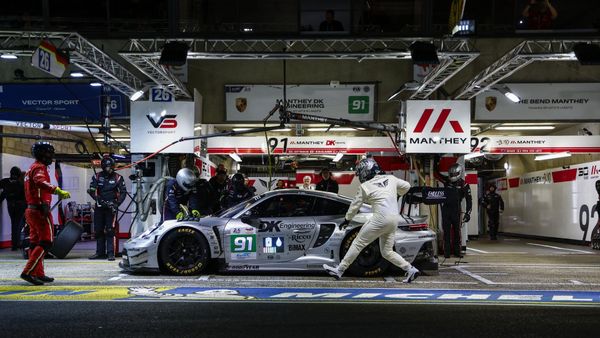
Porsche’s clearest Nürburgring argument looks different. Manthey returns with the #911 Porsche 911 GT3 R for Kévin Estre, Ayhancan Güven and Thomas Preining, with Matt Campbell as reserve driver. Manthey also brings continuity: the driver unit is familiar, the team knows the event, and the Grello programme carries an operating culture that does not need explaining to anyone who has watched the Nürburgring long enough.
That is concentration.
This contrast is the preview line: Mercedes-AMG brings spread, Porsche brings a sharper point.
The Nordschleife does not automatically reward either model. Volume can absorb trouble. It can also multiply exposure. Concentration can produce clarity. It can also leave a manufacturer with too few live options if the race turns against the lead car.
We should avoid making Verstappen Racing the story by default. The audience weight is real, and the NLS media data tells us that Verstappen-linked distribution has its own force. But audience is not lap time. Nor is it operational resilience.
At Nürburgring, the question is not whether Verstappen Racing brings attention.
It does.
The question is whether Mercedes-AMG’s wider structure can turn that attention into competitive pressure on Manthey’s more concentrated Porsche case.
NLS: the operating system behind the spectacle
The recent Nürburgring Langstrecken-Serie (NLS) participant documents are not public-facing drama. That is why they matter.
They remind us that the NLS and Nürburgring 24 ecosystem is not a romantic free-for-all. It is a controlled operating environment built around licences, permits, digital Race Control communication, GPS speed monitoring, onboard camera permissions, paddock process and class structure.
This matters when we write about the 24-hour race.
The Nordschleife looks untamed because the track is vast, narrow and unforgiving. The event around it is not loose. Cars need transponders. The series uses GPS to monitor vehicle speed. Teams receive Race Control messages and penalties through timing monitors and the VLN Team-Messenger App. Onboard footage sits inside a licence structure. Even paddock access and temporary structures are regulated.
That does not make the event sanitised.
It makes it legible.
For RSR, the Nürburgring should be read as an operations test before it is read as folklore. Pit communication, driver discipline, traffic management, visibility, repair time and crew rhythm matter as much as peak pace.
The better team is not always the fastest car in clean air.
It is the team that keeps functioning when the place starts asking bad questions.
Spa: the next WEC evidence set begins now
By the time this issue lands, the next WEC evidence set will already be forming at Spa-Francorchamps.
That timing matters. Spa is not just the next round. It is the final WEC race before Le Mans, and it arrives one week before the Nürburgring 24 Hours. The season is no longer giving us isolated tests. It is linking them.
Imola is the baseline.
At Imola, BMW gave RSR something to carry forward in both Hypercar and LMGT3. Manthey left with a strong Porsche GT-class floor. Iron Lynx Mercedes-AMG still had to move from presence to competitive relevance in WEC LMGT3.
Spa now tests whether those readings travel.
For BMW, the question is whether WRT can stay inside the competitive window without relying on Imola-specific rhythm. For Manthey, the question is whether Porsche’s LMGT3 floor remains as firm at a different circuit. For Mercedes-AMG, Spa is more severe. The marque has a huge GT3 footprint globally, but WEC LMGT3 has not yet become the place where Mercedes-AMG sets the terms.
That sits awkwardly with Affalterbach’s GT3 footprint elsewhere.
Not because one WEC round decides the season. It does not. But because Le Mans is too close for “still bedding in” to remain a comfortable phrase.
Spa will not settle the hierarchy.
It will tell us which pre-Le Mans arguments still deserve oxygen.
Formula 1: Miami’s story was regulatory, not celebratory
Kimi Antonelli winning again for Mercedes makes the obvious headline.
It is not the RSR headline.
The better signal from Miami came after the race, when the drivers were asked about the 2026 rules. Oscar Piastri said the reduced qualifying harvest limit had helped, but had not fixed the wider problem. Kimi Antonelli said qualifying felt more natural, while race-phase closing speeds remained massive and active aero made the car slow to respond in direction changes. Lando Norris went further, arguing that the rules still penalise drivers for pushing flat out and that the deeper problem sits with the battery.
That is the part worth keeping.
The 2026 Formula 1 rules have not collapsed. Nor have they matured. Miami suggests the correction has helped qualifying more than race behaviour, where closing speeds and energy deployment still distort wheel-to-wheel racing.
For RSR, this matters because Audi is building into this ruleset.
The Audi Revolut F1 Team, Audi’s factory Formula 1 entry, left Miami with a technical compliance note through Gabriel Bortoleto’s Sprint disqualification for an engine intake air pressure breach, plus a Sunday race that left Bortoleto 12th and Nico Hülkenberg retired with a technical issue.
That does not justify an Audi crisis piece.
It does justify keeping the Audi file open under two headings: regulatory maturity and operational stability.
F1 remains secondary for RSR. That is by design. But when a new manufacturer enters a regulation set still generating driver criticism about hardware limits, F1 becomes more than race coverage.
It becomes a manufacturer-risk story.
Future file: Acura, McLaren and the next rules cycle
A small future note belongs here because it changes the frame around Porsche and BMW in IMSA.
Acura has confirmed it will pause its IMSA GTP programme at the end of 2026. The class is expected to continue with factory-backed programmes from Aston Martin, BMW, Cadillac and Porsche in 2027. That is a smaller field than the recent peak, and it shifts the relative weight that Porsche’s customer depth and BMW’s WRT execution will carry.
That is not a German manufacturer story in itself.
It changes the room around the German manufacturers.
Fewer factory actors can make each remaining programme carry more of the competitive story.
At the same time, the wider prototype world keeps moving. McLaren has revealed its WEC-bound Hypercar project for 2027, adding another serious manufacturer commitment to the post-2026 field. The 2030 rules discussion, hybrid architecture, chassis supply and asset-life questions all sit beyond the immediate newsletter horizon, but they matter for the same reason.
The next endurance rules cycle may be less about who can build a fast car from scratch and more about who can afford to keep a car relevant for long enough.
That is where Porsche’s WEC absence, BMW’s continuing prototype build and the wider LMDh/Hypercar convergence story will eventually meet.
Not this week.
Soon enough.
Reading the next fortnight
Three races now shape the next phase of RSR’s work.
First, Spa.
The WEC round begins as this issue goes out, and its job is clear: test the Imola baseline before Le Mans. Watch BMW WRT in Hypercar and LMGT3, Manthey’s Porsche floor in GT, and whether Iron Lynx Mercedes-AMG can make WEC LMGT3 look less peripheral.
Then Nürburgring.
The 24-hour race is the GT3 operating test. Mercedes-AMG has spread. Manthey has concentration. Verstappen Racing has attention. None of that matters unless it survives the night.
Then Le Mans.
Not yet the article. The reference point.
Every serious endurance programme is now moving towards it, even the ones not present in Hypercar. Porsche proves the point most sharply. The 963 can win in IMSA with a customer team while the marque remains absent from WEC Hypercar’s biggest stage.
That tension will not resolve itself.
It is becoming the season’s central Porsche question.
Researched and analysed with AI assistance. Final editorial judgement remains human.