BMW answered Interlagos. The two-car question remains
The #15 BMW strengthened WRT’s repeatability case at São Paulo. Cadillac’s errors and the #20’s different weekend keep the wider verdict open.

Signal Note: BMW M Team WRT at the 2026 6 Hours of São Paulo
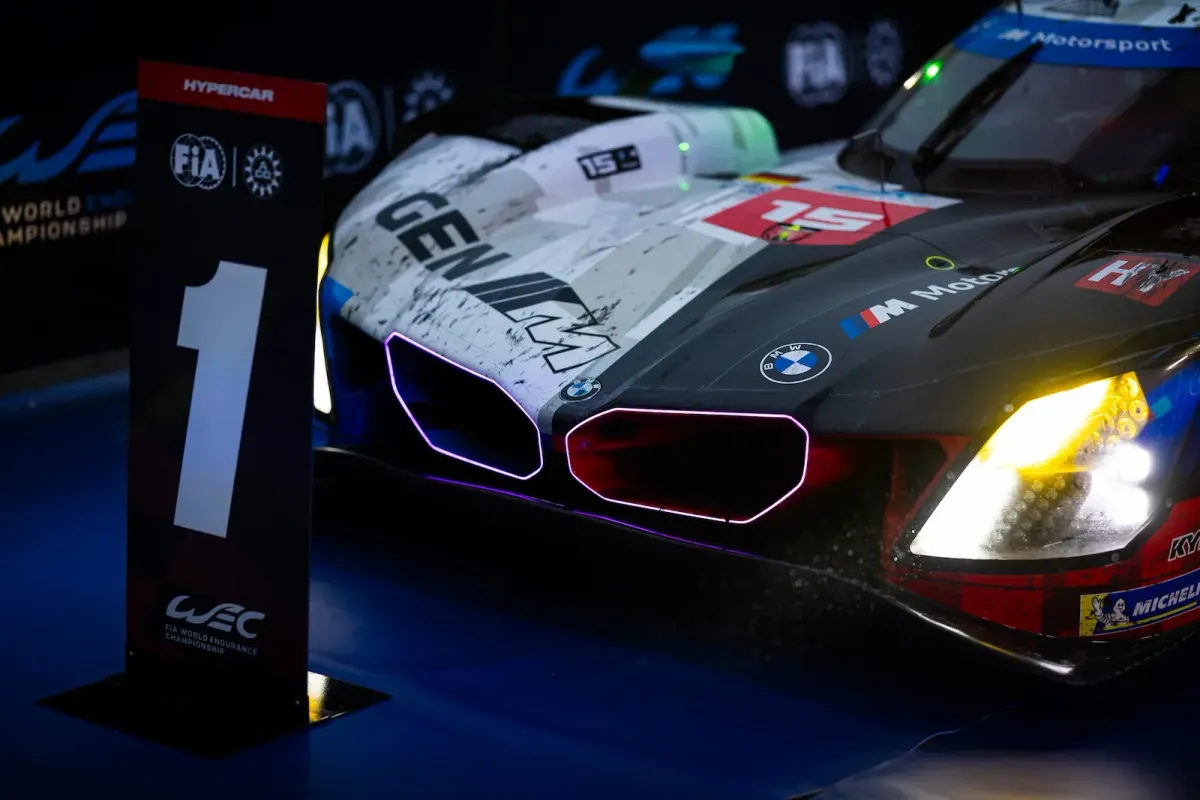
The #15 BMW M Hybrid V8 did not win at Interlagos by controlling every phase of the weekend. It won because BMW M Team WRT put the car in range, took track position when it was available and made fewer costly mistakes than the cars that started ahead.
That distinction matters. The result strengthens BMW’s case for repeatable front-running execution in the FIA World Endurance Championship (WEC). It does not settle the technical order, nor does it prove that both BMWs now operate at the same level.
Kevin Magnussen started fourth at the 6 Hours of São Paulo, moved past the third-placed Alpine A424 at the start and took second from Earl Bamber at Ferradura on lap 11. That opening stint put the #15 between the two Cadillac Hertz Team JOTA cars before their first stops went wrong.
The #12 Cadillac V-Series.R lost time to a jammed front-right wheel nut. The #38 overshot its pit box and had to be repositioned. Those errors did not determine BMW’s entire race, but they changed the order when the #15 was close enough to take the lead.
WRT did the rest. Raffaele Marciello kept the car in the contest, and Dries Vanthoor, despite feeling unwell, absorbed late pressure from the #51 Ferrari 499P and the recovering #12 Cadillac. The winning margin was 2.254 seconds after 242 laps; the first three cars were covered by 6.687 seconds.
This was not a race of attrition. All 35 starters reached the finish; there was one brief Full Course Yellow period and no Safety Car. The compressed result, therefore, gives clean execution more weight than survival luck.
It still leaves a live counter-reading. Magnussen believed BMW had the quickest car. Team principal Vincent Vosse took the harder line: WRT had run a faultless race, but he did not think the #15 was the quickest car and could not say whether it would have won without Cadillac’s pit-stop losses.
Vosse’s version fits the evidence better. BMW had enough pace to stay attached to the front and enough operational control to use the opening. That is a stronger claim than saying the race fell into its hands. It is also narrower than declaring a new Hypercar hierarchy.
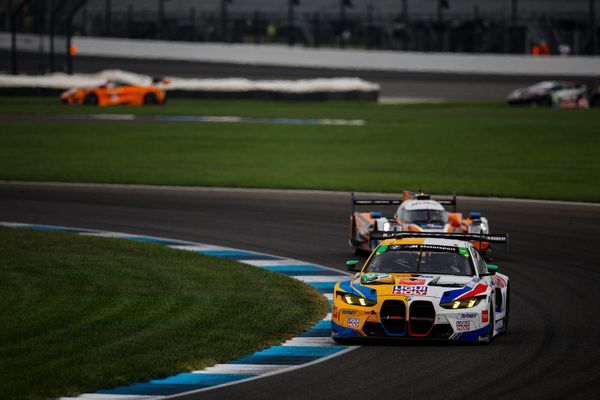
The #20 keeps that hierarchy question open. Sheldon van der Linde, René Rast and Robin Frijns started 16th after a qualifying session affected by poor grip and interference from the #19 Genesis. They recovered to sixth on the road, then fell to eighth after Frijns received a five-second penalty for contact with the #50 Ferrari.
BMW’s own post-race account admitted that the #20 could not match the sister car’s performance. The recovery showed strategic range and limited the damage, but it was not evidence of equal pace across the two entries.
That split changes how the recent sequence should be read. The #20 won at the 6 Hours of Spa-Francorchamps and finished second at the 24 Hours of Le Mans. The #15 had the speed to finish second at Spa, failed to score at Le Mans and then converted at São Paulo. WRT has now produced a front-running route with either car across three different events. It has not produced the same route with both cars at the same event.
That is repeatability at team level, not uniformity at car level.
Balance of Performance remains part of the evidence field. São Paulo cannot isolate chassis performance from the weight, power and energy parameters in force, nor from fuel strategy, tyre use, traffic and the Cadillacs’ lost time. The result says more about WRT’s ability to operate within the available window than about the size of that window.
The consequence is still real. Spa established that BMW could convert a difficult six-hour race. Le Mans showed that its challenge survived a 24-hour pillar. São Paulo added a second winning crew and did so in a largely green race where execution errors were exposed rather than hidden by repeated neutralisations.
The next test is the Lone Star Le Mans at the Circuit of The Americas. If both BMWs can produce representative stints, clean stops and comparable race positions there, the two-car case will strengthen. If the programme again depends on one entry while the other loses pace, track position or operational control, São Paulo will remain evidence of WRT’s conversion skill rather than BMW’s control of the class.
The #15 answered Interlagos. The programme has not answered the second car.
AI disclosure: AI tools were used to support the preparation, editing or review of this article. All factual claims were checked against identified sources, and final judgement, interpretation and publication responsibility remain with JP Hackett, Editor, The Rennsport Report.