RSR Intelligence · Issue 013
Porsche converted at Spa, Manthey answered at Watkins Glen, Mercedes-AMG split its Pro case, and BMW showed depth without control.

Issue 013 · Thursday 2 July 2026
Porsche converted, but the route mattered
Spa tested whether German GT3 depth still meant conversion, or whether it only meant more cars exposed to the same race.
Watkins Glen added the missing Porsche check.
That distinction matters. Porsche had two questions after Le Mans. One was broad: could its GT3 base still convert at a major 24-hour race? The other was specific: could Manthey recover from the redundancy problem exposed when Porsche’s visible Le Mans route depended on two LMGT3 cars and neither reached the podium?
The answer now has two parts.
Porsche converted at Spa through non-Manthey customer routes.
Manthey answered in IMSA, but not cleanly.
Porsche converted at Spa, but not through Manthey
The CrowdStrike 24 Hours of Spa was not a Manthey correction.
Porsche’s Spa Pro group ran through Lionspeed GP, Schumacher CLRT and Boutsen VDS, not Manthey. The Porsche Spa dossier lists 15 authorised Porsche entries, with the Pro cars entered by those teams.
That does not weaken the result. It stops the result from doing the wrong job.
The official classification records the #80 Lionspeed GP Porsche as the winner, with the #22 Schumacher CLRT Porsche fourth and the #2 Boutsen VDS Porsche eighth.
The win carries extra weight because #80 did not start from a clean grid slot. The amended grid listed #80 among the pit-lane starters, and the stewards confirmed the pit-lane start followed an engine replacement.
So Porsche’s Spa evidence is strong but narrow.
It proves Porsche’s sharpest GT World Challenge Europe routes could absorb damage and still convert.
It does not prove Manthey answered Le Mans at Spa. Manthey was not the Spa route.
The championship effect is real. The official Intercontinental GT Challenge manufacturers’ table puts Porsche on 92 points after three rounds, ahead of Mercedes-AMG on 84 and BMW on 67. Porsche scored 37 at Spa, while Mercedes-AMG scored 20 and BMW 14.
Porsche entered Spa nine points behind Mercedes-AMG. It left eight points ahead.
That is the clean Spa signal.
The caveat remains. Porsche did not prove that 15 entries create control. The winning evidence came from its Pro group. The #22 and #2 also made contact, with #22 receiving a five-second penalty.
The right reading is narrower and stronger.
Porsche converted at Spa through its non-Manthey Pro customer structure. That answered the broad GT3 conversion question. It did not settle the Manthey question.
Watkins Glen gives the Manthey correction
The Manthey follow-up came at Sahlen’s Six Hours of The Glen, not Spa.
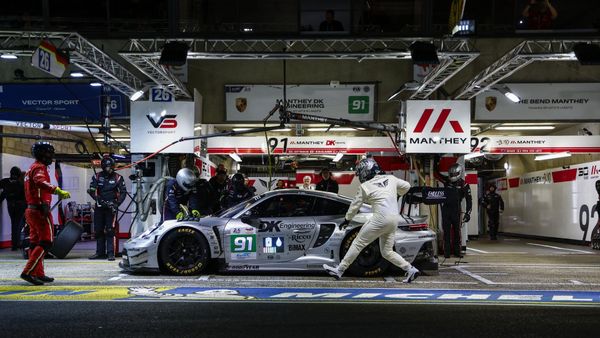
The official IMSA result gives the #912 Manthey 1st Phorm Porsche the GTD win, shared by Ryan Hardwick, Richard Lietz and Riccardo Pera, with Wright Motorsports completing a Porsche one-two in class.
That is the positive answer.
The #911 gives the tension.
Porsche says Loek Hartog was running fourth in the #911 Manthey Porsche when he made contact with the barriers at Turn 6, causing irreparable damage and ending the car’s race after two hours. The race notes support that sequence rather than complicate it: they show Hartog continuing slowly from Turn 6, stopping at Turn 7, continuing from Turn 8, and later retiring.
The publishable line is simple.
One Manthey car won GTD. The other retired after contact with the barrier from a strong class position.
The #912 told the other half of the Manthey story. Porsche says a well-timed pit stop gave the #912 enough energy to reach the finish. The race notes also list Hardwick, Lietz and Pera among the class winners, with Hardwick crediting clean race execution and Lietz saying the strategy felt uncertain but worked.
That matters more to the Le Mans carry-forward than the Spa win does.
Spa showed Porsche customer depth outside Manthey.
Watkins Glen showed Manthey could still convert, but not evenly across its two IMSA cars.
That keeps the Porsche reading disciplined. Porsche’s weekend was strong. It was not simple.
The brand won at Spa, took the IGTC lead, won GTD at Watkins Glen and put a customer Porsche 963 on the GTP podium. But the evidence still splits by organisation and programme.
Porsche has depth.
The route matters.
Mercedes-AMG converted one route
Mercedes-AMG left Spa with a result and a problem.
The result was #48 Mercedes-AMG Team MANN-FILTER. It finished second overall, 12.288 seconds behind the winning Porsche.
That was not a consolation result. Sportscar365 reported that #48 was the top scorer at the 12-hour point, and that Maro Engel, Lucas Auer and Luca Stolz left Spa leading the GT World Challenge Europe Endurance Cup standings by more than double the second-placed crew.
The problem was the rest of the Pro case.
The official classification lists #3 Mercedes-AMG Team Verstappen Racing and #17 Mercedes-AMG Team GetSpeed as not classified.
The #17 had already lost its Superpole route after its Qualifying 3 lap times were deleted for unauthorised work on the car. Sportscar365 then reported that the car’s race ended after Maxi Götz collided with the #177 Grupo Prom Racing Mercedes-AMG at pit entry.
That gives Mercedes-AMG’s Spa its shape.
One Pro route converted. Two did not.
That is not a failure across the customer programme. A Spa runner-up finish and an Endurance Cup lead still matter.
But #48 cannot answer for #3 and #17.
Mercedes-AMG kept one strong route alive. It did not validate the whole Pro spread.
BMW had depth without a sustained winning route
BMW should not be dismissed. It should not be inflated.
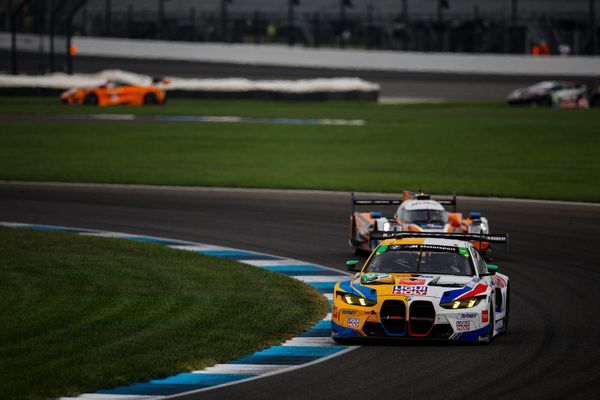
The final classification gives BMW a dense result map: #46 Team WRT sixth, #98 ROWE Racing ninth, #998 ROWE Racing 11th, #32 Team WRT 12th, #991 Paradine Competition 13th and #30 Team WRT 15th.
That is depth.
It is not control.
The #998 won the Gold Cup. The #991 finished second in Bronze. The #30 finished second in Silver. BMW had class strength and a top-15 presence.
The overall reading is harsher.
Sportscar365 reported that the #46 WRT BMW led after repeated cautions at night, then slipped to sixth. Andreas Roos said BMW had travelled to Spa with the ambition of fighting for the overall win and was disappointed not to achieve that with its drivers and teams.
That keeps the claim honest.
BMW had structure, class reach and numbers inside the top 15.
It did not sustain an overall winning route.
That fits the Issue 012 hierarchy. Spa was useful for BMW. It was not the main BMW test. The prototype programme still carries the heavier post-Le Mans question.
Audi remains a comparison
Audi stays as context.
The final classification records one classified Audi: the #25 Saintéloc Racing Audi, 30th overall and ninth in Silver. The #84, #88, #28, #99 and #66 Audis were not classified.
That matters because there were flashes.
Sportscar365 reported that the #84 Eastalent Racing Audi took the six-hour maximum score because it had not pitted while the main contenders had pitted, and then crashed out overnight.
A scoring checkpoint is not a control.
Audi sharpens the German manufacturer story by contrast. Customer persistence can create moments. Spa punished moments that did not last.
Briefs
JDC-Miller keeps Porsche’s privateer prototype route live
Watkins Glen also gave Porsche a small prototype note.
The official IMSA result has JDC-Miller MotorSports finishing third overall and in GTP with the #5 Porsche 963 of Laurin Heinrich, Tijmen van der Helm and Kaylen Frederick. JDC-Miller says it was its second podium in three races, following a victory at Laguna Seca.
The race was not clean. JDC-Miller says the #5 ran near the front for almost three hours before losing a tyre after light contact, making an unscheduled stop and falling a lap down. The race notes support the tyre-loss sequence, recording Frederick with a flat tyre, then a left-rear-only stop.
The recovery matters. JDC-Miller says a caution put the #5 back on the lead lap before Heinrich drove through to third. The race notes later show Heinrich briefly leading overall before the final sequence shook out.
That supports a narrow reading.
Porsche’s IMSA privateer prototype route remains credible. It is no longer a one-off result at Laguna Seca.
But title control still sits elsewhere. RACER reported Aitken’s GTP drivers’ championship lead over Heinrich at 203 points after Watkins Glen.
The 2030 framework changes the Porsche question
The 2030 prototype framework belongs here as a brief.
IMSA, the ACO and the FIA have outlined a top-class prototype framework for 2030. The plan moves IMSA GTP and WEC Hypercar towards one two-wheel-drive platform, keeps internal combustion and hybrid power, allows single-source or bespoke hybrid systems, allows constructor or in-house chassis, and sets a five-year homologation period with no performance evolutions. The details still need a working group definition.
For BMW, the direction is cost-controlled convergence. Roos told Sportscar365 the framework is what BMW needs, while stressing cost control and future technical detail.
For Porsche, the point is conditional. Thomas Laudenbach said the single-platform direction will play a role in any WEC Hypercar return decision, but also said Porsche has no new decision and should not be expected back next year.
This is not a return signal.
It is a lower barrier.
The rules reduce one technical obstacle. They do not address cost, governance, or Porsche’s appetite for another factory-prototype commitment.
GT3 watch: Ratel sets the next question
Stéphane Ratel’s GT3 warning should stay as a watch item.
Sportscar365 reported that Ratel warned against GT3 cars being developed first for racing and then homologated for the road. He linked that trend to rising purchase and running costs, and said lower-level championships may struggle to absorb them.
That is an agenda-setting claim, not an outside verdict. Ratel is interested in defending the category he built.
The useful RSR question is narrower: can the next GT3 cycle keep customer racing broad enough to remain relevant below the headline events?
Working judgement
Porsche converted, but the route mattered.
At Spa, Porsche converted through non-Manthey Pro routes. At Watkins Glen, Manthey gave its own answer: one car won GTD through late strategy and execution, while the other retired after barrier contact from a strong class position.
Mercedes-AMG converted one Pro route. BMW showed depth without a sustained winning route. Audi showed how little a flash means without durability.
The future notes should stay smaller.
JDC-Miller keeps Porsche’s privateer prototype route alive, but not in control. The 2030 prototype framework changes the Porsche return question, not the answer. Ratel’s warning raises a cost question for GT3, not a verdict.
That is enough for Issue 013.
Not everything needs a verdict.
Some evidence tells us the next question.
AI tools were used to support the preparation, editing or review of this newsletter. All facts were checked against named sources, and final judgement, interpretation and publication responsibility remain with JP Hackett, Editor, The Rennsport Report.