Porsche did not win Spa by counting cars
Porsche had 15 cars at Spa, but the evidence sits with three Pro entries. The #80 Lionspeed GP Porsche started from the pit lane, climbed from 15th at six hours to fifth at 12 hours and then won the race. That is more useful than the scale story.

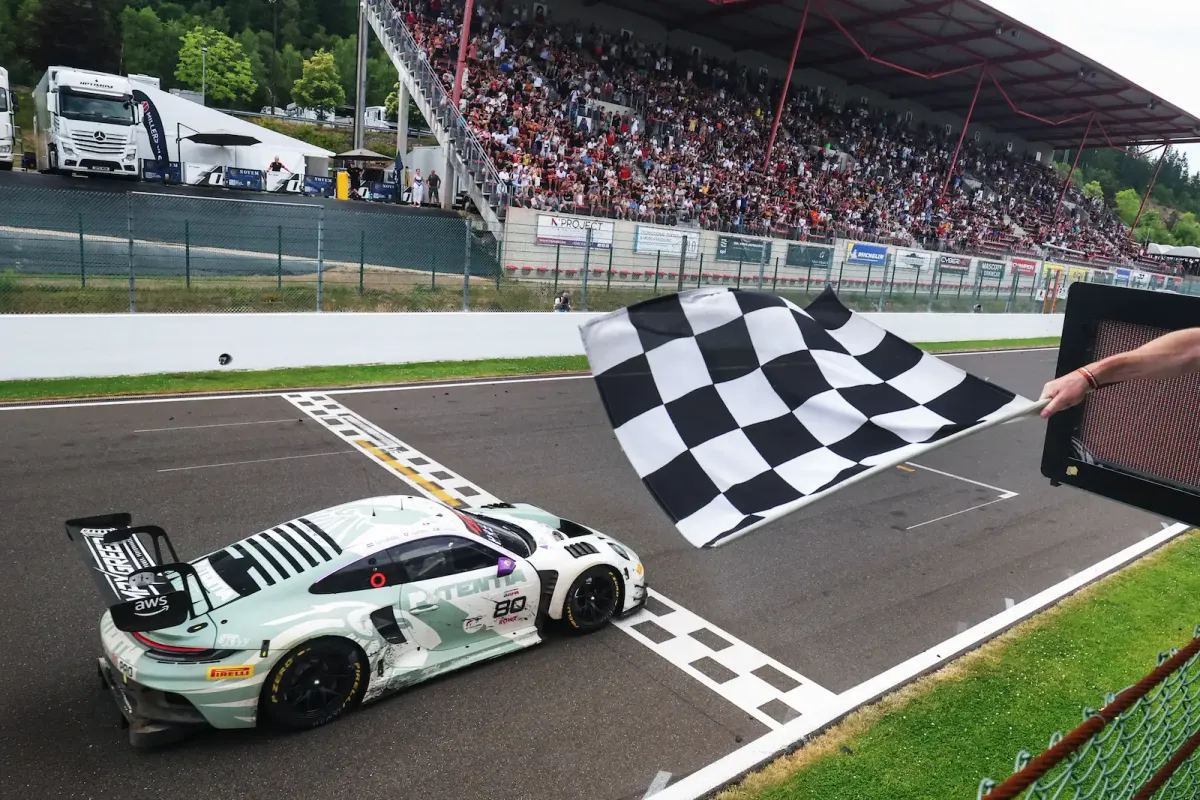
Porsche had 15 cars in the 2026 CrowdStrike 24 Hours of Spa.
That number is not the story.
The story is the #80 Lionspeed GP Porsche 911 GT3 R sitting in the pit lane as the race started, crossing the timing line last, sitting 15th after six hours, reaching fifth after 12 hours and taking the chequered flag after 541 laps.
Ricardo Feller, Thomas Preining and Bastian Buus turned that pit-lane start into first place. They finished 12.288 seconds ahead of the #48 Mercedes-AMG Team MANN-FILTER Mercedes-AMG GT3 EVO of Lucas Auer, Luca Stolz and Maro Engel. The #51 AF Corse Ferrari 296 GT3 Evo completed the podium.
Those facts give Porsche a clear headline. They do not give Porsche a simple verdict.
The six-hour and 12-hour positions come from the official checkpoint classifications. Porsche’s note that #80 first took the lead on Sunday morning remains Porsche-sourced until the lap-by-lap timing record is fully worked through.
So the safe line is this: Porsche did not prove that 15 cars win at Spa. Porsche proved that its three Pro customer entries, run by Lionspeed GP, Schumacher CLRT and Boutsen VDS, gave it real cars in the fight after the #80 had already been pushed to the back of the race.
What the three Porsche Pro cars show
The useful Porsche evidence is easy to name.
It is the #80 Lionspeed GP car winning from the pit lane.
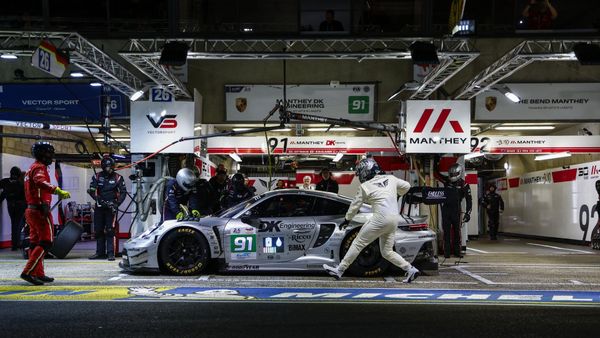
It is the #22 Schumacher CLRT Porsche 911 GT3 R of Ayhancan Güven, Matt Campbell and Frédéric Makowiecki finishing fourth.
It is the #2 Boutsen VDS Porsche 911 GT3 R of Morris Schuring, Dorian Boccolacci and Alessio Picariello finishing eighth.
Those are the cars that carry the argument.
The rest of the Porsche entry filled the class podiums in Gold, Bronze and Pro-Am. Those results matter for the customer-racing file. They did not decide the overall winner.
The overall win was decided by the front of the Porsche entry list, not by its length.
The flaw sits inside the Porsche result
This was not a neat Porsche race.
The stewards found that the #22 Porsche did not leave enough room and touched the #2 Porsche at Turn 1. They gave #22 a five-second penalty.
Earlier, the #2 received a drive-through and one Behaviour Warning Point for contact with the #58 Garage 59 McLaren at Turn 18.
Those incidents matter because they show that Porsche’s depth carried internal friction. Porsche had three Pro cars in the top eight, but two of them compromised each other while fighting near the podium.
So this is not a story about clean control.
It is a story about strong cars surviving messy moments.
That is more useful than the 15-car line because it survives the evidence against it.
Mercedes-AMG was the car between Porsche and the win
Mercedes-AMG is the sharpest German comparison because the #48 was the final car between Porsche’s pit-lane start and the win.
The #48 Mercedes-AMG Team MANN-FILTER car finished second overall. It came within a dozen seconds of turning Porsche’s drive from the pit lane into a near miss.
Mercedes-AMG did not fail at Spa. One of its leading cars stood on the podium.
The weakness is visible in the other Pro cars.
The #3 Mercedes-AMG Team Verstappen Racing Mercedes-AMG GT3 EVO was not classified. The #17 Mercedes-AMG Team GetSpeed Mercedes-AMG GT3 EVO was also not classified. The #17 had already lost all its third qualifying times after unauthorised work on the right rear of the car.
That leaves a split picture: one Mercedes-AMG in second place, with two leading Mercedes-AMG Pro cars missing from the finish order.
The #3 still needs care. Decision 43 mentions only a Night Practice pit-lane speeding fine. It does not explain why the #3 was not classified. Until a race document explains the retirement, the cause stays open.
BMW filled the top 15, but not the podium
BMW did not fall apart.
The #46 Team WRT BMW M4 GT3 EVO of Valentino Rossi, Max Hesse and Dan Harper finished sixth.
The #98 ROWE Racing BMW M4 GT3 EVO finished ninth.
The #998 ROWE Racing BMW M4 GT3 EVO won the Gold Cup.
The #991 Paradine Competition BMW M4 GT3 EVO was second in Bronze.
The #30 Team WRT BMW M4 GT3 EVO was second in the Silver class.
BMW had six cars in the top 15.
That is not failure. It is also not the Spa result BMW came for.
The factory-supported cars from Team WRT and ROWE Racing brought recent Spa-winning know-how. They left with class trophies and no overall podium.
Without the full Balance of Performance table and a stint-by-stint pace file, this should stay as a diagnosis rather than a verdict.
Audi shows why a six-hour order is not enough
Audi belongs here only as a warning.
The #84 Eastalent Racing Audi R8 LMS GT3 EVO II led at six hours. By the final classification, only the #25 Saintéloc Racing Audi R8 LMS GT3 EVO II was classified. It finished 30th overall and ninth in Silver.
Audi had no class podium.
A car can lead for six hours and disappear from the final sheet. A manufacturer can look live on Saturday and leave with one classified car on Sunday.
That is why the #80 Porsche’s checkpoints matter, but do not finish the story on their own.
Porsche converted. Audi did not.
The standings page now backs the Porsche point
The Intercontinental GT Challenge (IGTC) standings page now gives the Spa result wider weight.
After Spa, Porsche leads the GT3 manufacturers’ table on 92 points. Mercedes-AMG is second on 84. BMW is third on 67.
That table does not turn the race into a 15-car story.
It shows that the #80 win, the #22 fourth place and the #2 eighth place carried into the season table. Porsche left Belgium with the race win and the points lead.
Scale tells you how many cars a manufacturer unloads.
Spa showed which cars still mattered after the first problem hit.
AI tools were used to support the preparation, editing or review of this article. All facts were checked against named sources, and final judgement, interpretation and publication responsibility remain with JP Hackett, Editor, The Rennsport Report.