RSR Intelligence · Issue 012
BMW moved from promise to pressure, Porsche lost its fallback route, and Mercedes-AMG still needs Spa to answer the GT3 question.

Issue 012 · Thursday 18 June 2026
Porsche loses redundancy at Le Mans
Issue 011 asked whether German manufacturer depth could become control.
The 24 Hours of Le Mans gave a sharper answer than expected. Not a full verdict. A stress test.
BMW M Team WRT left with the clearest upgrade. The #20 BMW M Hybrid V8 finished second overall, close enough to make defeat feel like a missed win rather than a polite podium. Porsche left with the harder structural problem. Its LMGT3 route broke, and there was no Hypercar programme present to absorb the damage. Mercedes-AMG left with too little clean evidence from Le Mans, which moves the real GT3 question towards Spa.
That is the useful reading.
BMW gained pressure. Porsche lost redundancy. Mercedes-AMG remains unresolved.
BMW has moved from promise to pressure
BMW did not win Le Mans. That matters because Toyota converted when the race came back towards it.
Robin Frijns, René Rast and Sheldon van der Linde finished 10.9 seconds behind the winning Toyota. For BMW M Motorsport, it was the first overall podium at Le Mans since 1999. The result carried history, but the more useful point is how BMW reached it.
The #20 started fourth, led phases of the race, stayed inside the decisive fight and gave WRT a clean full-race execution case. BMW’s own post-race account pointed to pit stops, strategy and race discipline. Vincent Vosse described the #20 race as ‘absolutely flawless’, with no penalties and no bad pit stops.
This is more than a good result.
Before Le Mans, BMW still had to prove that the M Hybrid V8 could turn promise into full-distance evidence at the event that matters most. After Le Mans, the pressure changes. A car that can finish within 10.9 seconds of victory at Le Mans now has to show that this was not only a Le Mans peak.
The caveat is clear. The #15 BMW took pole but retired after contact, a puncture and a technical defect. BMW’s LMGT3 cars did not match the Hypercar result, with one seventh-place finish and one gearbox retirement. BMW left Le Mans upgraded in Hypercar, not across the whole WRT operation.
The right phrase is narrow: BMW moved from promise to pressure.
Not proof. Pressure.
BoP stops this from becoming a clean car-quality verdict
There is another restraint.
Ferrari left Le Mans, arguing that the Hypercar field had been unbalanced from the test day onward. That does not cancel BMW’s race. Balance of Performance did not run the pit stops, manage traffic or keep the #20 out of trouble for 24 hours.
But it does stop us from treating the Hypercar result as a pure ranking of car quality.
That distinction matters. BMW’s Le Mans result is strong evidence of execution, competitiveness and organisational maturity under pressure. It is not yet a settled verdict that the BMW M Hybrid V8 has crossed into repeatable control.
The Rolex 6 Hours of São Paulo becomes the next useful test. If BMW carries this level into a normal six-hour FIA World Endurance Championship round, the Le Mans signal gets stronger. If it drops away, Le Mans remains a breakthrough rather than a shift.
Porsche’s problem was not only the result
Porsche’s Le Mans was not a simple LMGT3 disappointment.
It was a portfolio problem.
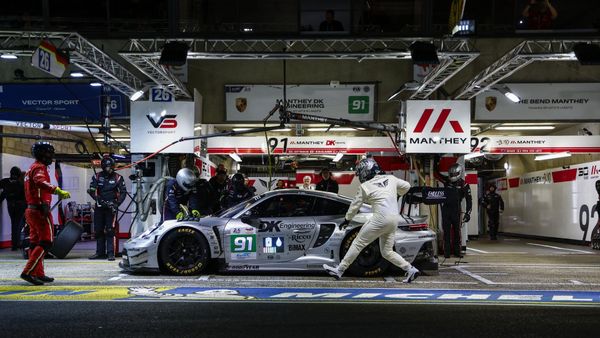
With no Porsche 963 entered in Hypercar, Porsche’s visible Le Mans route ran through Manthey in LMGT3. That placed more weight on the Porsche 911 GT3 R than it would normally carry. When both Manthey cars failed to reach the class podium, Porsche lost its only live route to a Le Mans class marker.
The #92 The Bend Manthey car arrived in France as the FIA Endurance Trophy leader in LMGT3. Its race fell away early. Yasser Shahin came into the pits in the second hour with a broken tie rod, costing the car three laps. Riccardo Pera, Richard Lietz and Shahin recovered to 13th and scored four championship points. That salvage has value, but it did not give Porsche a path to a class victory.
The #91 Manthey DK Engineering car had the most painful race. Ayhancan Güven, Timur Boguslavskiy and James Cottingham led LMGT3 at times in the first third of the race. A puncture before midnight forced an unscheduled stop and repair work. Manthey also changed the brakes during a safety car period and later replaced the damaged front end.
The car fought back towards the podium. Then, at around 10am on Sunday, Güven crashed at the exit of the first Hunaudière chicane after a technical fault. He was uninjured. The race was over.
That is why the Porsche reading has to be careful. This was not proof that the 911 GT3 R lacked pace. The #91 had enough pace to matter. The #92 had enough resilience to score points after early damage.
The problem is harsher than pace. Porsche had no redundancy.
The historical marker makes it sharper
The historical point gives the Porsche section its weight.
The ACO results archive points towards 2026 being the first Le Mans since 1991 without a Porsche or Porsche-powered car on a class podium. From 1992 through 2025, Porsche machinery or Porsche power appears somewhere in the class podium record: 962, Dauer 962 LM, 911 GT cars, RS Spyder, 919 Hybrid, 911 RSR, 911 GT3 R and the 963. In 2026, that thread appears to stop.
That should not be turned into melodrama.
It should be treated as a strategic warning.
Porsche did not lose its GT3 base at Le Mans. Spa Prologue evidence already argues against that. Porsche did lose its Le Mans safety net. In 2025, a 963 podium could still carry the marque’s top-class presence. In 2026, with no Hypercar entry and Manthey unable to convert LMGT3 pace into a podium, Porsche had nowhere else to go.
That is the sharper lesson.
Porsche did not simply miss an LMGT3 podium. It lost the redundancy that normally protects a manufacturer with such a wide Le Mans footprint.
Mercedes-AMG still needs Spa for a readable answer
Mercedes-AMG’s Le Mans result was poor, but it does not give us a clean platform verdict.
Iron Lynx ran three Mercedes-AMG LMGT3 entries. Two retired. One finished 16th in class. That is not good enough for a manufacturer trying to build legitimacy in WEC LMGT3.
The detail matters.
The #61 sustained early front-right damage after a spin and light impact, then needed repeat repair work before retiring. The #79 retired after Lin Hodenius hit a kerb at Turn 1, damaging the engine and causing an oil leak. The #62 reached the finish, but lost time in the pits due to a defective fastening component, later identified by Stefan Wendl as a sheared bolt on the rear suspension.
There was some week-starting promise. The #61 and #62 both reached Hyperpole after Bronze qualifying. The race then removed the chance of a clean reading.
So we should not write that Mercedes-AMG failed the Le Mans performance test. The evidence is too contaminated by damage and mechanical issues.
The better line is this: Mercedes-AMG left Le Mans without the answer it needed.
The CrowdStrike 24 Hours of Spa now matters more because it is closer to the brand’s real GT3 operating model. Mercedes-AMG’s case rests on customer depth, repeatable 24-hour execution and breadth across proper GT3 grids. Le Mans did not prove that case. Spa can test it.
Spa separates depth from conversion
The Spa Prologue should not be mistaken for race evidence. Test times do not prove stint quality, tyre wear, night pace, pit discipline or 24-hour reliability.
They do show depth.
Porsche had a strong Prologue. Güven topped day two in the #22 Schumacher CLRT Porsche, days after the Le Mans crash in the Manthey DK Engineering car. Porsche entries also led the Gold Cup, Bronze Cup and Pro-Am across the two-day test. With 16 cars on the 70-car grid, Porsche has the largest brand presence at Spa. Mercedes-AMG has 11 cars. BMW has eight.
That gives Spa a clear function for Issue 012.
For Porsche, Spa asks whether GT3 breadth can return to conversion after Le Mans.
For Mercedes-AMG, Spa asks whether the brand’s customer-racing depth can produce the 24-hour evidence Le Mans denied.
For BMW, Spa is useful but secondary. The more important BMW checks sit in WEC and IMSA, because Le Mans upgraded the Hypercar programme rather than the BMW M4 GT3 EVO.
Watkins Glen gives Porsche another route
Porsche’s next answer is split across two races.
Spa will test the 911 GT3 R platform. Watkins Glen will test whether Porsche’s IMSA prototype programme can keep carrying the marque’s top-class story while the WEC Hypercar thread is absent from Le Mans.
Laurin Heinrich will miss Spa with Schumacher CLRT to race the #5 JDC-Miller MotorSports Porsche 963 at Watkins Glen. That matters because Heinrich remains in the IMSA title fight after wins at Daytona, Sebring and Laguna Seca.
This should not be overread as Porsche choosing IMSA over Spa. The calendar clash matters, and one driver's move does not define a whole manufacturer's strategy.
But it does show where Porsche’s next prototype evidence has to come from.
After Le Mans, Porsche needs Spa and Watkins Glen for different reasons. One tests GT3 scale. The other tests prototype concentration.
What we are watching
BMW: São Paulo is the next WEC falsifier. The Le Mans podium becomes more meaningful if BMW can repeat its pace and execution outside the Le Mans-specific environment.
Porsche: Spa and Watkins Glen now split the recovery path. Spa tests GT3 breadth. Watkins Glen tests whether IMSA can keep carrying Porsche’s prototype case.
Mercedes-AMG: Spa has to produce a readable 24-hour GT3 signal after Le Mans gave damage, retirements and mechanical issues rather than clarity.
BoP: Ferrari’s Le Mans comments should remain a caveat, not the story. They do not invalidate BMW’s execution, but they stop us from treating the Hypercar order as a clean engineering verdict.
Working judgement
Le Mans did not turn German depth into control.
It did something more useful. It separated the types of evidence.
BMW gained the strongest upgrade, but also took on a heavier burden. Porsche exposed a lack of redundancy at Le Mans. Mercedes-AMG left without a clean answer and now has to rely on Spa to test the depth case.
That is enough for Issue 012.
Not a verdict. Evidence.
The next answer comes quickly.
AI disclosure: Researched and analysed using AI tools.