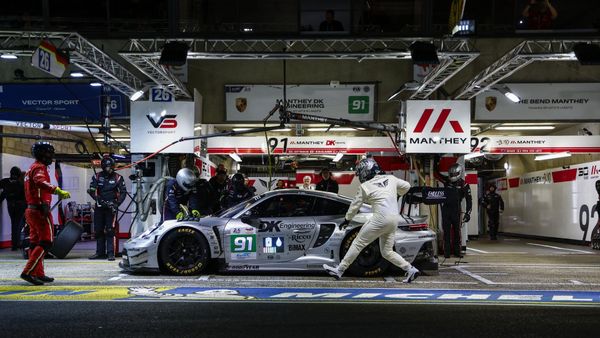
BMW's WEC form turns Le Mans podium into evidence
BMW's #20 took a Le Mans podium that fits a three-round WEC arc. The pace gap to the winner is now something to close, not explain. Interlagos is the test.

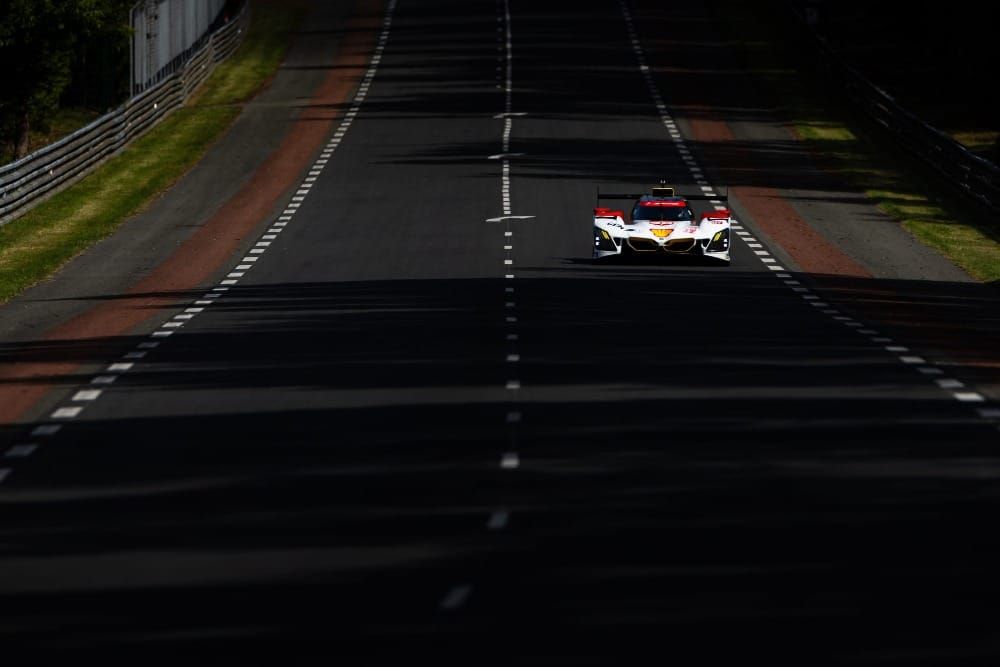
Three data points, three circuits. Fifth at Imola, first at Spa, second at Le Mans. The #20 BMW M Hybrid V8 of Robin Frijns, René Rast and Sheldon van der Linde has built something that reads as a sequence rather than a collection of results.
Le Mans needs care as evidence. It is longer, faster and more specific than any standard FIA World Endurance Championship round. This note treats BMW's podium as confirmation of a trend already evident at Imola and Spa, not as proof in its own right.
The official classification has the #7 Toyota of Mike Conway, Kamui Kobayashi and Nyck de Vries winning on 381 laps, with the #20 BMW second on the same lap, 10.913 seconds behind, having made 30 pit stops to Toyota's 32. The two-stop difference does not prove better tyre life on its own, but it supports the wider picture of a BMW race built on stint execution rather than one-lap pace. This was BMW M Motorsport's first overall Le Mans podium since the BMW V12 LMR victory in 1999.
The timing record from the final hours is sharper than the headline result. At hour 22, the #20 sat second, 14.6 seconds behind the lead. At hour 23, it was third, eight-tenths of a second behind Sébastien Buemi's #8 Toyota and 20 seconds from the front. In the final hour, Frijns passed Buemi and pulled approximately nine seconds back from the leader before the flag. The podium was not circumstantial. BMW engaged in the final-phase contest, executed a pass on a factory Toyota under race conditions, and finished closer to the winner than most pre-race readings of this programme would have supported.
The pace gap is real and measurable. BMW's best race lap was 3:25.607, set by Frijns on lap 304. The fastest Hypercar race lap was Ryo Hirakawa's 3:25.041 in the #8 Toyota on lap 306. The gap was 0.566 seconds. Both cars completed 381 laps. That is a deficit to close, not a separation between programmes.
The wider point is that the package now has supporting evidence behind it. The aerodynamic update BMW developed with Circuit de la Sarthe in mind has translated to race pace at that circuit. The shared technical director, data pipeline and facility between BMW's World Endurance Championship and IMSA SportsCar Championship operations, cited at the team principal level as active infrastructure rather than background, now has two standard WEC rounds and one Le Mans result to back it up.
Two BMW stories came out of this race, and they are not the same evidence. Dries Vanthoor put the #15 BMW M Hybrid V8 on BMW M Motorsport's first Le Mans pole after the faster Cadillac lap was deleted. The car of Vanthoor, Kevin Magnussen and Raffaele Marciello then retired after contact with an LMP2 car caused rear-right damage at the six-hour mark, followed later by an electrical failure. Its best race lap, 3:25.638, was within a few hundredths of the #20's. Both Hypercars had the pace to run at the front. Only one completed the argument.
The LMGT3 programme did not. Team principal Vincent Vosse was direct: BMW simply had no chance in the class. Both BMW M4 GT3 EVO entries took drive-through penalties, the #69 retired with a gearbox failure, and the #32 finished seventh. The Hypercar and LMGT3 cars are not one story from this weekend, and reading them together would overstate the result.
Interlagos in July is the next point on the line. A circuit with none of Le Mans's specific demands will test whether the #20's race pace is a durable package shift or partly circuit-specific form. The Spa win and the Le Mans podium point one way. Interlagos will confirm or complicate it.
BMW's Hypercar programme has moved from aspirational to evidential across three WEC rounds in 2026. The margin to the race winner was 10.9 seconds over 24 hours. That is now a gap BMW needs to close, not explain.