RSR Intelligence · Issue 015
From Oschersleben to Tokyo, Porsche supplied speed and breadth while Mercedes converted more of its opportunity. BMW recovered and Audi found direction.

Issue 015 · Thursday 30 July 2026
Speed did not settle the weekend
The fastest package did not always produce the most valuable weekend.
At Oschersleben, Porsche, Manthey and Thomas Preining supplied the clearest evidence of preparation and outright performance. Preining led both Friday practice sessions, took both pole positions, won on Saturday and remained in contention on Sunday.
Yet Maro Engel and Winward Racing left with the stronger championship return.
The distinction appeared elsewhere. Mercedes reached Formula 1’s summer break leading both championships, but technical losses continued to obstruct a complete two-car conversion. Audi produced smaller results from a much lower base, yet established a credible direction across its latest three races.
In Tokyo, Porsche secured Formula E’s manufacturers’ title without controlling the weekend through its factory team. Andretti, Cupra Kiro and the works operation supplied different scoring routes when no single part of the programme dominated.
Here, championship value means the durable competitive position a programme extracts from the performance available to it within its own series. That may appear through points, title protection or several viable entries. It is not a common currency across championships with different cars, scoring systems and competitive structures.
The comparison is therefore limited but useful: how much available performance survived preparation, reliability and execution long enough to matter?
Oschersleben measured preparation and vulnerability
Preining and Ricardo Feller finished first and second in both Friday practice sessions. The second session included fresh-tyre qualifying simulations, and Preining again set the fastest time.
Preining then took pole position for both races. He converted the first into a lights-to-flag victory on Saturday, finishing 1.601 seconds ahead of Luca Engstler. Engel placed third and Lucas Auer fourth.
Manthey’s advantage existed before the first race began. It came from preparation and qualifying access rather than one favourable race sequence.
Feller’s results impose an important limit. He finished tenth on Saturday and eighth on Sunday, extending his uninterrupted points run since joining Manthey. Those results supported the team’s accumulation without reproducing Preining’s front-running performance.
Sunday separated performance from conversion more sharply.
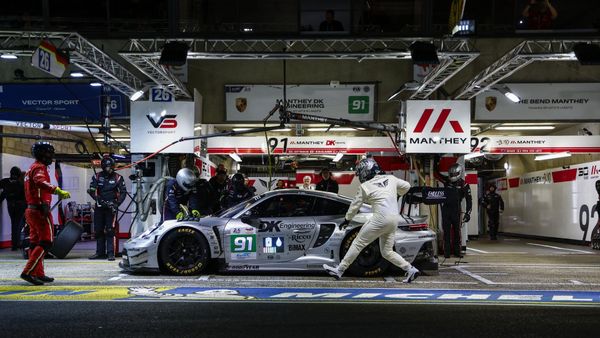
Preining again started from pole and led the opening phase. At Manthey’s second stop, a wheel-nut retainer jammed and required additional force to release. The delay moved Mirko Bortolotti into the lead, Engel into second and Preining into third.
Manthey identified the problem as a component failure. The delay was technical, not a procedural mistake by the crew.
Bortolotti won by 3.027 seconds from Engel. Preining finished another 0.404 seconds behind, with Marco Wittmann only 0.209 seconds behind the Porsche in fourth.
Manthey lost the Sunday result, but not the performance argument. Two poles, one victory and a third place established the strongest peak of the weekend. The team climbed from sixth to second in the teams’ championship with 179 points.
Mercedes-AMG produced a different form of value.
Engel finished third and second. His Saturday stop cost track position, while Winward’s later Sunday stop and cleaner execution recovered it. He left Oschersleben leading the drivers’ championship with 145 points, 28 ahead of Preining.
Winward led the teams’ classification with 205 points, while Mercedes-AMG led the manufacturers’ table with 277.
That was stronger championship conversion, not Mercedes-AMG control. Auer followed fourth on Saturday with 12th on Sunday. Jules Gounon was not classified in the opening race and finished ninth in the second. Tom Kalender finished 13th and 18th.
The result strengthens the Mercedes-AMG interpretation around Engel and Winward. It does not describe every Mercedes-AMG entry.
BMW’s recovery was more fragmented. Kelvin van der Linde finished seventh in both races. Wittmann was not classified on Saturday after a tyre failure, then recovered to fourth on Sunday.
Fourth place showed useful race pace. It did not establish BMW programme control or justify a GT3 baseline change.
There is a credible counter-reading. Porsche’s advantage appeared in practice, qualifying and both races. One jammed component may matter less across a season than Manthey’s repeatable access to speed. Engel also gained from Preining’s technical delay.
Championships still reward what reaches the classification. Oschersleben strengthened Manthey’s performance case and Engel’s championship position at the same time. Neither cancels the other.
Mercedes holds authority, Audi builds direction
Formula 1 reached its summer break with Mercedes and Audi facing different conversion problems.
Kimi Antonelli recovered from seventh to third in Hungary and entered the break leading the drivers’ championship. Mercedes also led the constructors’ championship.
George Russell dropped to the rear when anti-stall activated at the start and recovered to seventh. Mercedes accepted responsibility and continued to investigate the cause.
The incident followed Spa, where Mercedes reported that both cars suffered a lack of boost on the opening lap. Antonelli recovered to win, while Russell’s larger loss dropped him into the pack before his retirement.
The pattern does not displace Mercedes as the championship benchmark. It shows that the team’s available performance is not converting cleanly through both cars. Russell continues to absorb technical losses before his pace can contribute fully.
Audi reached Hungary from a much lower competitive base.
Nico Hülkenberg converted tenth on the grid into ninth and scored his first points of the season. Gabriel Bortoleto recovered from 14th to 11th using a Soft-Hard one-stop strategy.
Hungary gave Audi its third consecutive points-scoring race. The team entered the break eighth in the constructors’ championship, one point ahead of Williams and nine behind Haas. It had not yet scored with both cars in the same race.
Three successive scoring races establish direction, not security. The margin over Williams is minimal, while Haas remains within one strong weekend.
The comparison should go no further. Mercedes must reduce technical losses within a championship-leading operation. Audi must turn recent progress into repeatable two-car conversion.
For RSR, that is the relevant manufacturer evidence. It does not make Formula 1 a routine coverage environment.
Porsche’s Formula E title came through several routes
Porsche’s Formula E title offers a different form of programme resilience.
Saturday’s Tokyo race produced a Porsche-powered one-two through affiliated teams. Dan Ticktum won for Cupra Kiro, while Jake Dennis finished second for Andretti. Neither factory Porsche scored.
Sunday produced a different combination.
Dennis recovered from deep in the field to finish third. Nico Müller placed eighth for the factory team, while Felipe Drugovich finished 11th in the second Andretti entry. Ticktum was 13th, Pascal Wehrlein 14th and Pepe Martí was not classified.
Dennis also recorded the fastest lap among the top ten. He did not start from pole.
Porsche secured the manufacturers’ championship while Jaguar continued to lead the teams’ championship.
That separation matters. Porsche did not need its factory team to control Tokyo because several affiliated entries could contribute. Saturday’s points came from Cupra Kiro and Andretti. Sunday’s contribution came through Dennis and Müller.
This is not directly equivalent to GT3 customer racing. Formula E uses different technical, sporting and commercial relationships. Its results cannot prove that Porsche’s GT and endurance structures work by the same mechanism.
The narrower conclusion concerns distributed programme capacity.
Porsche had enough viable entries for a poor result from one part of the programme to be offset by another. That fits its wider competitive-breadth baseline without turning Formula E into evidence for claims it cannot sustain.
The next measurements
Magny-Cours will test whether WRT’s Misano Sprint Cup sweep represented repeatable BMW control or a circuit-specific peak.
Road America asks a broader organisational question. Its different cars, crews and sporting structures cannot validate Manthey’s Oschersleben performance, but the six-hour IMSA race can show whether comparable competence appears in a distinct programme.
BMW M Team WRT’s pursuit of a first GTP victory, Paul Miller Racing’s GTD Pro position and Porsche’s multiple competitive routes provide the other measurements. These are triggers for later interpretation, not predictions about the races.
The latest evidence did not identify one superior manufacturer across every environment. It exposed different ways of creating durable competitive position.
Porsche supplied speed and programme breadth.
Mercedes supplied championship authority alongside visible technical losses.
BMW supplied pockets of recovery rather than programme control.
Audi supplied direction without security.
The next evidence must show which of those readings lasts.
AI disclosure: AI tools were used to support the preparation, editing or review of this newsletter. All factual claims were checked against identified sources, and final judgement, interpretation and publication responsibility remain with JP Hackett, Editor, The Rennsport Report.
Read more
- RSR Intelligence · Issue 014, which established the team-level structures behind the unsettled manufacturer order.
- Mercedes-AMG reads DTM’s new tyre regime first, which set the earlier Mercedes-AMG and Engel operating baseline under DTM’s changed tyre regime.
- BoP is governance, not an excuse, which explains why performance windows must be separated from execution.
- GT3 became the centre by staying useful, which sets the wider context for distributed programme capacity and customer-racing depth.