Le Mans asks three German questions
Le Mans 2026 is not asking whether Germany is present. BMW, Porsche and Mercedes-AMG all have routes into the race, but each faces a different test of authority.

The 2026 24 Hours of Le Mans is not asking whether Germany will be represented.
It is asking what kind of German authority still exists.
That authority now takes three forms. BMW has the only German Hypercar route to the overall win. Porsche has no Hypercar entry, but still has a class route through Manthey. Mercedes-AMG has three LMGT3 entries through Iron Lynx, but its FIA World Endurance Championship (WEC) case still needs proof in race-week conditions.
This is not a prediction piece.
Wednesday will not decide the race. Free Practice 1, qualifying and Free Practice 2 (FP2) will not tell us who can survive 24 hours. They can tell us which German questions are becoming real and which ones remain mostly theoretical.
FP2 may be the most useful session. Daylight pace can flatter. Night running starts to expose driver confidence, traffic judgement, car stability, tyre behaviour and whether a crew can work without chasing a headline time.
BMW: overall authority
BMW carries the heaviest German question because it is the only one with a car in the outright fight.
The BMW M Hybrid V8 gives BMW M Team WRT a route to the overall win. No other German manufacturer has that at Le Mans in 2026. That makes BMW the centre of the German Hypercar story, but not the favourite by default.
The case for BMW is credible. It is not complete.
Spa gave BMW momentum. It also gave WRT proof that the programme has moved beyond waiting for the car to become usable. A one-two in the WEC matters because it reflects race pace, strategy, and team control rather than a single clean lap.
Le Mans asks for more.
The combined Test Day order did not turn BMW into a Le Mans authority. Aston Martin, Toyota and Cadillac headed the order before the first BMW appeared. The No 20 BMW was seventh overall. The No 15 was 16th. That order needs context: BMW did not chase qualifying simulations, and the No 15 completed more Hypercar laps than any other car while working through tyre compounds, mileage, stint length and tyre behaviour. That is useful race-week work, not proof of authority.
That distinction matters.
BMW’s Wednesday test is not a qualifying headline. It is whether the No 20 repeats its stronger Test Day shape and whether the No 15 moves into the same working range. One BMW near the front is a threat. Two BMWs in the right window would look more like a programme.
FP1 should show whether the baseline is clean. Qualifying will show the ceiling. FP2 should tell us more about the race: night rhythm, traffic behaviour, tyre response and whether WRT looks settled when the easy evidence drops away.
BMW does not need to prove on Wednesday that it can win Le Mans.
It needs to avoid providing evidence that Spa was a track-specific peak.
Porsche: class authority
Porsche’s question is different and more uncomfortable.
There is no Porsche 963 in the Hypercar field. That removes Porsche from the overall race before the first proper session of the week. A brand so closely tied to Le Mans cannot shape the outright contest if it has no car in it.
Yet Porsche is not absent in any meaningful sense.
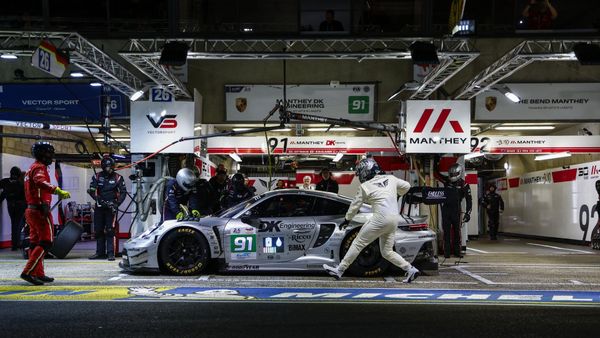
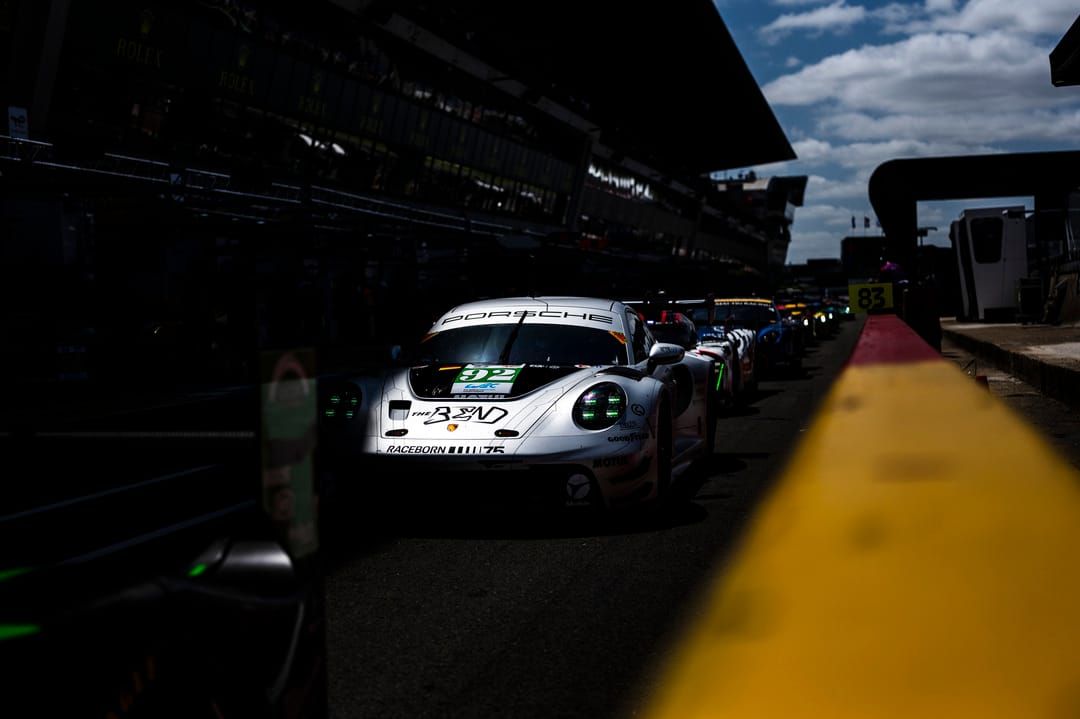
Its route runs through Manthey DK Engineering, The Bend Manthey and the Porsche 911 GT3 R LMGT3. That is a smaller kind of authority than an overall win bid, but it may be the clearest German authority so far.
Test Day supports that reading. The No 91 Manthey DK Engineering Porsche was second in the combined LMGT3 order, only 0.009s behind the leading Ferrari.
That is the strongest German LMGT3 signal on the board.
It is not class control. LMGT3 rarely lets the fastest early car own the story without resistance. Bronze-driver exposure, minimum drive time, traffic, slow zones, penalties and tyre preparation can all move the race away from the car that looked best before Wednesday night.
Porsche’s task is to make Manthey’s Test Day pace repeatable.
Qualifying matters because it will show whether the No 91 has a true class ceiling. FP2 matters because class races at Le Mans are often shaped in the dark: where the Bronze drivers sit in traffic, how cleanly the car works in mixed-speed packs, and whether the team can keep the race calm.
The Porsche question is not whether it can replace a missing Hypercar programme. It cannot.
The question is whether Manthey can keep Porsche central anyway.
If the No 91 remains near the LMGT3 front after Wednesday night, Porsche has a genuine class-authority story. If it fades into the pack, the absence of a Hypercar entry becomes harder to ignore.
Mercedes-AMG: legitimacy
Mercedes-AMG has the most fragile question.
The brand has three LMGT3 entries through Iron Lynx and Team Qatar by Iron Lynx. That gives Mercedes-AMG a serious footprint. It also creates additional ways to measure the programme.
Mercedes-AMG has already demonstrated presence, including a quiet 12th place for the No 61 at Le Mans last year. It still needs proof.
The Test Day evidence keeps the programme in the waiting room. The three Iron Lynx cars sat mid-pack in the combined LMGT3 order: No 79 tenth, No 61 13th and No 62 17th.
That is not a failure. It is also not a signal of class authority.
Mercedes-AMG needs a different Wednesday from BMW and Porsche. It does not need to top LMGT3. It needs to become raceable in public.
The success threshold is clear enough.
One car needs to emerge as a credible class lead option. The three entries need to show a narrower spread. FP2 needs to deliver clean night mileage. The team needs to avoid the small things that make WEC programme development look exposed: contact, penalties, messy traffic choices, and uneven driver cycles.
The failure threshold is just as clear.
If all three cars remain buried in the middle of LMGT3, if one entry carries the programme alone, or if the night session shows more searching than settling, Mercedes-AMG will still have presence rather than proof.
Iron Lynx gives Mercedes-AMG a serious platform. The badge gives the project attention. Neither gives it Le Mans legitimacy.
That has to be earned in the dull parts of the week: clean laps, clean stops, clean stints, and at least one car that looks like it can still matter on Sunday morning.
Do not crown anyone on Wednesday
The temptation is to use Wednesday to crown someone.
That would be a mistake.
Test Day was enough to shape the questions, not answer them. Qualifying will narrow the picture, but it will reward a specific kind of performance. The better evidence is a pattern: whether the same car keeps appearing in the right place across different sessions, different light and different traffic.
For BMW, the pattern to watch is whether WRT has two racey Hypercars rather than one quick car and one problem to solve.
For Porsche, it is whether Manthey’s No 91 pace survives beyond a Test Day headline and into night-running evidence.
For Mercedes-AMG, it is whether three entries become a programme rather than a presence.
That is why Le Mans 2026 asks three German questions rather than one.
BMW has the overall route.
Porsche has the clearest class signal.
Mercedes-AMG has the legitimacy test.
Wednesday will not finish the argument. It should tell us which one is worth carrying deepest into the week.
AI disclosure: Researched and analysed with AI tools.