RSR Intelligence · Issue 011

June will test whether depth can become control
Issue 010 set a baseline: Mercedes-AMG had Nürburgring proof, BMW carried Germany’s FIA WEC Hypercar weight, and Porsche now leaned on GT depth instead of WEC Hypercar control. That remains true. However, the focus of the discussion has shifted. June will not test which manufacturer looks strong on paper. It will test whether depth can become control.
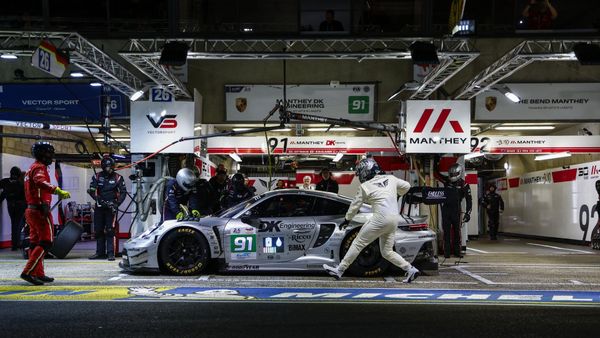
This is a tougher measuring stick.Mercedes-AMG has the strongest GT3 momentum, but Le Mans asks a different question than Nürburgring, Monza, or Spa. BMW has WRT momentum in prototypes, but its GT3 case is uneven. Porsche retains speed and depth, but the 963’s prototype focus now runs through IMSA, while Le Mans relies on LMGT3 and Manthey, not the top class.
The 94th 24 Hours of Le Mans runs from 10 to 14 June 2026. Race week is close enough now that these are no longer background signals. They are pressure points. This issue is not trying to make a quiet week sound louder than it was.
The useful threads are GT3 depth, prototype concentration, and the question each German manufacturer now faces.
Mercedes-AMG has GT3 depth. Le Mans asks a different question
Mercedes-AMG is the most overhyped manufacturer. The case is tempting. It won Nürburgring. Monza saw the No 48 MANN-FILTER Mercedes-AMG GT3 EVO finish second.
Spa features one of the deepest GT3 structures.
At Le Mans, three Iron Lynx Mercedes-AMG LMGT3s compete.
That sounds like one continuous arc.
It absolutely is not.
Monza and Spa belong to customer GT3, but Le Mans sits in WEC LMGT3: new rhythm, driver pressure, traffic, and Iron Lynx as the key link.Mercedes-AMG’s GT3 depth supports the case.
It does not prove it before the race. At Monza, Auer, Engel, and Stolz were second in the No 48 after a chaotic race that wasn’t a straight performance test. Mercedes-AMG’s release notes the contamination: an opening multi-car crash, a three-minute penalty for No 17 Team GetSpeed, a pit-cycle drop for No 48, and Winward Racing’s late exit after an accident.
There is no claim of dominance.
This is a statement of depth. Mercedes-AMG had several cars in contention. It lost one route but preserved another. Stefan Wendl, head of Customer Racing, said No 48 needed luck for the podium and Winward lost a deserved finish.
This admission matters. It keeps the reading honest.
The Spa question is clear. Mercedes-AMG does not need one perfect car. It needs enough credible cars to absorb disorder. Monza suggests it has that kind of depth. It does not prove control.
Le Mans is less settled again. Mercedes-AMG says Iron Lynx will run three LMGT3 cars at Le Mans 2026. No 61 and No 79 stay with regular WEC line-ups.
No 62 runs as Team Qatar by Iron Lynx with Abdulla Al-Khelaifi, Giuliano Alesi, and Julian Hanses. The LMGT3 class has 25 cars, and all three entries keep the Silver Arrow look: black, dark red, and yellow rear sections.
It is a formidable presence. But it is not a case for performance yet.
RSR frames Mercedes-AMG’s WEC return as a GT-door strategy, not a Hypercar focus. The program brings brand value and customer logic. What’s missing before Le Mans is a Sarthe-specific proof point.
So the Mercedes-AMG line for Issue 011 should stay narrow.
It has GT3 depth.
But its Le Mans presence is yet to be tested.
It still needs to show that one can translate into the other.
Monza warns against naming a Spa favourite
Monza must not dictate the form guide. It stands as a warning shot.
German relevance mattered: No 66 Tresor Attempto Audi R8 LMS GT3 EVO II won. No 48 Mercedes-AMG finished second. No 2 Boutsen VDS Porsche 911 GT3 R EVO was fourth. No 98 ROWE BMW M4 GT3 EVO finished fifth.
The order dissolves under scrutiny.
A crash eliminated leaders.
No 17 Mercedes-AMG led before its penalty; No 48 led later. No 32 Team WRT BMW got into contention. Porsche stayed close.
The final phase broke the order again.
It is why the Audi win matters inside an RSR issue, even though Audi is not one of the three primary manufacturers. Audi keeps the reading honest. If Monza means “Mercedes-AMG finished second, so it’s the Spa favourite,” that’s too soft.
Audi won. Mercedes-AMG had depth. BMW had hidden competitiveness. Porsche was up front without dominating. This is a wild GT3 grid, not a pecking order.
BMW’s release advises caution. Monza had full-course yellows and accidents. Farfus, Marciello, and Dennis placed fifth in No 98. No 32 Team WRT fought for victory until a restart crash ended it.
The counterweight: No 46 Team WRT BMW had a clutch failure after early progress. No 32 lost its result when van der Linde misjudged Turn 1 on the restart and collided with a Porsche.BMW’s Monza dilemma, distilled.
The pace and strategy case exists. The result does not.
Spa will measure which of those matters more.
BMW’s WRT signal is stronger in prototypes than in GT3
BMW’s clearest weekend signal came from BMW M Team WRT.
Not at Monza. Detroit, not Monza, delivered clarity.
IMSA pit notes put No 25 BMW M Hybrid V8 second behind the No 31 Cadillac V-Series.R and ahead of the No 7 Porsche 963 in fifth. No 6 Porsche was eighth, No 24 BMW ninth, and No 5 JDC-Miller Porsche 963 was 11th, two laps down.
That makes BMW the best German prototype result of the Detroit weekend. But BMW is not the standard yet.
Cadillac controlled the race. The GM result gives context, preventing us from reading BMW versus Porsche in isolation. IMSA’s report calls No 31 Cadillac dominant, with BMW and another Cadillac on the podium.
The real BMW signal is execution. The Detroit pit notes show Kévin Estre taking the overall lead in the No 6 Porsche during the pit cycle. Marco Wittmann then led in the No 25 BMW before the race moved back towards Cadillac. That detail matters more than the headline result.BMW didn’t inherit second; WRT managed a strategic race, kept the No 25 in play, and earned the best German result.
It fits the pattern RSR already saw at Spa, where BMW won the WEC race but not the full Hypercar argument. BMW M Team WRT proved execution at Spa. It did not prove that BMW owned Hypercar before Le Mans.
Detroit stamps the same conclusion.WRT is becoming BMW’s strongest asset because it keeps finding routes through imperfect races.
Monza complicates that. No. 32 Team WRT BMW was in contention but ended up with damage and a penalty. No 46 retired early. ROWE Racing’s fifth gave BMW’s best GT3 result; ROWE’s No 998 Gold Cup and Oman Racing’s Bronze Cup added class value.
This supports a restrained BMW line. WRT is real. BMW’s prototype case is being built. BMW’s GT3 case isn’t as clear as Mercedes-AMG’s depth.
Le Mans will now test the first of those more heavily than the second. BMW carries Germany’s top-class WEC question. It has momentum. It also has less room to hide.
Porsche’s problem is not speed. It is concentration
Detroit was not a simple Porsche performance failure.
The No 6 Porsche led a pit cycle. The No 7 finished fifth. The No 6 ended up eighth after repairs. JDC-Miller had a tough day: a pit penalty, contact, a stop-and-hold penalty, and finished 11th. That is not slow. It is exposed. Without a Porsche 963 in WEC Hypercar at Le Mans, IMSA now carries more prototype weight.
When Porsche wins, focus is sharp; after Detroit results of fifth, eighth, and 11th, no WEC counterweight softens the narrative. RSR’s live Porsche analysis already frames the Le Mans absence as a rules, value and leverage story rather than a failed-car story. The 963 still had performance.
The problem was what WEC made that worth. Detroit sits under the same logic.
Porsche had speed in Detroit but lacked clean execution. Factory cars recovered but missed the podium. JDC-Miller’s Laguna Seca win lost impact without further execution. AO Racing’s GTD Pro result gave little relief. The uncomfortable part is that Porsche finished fifth. Every IMSA 963 run now carries added weight.
Porsche’s Le Mans impact still matters, but now comes via LMGT3, Manthey, and the 911, not the prototype fight. This authority is narrower. It can still win, but can’t answer every question the 963 once did. Watkins Glen now becomes the better Porsche test. Detroit was a street-course sprint with contact and compression. Watkins Glen is six hours. It will ask whether Porsche’s IMSA concentration rests on endurance control or isolated peaks.
This is the question Porsche needs to answer after Laguna Seca and Detroit.
What stays in the notebook
The Porsche Mobil 1 Supercup file should be placed in the archive for now. There is real structural material in it. Porsche says the new Supercup season brings the latest Porsche 911 Cup, ABS adaptation, 28 permanent entries, and a fuel blend with 80% renewable components.
The release also says the fuel uses eFuel from the Haru Oni pilot plant and claims a 52% reduction in CO2 compared to the fossil-fuel comparison used in the document. That may be useful later. It is not Issue 011.
The same applies to the SRO GT Academy note in Mercedes-AMG’s newsletter. It may help a future customer-racing pathway piece, especially because Mercedes-AMG links the academy to a 2027 GT World Challenge Europe Endurance Cup seat. It does not belong in the main spine of this issue.
The Mercedes Formula 1 material stays outside the frame.
What I’m watching next
Three things matter now.
First, whether Mercedes-AMG’s GT3 depth survives Le Mans week in LMGT3, rather than remaining a GTWC and Nürburgring signal.
Second, whether BMW M Team WRT can turn execution into top-class Le Mans control, not just selected strategy wins.
Third, whether Porsche can make IMSA concentration look like focus rather than exposure. Those are not predictions. They are the live tests.
The counter-reading
The case against this issue is clear. We may still be making too much structure from two messy races. Monza was crash-shaped. Detroit was a short street sprint. Mercedes-AMG’s Monza podium relied partly on timing and luck. BMW’s No 32 GT3 result collapsed.
Porsche led in Detroit but did not convert. Cadillac, not BMW or Porsche, set the GTP standard. That counter-reading is fair. It changes the tone, not the issue.
This newsletter should not sell verdicts. It should map pressure. Mercedes-AMG has depth, but Le Mans asks for translation, and Spa asks for control. BMW has WRT execution, but its Le Mans burden is larger than its Detroit podium.
Porsche has speed, but concentration makes every IMSA result louder. Those are not final answers. They are the questions June has made harder to avoid.
Closing note
Issue 011 should not predict Le Mans or Spa. It should name the pressure now bearing down on each manufacturer. June will test depth. The harder question is control.
AI disclosure: AI tools were used to support the preparation, editing or review of this newsletter. All facts were checked against named sources, and final judgement, interpretation and publication responsibility remain with JP Hackett, Editor, The Rennsport Report.